
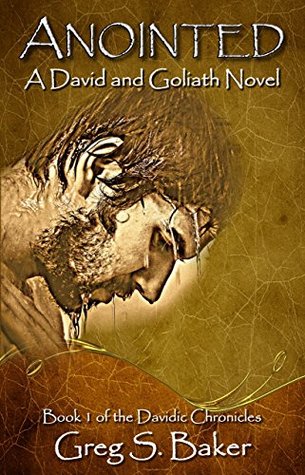
More on this book

Kindle Notes & Highlights

Lifting his free hand, Jesse spoke the grace after the meal,[79] “We bless Thee, O Jehovah Elohim, for the good of the land which we have enjoyed this night. We are full because of Thy blessings upon our land, and thank Thee for such.”
Without a shepherd, the sheep would stray and most likely die. He’d seen sheep wander lost and thirsty just over the hill from water but lacking the instincts to find it for themselves. He wondered if that was how Jehovah Elohim saw people…as wandering sheep.
The Hebrew soldiers took one look at the giant, turned, and fled, swarming up the steep slope to their fortifications, scrambling and tearing at the earth to help climb. Fear fell over the camp. David glanced at his brothers and saw it in their faces too.

I never thought it before, but I wonder if God increased everyone's fear. It wouldn't be normal for any not to be afraid, so God could have just increased it enough to prevent anyone from attacking Goliath. That would assure that the job would go to David.
Maon, David’s brother, is fictional. There was an eighth son of Jesse, but the Bible does not mention his name. The Chronicles mentions only seven sons of Jesse, but the Samuels mention eight. Maon is the fictional name of a real son of Jesse who was never named. His role in the story is purely fictional.
The Philistine spies and David’s interaction with them are also fictional.
The battle where Saul is nearly trapped by Goliath is fictional.
The priest in Bethlehem is fictional. No doubt a priest lived within the city, but his role, influence, name, and family are unknown to
Doeg the Edomite is a real person who really was the chief of Saul’s herdsmen.
Sources The King James Bible www.biblicalarchaeology.org www.ancient-hebrew.org www.gci.org/bible/hist/weapons en.wikipedia.org/wiki/Sling_(weapon) www.gotquestions.org/Jehovah.html www.theoldtestamenttimeline.com www.israelbiblicalstudies.com & blog.israelbiblicalstudies.com www.jewfaq.org www.bible-history.com
www.biblewalks.com/info/trees.html www.netours.com/content/view/241/26/ www.bearsoftheworld.net/syrian_brown_bear.asp en.wikipedia.org/wiki/Asiatic_lion www.bibleatlas.org Jan H. Negenman, New Atlas of the Bible (New York: Doubleday & Company Inc., 1969). Rand-McNally Bible Atlas - Published in 1910. Smith Bible Atlas - Designed and edited by George Adam Smith, 1915. Jan H. Negenman, New Atlas of the Bible (New York: Doubleday & Company Inc., 1969). Fred H. Wight, Manners and
Customs of Bible Lands (Moody Bible Institute of Chicago, 1953). Boyd Seevers, Warfare in the Old Testament (Grand Rapids, MI: Kregel Publications, 2013). Chaim Herzog and Mordechai Gichon, Battles of the Bible – A Military History of Ancient Israel (Barnes and Noble Publishing, 2006). A. Van Deursen, Illustrated Dictionary of Bible Manners and Customs (Grand Rapids, MI: Zondervan, 1958).
Commentaries and Dictionaries James Orr, M.A., D.D., General Editor, International Standard Bible Encyclopedia. John McClintock and James
Strong, Cyclopedia of Biblical, Theological and Ecclesiastical Literature (1895). Canne, Browne, Blayney, Scott, and others, with introduction by R. A. Torrey, Treasury of Scriptural Knowledge (1834; public domain). John Gill's Exposition of the Bible (1746-1766, 1816; public domain). Jamieson, Fausset and Brown Commentary - A Commentary, Critical and Explanatory, on the Old and New Testaments (1871; public domain). Adam Clarke's Commentary on the Bible (1810-1826; public domain). Joseph Benson's Commentary on the Old and New Testaments
(1857; public domain). Albert Barnes' Notes on the Bible (1847-85; public domain). Matthew Henry's Commentary on the Whole Bible (1708-1714; public domain). W. Robertson Nicoll, Sermon Bible Commentary (1888-1893; public domain). John Wesley's Notes on the Bible (1755-1766; public domain). F. B. Meyer, Through the Bible Day by Day – A Devotional Commentary (1914; publi...
This highlight has been truncated due to consecutive passage length restrictions.
