
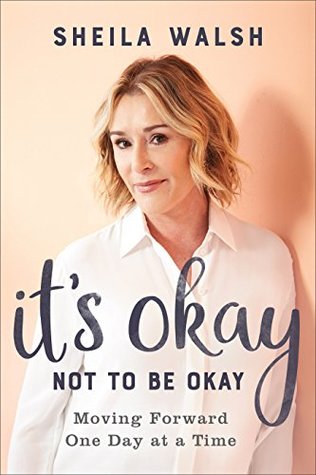
More on this book
Community


Kindle Notes & Highlights

by
Sheila Walsh
Read between
June 16 - August 15, 2020

It’ll never be about us getting anything perfect, but when we are present God can do what only He can do.
After my father’s death she asked God for two things: She asked that we would all come to faith in Christ at an early age. She asked that she would live to see us all grown and settled in our careers and calling.
“I’d have loved to be a teacher,” she said. “Or lead a Bible study.”
Nothing was perfect, but we were all present and God was with us. Several weeks later I wept with Mum on the phone as she told me that one of her neighbors had given her life to Christ as the message of the Gospel of John became real to her.
It is important to observe here that it is not the “amount” of faith which brings the impossible within reach, but the power of God, which is available to even the “smallest” faith.2 I love that. God takes us where we are, and when we step out and offer Him the smallest wisp of faith, He moves on our behalf. But if we sit around waiting for the fear to disappear, we’ll probably be sitting for a while.
Then a friend told her something that changed her life. Her friend said, “Why don’t you do it afraid?”
Do it afraid.
The what-ifs that so often hold us back usually have their roots in a flawed belief system. We believe that if we’re going to take a step out, we have to be sure that whatever we’re attempting will be successful. I don’t think that’s what we’re asked to do. I believe we’re asked to step out in faith and leave the results to God. Perhaps you’ve stepped out in the past, convinced that God had called and equipped you, and things didn’t turn out as you expected. That can feel devastating. You may have had a broken relationship with a family member, and after praying over the situation you knew
...more
and presented your case. You did it respectfully and convincingly, but it wasn’t received that way. Instead of moving forward it felt like you took two steps back. Those types of experiences can shut us down inside. They can make us angry with ourselves,...
This highlight has been truncated due to consecutive passage length restrictions.
promised there would be things from Elijah’s story that would help us, but the help is actually not from Elijah’s life; the help is all about God. It’s about what God does when we’ve come to the end of ourselves. The next part of the story is such a picture of grace. But as he was sleeping, an angel touched him and told him, “Get up and eat!” He looked around and there beside his head was some bread baked on hot stones and a jar of water! So he ate and drank and lay down again. (vv. 5–6) An angel touched him. I find that very moving. There’s something so healing about a simple touch. Not only
...more
Several places in the Old Testament (see Gen. 16:7, Exod. 3:1–4, Judg. 2:1–4) we have appearances recorded of the angel of the Lord. In fact, in Exodus 3:44 the angel is referred to as “God” and “the LORD.” This type of appearance is called a theophany, which means “appearance of God.” How merciful that Christ Himself would touch this worn-out man with no word of judgment, just loving care for the needs of his body.
God’s questions are never to inform Himself; He knows everything. The questions are to reveal to us what’s going on inside of us.
God is moving even when we can’t see Him. God is in control even when things seem out of control. When the wind and the
earthquake and the fire hit the mountain, Elijah was protected by the rock. The rock took the blast just as Christ, the Rock, took the full force of the wrath of God on Himself on the cross so that you and I can lean in to the gentle whisper of God when we don’t understand what’s going on around and inside us.
You don’t have to be perfect, just present. You can pour out your what-ifs to the Lord. When you take that step and things seem to go wrong, God is working, God is faithful, and God is a God of grace.
Just know this: when you’ve come to the end of yourself and you don’t get it, take a nap, have a good meal, and lean in for the gentle whisper of God. For every what-if that crosses your mind—and trust me, they still cross mine—allow the truth of God’s Word to be louder than the clamor of fear.
I praise you, for I am fearfully and wonderfully made. Wonderful are your works; my soul knows it very well. (Ps. 139:14 ESV) For nothing will be impossible with God. (Luke 1:37 ESV) Jesus looked at them intently and said, “Humanly speaking, it is impossible. But with God everything is possible.” (Matt. 19:26)
Reflecting on my own life, I know that experiencing a negative event in childhood can heighten the need for control later in life. If you’ve experienced sexual, physical, verbal, spiritual, or emotional abuse as a child, the feeling of being out of control is crushing.
In those situations, if you dig a little deeper, underneath that need to control lies one of the greatest enemies of our souls: shame.
The confusion, fear, grief, and shame that produced in me pushed me into a desperate need to control something.
I tried to control the love of God.
I believe the mercy of God allows us at some point in life to hit the wall and, when everything else falls apart, we are held by His mercy.
Everything that has made sense until that point in life is now exposed as a sham. For me, that agonizing, lonely place where I, like Elijah, asked God to take my life became the place where I heard that still, small voice, that whisper: I love you. Always have. Always will. Rest for a while. Let go.
The true, unadulterated gospel of Jesus Christ is that God loves us so much that He sent Jesus Christ
to take our place on the cross. When Christ cried out, “It is finished,” He was saying, “The bill is paid in full.” He took the shame, the punishment on Himself so that when we are in relationship with Him, when we trust that finished work on the cross, we are forgiven, we are loved, and we ar...
This highlight has been truncated due to consecutive passage length restrictions.
If, right now, you find yourself in a place where life feels out of control and nothing seems okay, my heart leans toward you, but more than that, God’s Word speaks directly to you in that lonely, confusing place.
In my life, the greatest truth that helps me let go of what I can’t control is the foundational belief that no matter how things appear, God is still on the throne.
I write what it looks like because often our idea of God being in control is radically different than this story.
But God was with him and rescued him from all his troubles.
“But God was with him and rescued him from all his troubles.” Twelve words, a capsule of the truth.
When parents clearly favor one over another it causes a lot of pain and resentment. When there’s a second marriage and children are involved it takes wisdom to know how to navigate those potentially troubling waters.
I have friends who have blended families, and I’ve watched them do it beautifully, but it took time, patience, wisdom, and more than a few tears.
He was just a boy. At seventeen you do what seems good. Medical science tells us that the frontal lobe, the rational part of the brain, is not fully developed until twenty-five.
Don’t ignore the genesis of a problem, because it will only grow.
The natural question to ask is, “Can someone else mess up God’s plan for my life?”
Are you condemned by someone else’s choice to live a second-best life?
I say a resounding no. Can people harm you? Yes. Can people lie about you and break your heart? Yes.
Those who live in the shelter of the Most High will find rest in the shadow of the Almighty. This I declare about the LORD: He alone is my refuge, my place of safety; he is my God, and I trust him. For he will rescue you from every trap and protect you from deadly disease. He will cover you with his feathers. He will shelter you with his wings. His faithful promises are your armor and protection. (91:1–4) There are moments in life when there is nothing you can do to control what’s happening. In those times, find your hiding place under the shelter of
God’s wings. That night I had to let go of what I couldn’t control and trust my Father.
You intended to harm me, but God intended it all for good. He brought me to this position so I could save the lives of many people. (Gen. 50:20) Even when people intend to harm us, God is still in control. No matter what their motive was or how it impacts our life for a time, God is with us and He will bring good from it. That’s what Paul was saying to the church in Rome when he reminded them that “God causes everything to work together for the good of those who love God and are called according to his purpose for them” (Rom. 8:28). He didn’t say that all things were good or that all things
...more
It’s tempting to pull out an encouraging verse of Scripture and put it on a T-shirt, but when we do that we miss the context, and actually, we miss the greater hope. If you go back just one verse in Jeremiah 29, to verse 10, you read, “This is what the LORD says: ‘You will be in Babylon for seventy years. But then I will come and do for you all the good things I have promised, and I will bring you home again.’”
sit with it for a while. God in His mercy was preparing His people for what was ahead. He gently says to us, Don’t panic that you’ve been carried away. Don’t think everything is out of control. I’m letting you know that this will take some time so that you won’t fix your eyes on what you see but
on what I have promised. Jesus did the same thing. In the last conversation He had with His closest friends, recorded in John’s Gospel, He tried to prepare them for the events that were about to unfold. They couldn’t understand at the time, but they would be able to look back and remember. I have told you these things so that you won’t abandon your faith. (16:1)
Our problem is that we view our lives through the window of our culture rather than the rock-solid promises of God’s Word. We live in a culture of perception. We perceive certain people to be winners or losers depending on how the circumstances of their lives fall into place.
When we view our faith through that window, we’ve corrupted it. We’ve either reduced God to a vacillating rich uncle who gives one day and takes away the next or someone who doesn’t care about us, who allows our lives to be blown around with no plan in place. The truth is that whether we win or lose, we’re not in control. We never have been. God is in control and He is for us. When we believe that, only then can we let go of what we don’t understand and trust God.
The LORD was with Joseph, so he succeeded in everything he did as he served in the home of his Egyptian master. (Gen. 39:1–2)
The Lord was with Joseph. We need to stop right there. That is a profound, eye-washing truth.
Until we embrace the understanding that God, and no one else, is in control, our faith remains shaky. When we begin, by faith, to grasp hold of this truth as deep as the marrow in our bones, it changes us. We don’t have to be afraid anymore. Hymn writer Edward Mote said it so well: My hope is built on nothing less Than Jesus’ blood and righteousness; I dare not trust the sweetest frame, But wholly lean on Jesus’ name. On Christ, the solid Rock, I stand; All other ground is sinking sand.
Joseph had no control over his new situation, yet he brought everything he had to serve his owner. I’m challenged by that. There are times in life when we’re expected to do things that are “not our job.”
How we respond in those moments tells us a lot about ourselves. Will we serve, or say, “This is not okay. Do you people know who I am?” Our position in life sh...
This highlight has been truncated due to consecutive passage length restrictions.
