
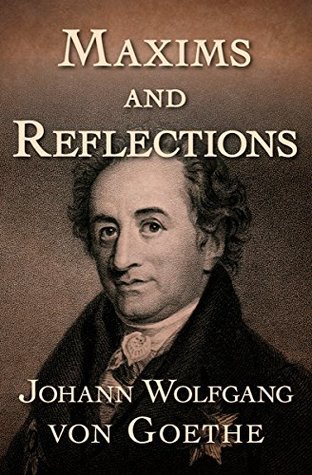
More on this book
Community


Kindle Notes & Highlights

The absent works upon us by tradition. The usual form of it may be called historical; a higher form, akin to the imaginative faculty, is the mythical. If some third form of it is to be sought behind this last, and it has any meaning, it is transformed into the mystical. It also easily becomes sentimental, so that we appropriate to our use only what suits us.
History-writing is a way of getting rid of the past.
Memory may vanish so long as at the moment judgment does not fail you.
There are problematical natures which are equal to no position in which they find themselves, and which no position satisfies. This it is that causes that hideous conflict which wastes life and deprives it of all pleasure.
If we do any real good, it is mostly clam, vi, et precario
It is difficult to be just to the passing moment. We are bored by it if it is neither good nor bad; but the good moment lays a task upon us, and the bad moment a burden.
108. It is as certain as it is strange that truth and error come from one and the same source. Thus it is that we are often not at liberty to do violence to error, because at the same time we do violence to truth.
118. Real obscurantism is not to hinder the spread of what is true, clear, and useful, but to bring into vogue what is false.
137. It is much easier to recognise error than to find truth; for error lies on the surface and may be overcome; but truth lies in the depths, and to search for it is not given to every one.
Ingratitude is always a kind of weakness. I have never known men of ability to be ungrateful.
A man never understands how anthropomorphic he is.
168. If a man sets out to study all the laws, he will have no time left to transgress them.

Hence we study Torah, Talmud, and Mussar
174. When I hear people speak of liberal ideas, it is always a wonder to me that men are so readily put off with empty verbiage. An idea cannot be liberal; but it may be potent, vigorous, exclusive, in order to fulfil its mission of being productive. Still less can a concept be liberal; for a concept has quite another mission. Where, however, we must look for liberality, is in the sentiments; and the sentiments are the inner man as he lives and moves. A man’s sentiments, however, are rarely liberal, because they proceed directly from him personally, and from his immediate relations and
...more
186. As in Rome there is, apart from the Romans, a population of statues, so apart from this real world there is a world of illusion, almost more potent, in which most men live.
188. Thoughts come back; beliefs persist; facts pass by never to return.
191. There is no virtue in subordinating oneself; but there is virtue in descending, and in recognising anything as above us, which is beneath us.
199. Truth is at variance with our natures, but not so error; and for a very simple reason. Truth requires us to recognise ourselves as limited, but error flatters us with the belief that in one way or another we are subject to no bounds at all.
202. That is true Symbolism, where the more particular represents the more general, not as a dream or shade, but as a vivid, instantaneous revelation of the Inscrutable.
203. Everything of an abstract or symbolic nature, as soon as it is challenged by realities, ends by consuming them and itself. So credit consumes both money and itself.
209. Despotism promotes general self-government, because from top to bottom it makes the individual responsible, and so produces the highest degree of activity.
221. It is no wonder that we all more or less delight in the mediocre, because it leaves us in peace: it gives us the comfortable feeling of intercourse with what is like ourselves.
231. Nothing is more terrible than ignorance in action.
276. Fools and wise folk are alike harmless. It is the half-wise, and the half-foolish, who are the most dangerous.
The true is Godlike: we do not see it itself; we must guess at it through its manifestations.
Potentially misleading insofar as focusing on the the manifestation may lead to confabulating the truth with its manifestation leading to a type of idol
fairest
Every, not solely fairest
319. Where I cannot be moral, my power is gone.
320. A man is not deceived by others, he deceives himself.
407. It is not language in itself which is correct or forcible or elegant, but the mind that is embodied in it;
414. A man who has no acquaintance with foreign languages knows nothing of his own.
420. Productions are now possible which, without being bad, have no value. They have no value, because they contain nothing; and they are not bad, because a general form of good-workmanship is present to the author’s mind.
430. Mysticism is the scholastic of the heart, the dialectic of the feelings.
448. There is no such thing as patriotic art and patriotic science. Both art and science belong, like all things great and good, to the whole world, and can be furthered only by a free and general interchange of ideas among contemporaries, with continual reference to the heritage of the past as it is known to us.
the more poetry and the arts of speech decay, the more will blame swell and praise shrink.
487. False tendencies of the senses are a kind of desire after realism, always better than that false tendency which expresses itself as idealistic longing.
529. We more readily confess to errors, mistakes, and shortcomings in our conduct than in our thought.
