
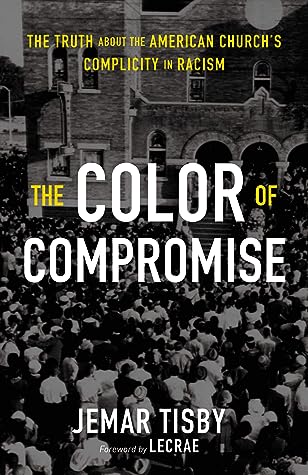
More on this book
Community


Kindle Notes & Highlights
by
Jemar Tisby
Read between
June 24 - July 22, 2020

“fashioning Jesus into a particular and visualized body made it impossible for any universal savior to rise above the conflicts.”
Some of the more “radical” elements of King’s message—which included democratic socialism, ending the war in Vietnam, nuclear de-escalation, a Poor People’s Campaign to force the federal government to address systemic poverty, and support of a sanitation workers’ strike in Memphis when he was killed—have largely been omitted from popular American memory.
Though it is evident that Graham did more than many during his time, he held back from making bold public proclamations of solidarity with black citizens and from demonstrating alongside activists during the March on Selma, a move he later said he regretted.

Graham didn't have this problem, but many ministry professionals have to balance our desire to be true to the prophetic word with an equally important desire to not put our families and livelihoods in jeopardy. Many of us are called as ministers AND spouses AND parents. It's not a binary question of whether we are activists or not - it involves real complexities that almost always guarantee some part of our holy life will pay a price no matter what action or inaction we choose.
“Bebbington’s quadrilateral,” evangelicals accept and promote four principles: conversionism, an emphasis on a personal decision to follow Jesus Christ; biblicism, an understanding of the Bible that interprets miracles as true and Scripture as divinely inspired; crucicentrism, a focus on the crucifixion of Christ as a sacrifice for his followers; and activism, an engaged faith whose adherents seek to work out their faith through evangelism and advocacy.6
An honest assessment of racism should acknowledge that racism never fully goes away; it just adapts to changing times and contexts.
In 1964, President Johnson signed the Civil Rights Act into the law. The next year, the Voting Rights Act passed, and in 1968 the Fair Housing Act became law. Legalized segregation in the form of Jim Crow was now officially banned. Given these shifts, one might be tempted to declare that systemic or legal racism in America had ended, and that aside from a few backwards thinking people—the real racists—the progress of the civil rights movement indicated that the nation had largely overcome its racist past. Such an optimistic assessment would be wrong.
Add electing Obama in 08 & 16 to the list, too.
the United States has had more than 300 years of race-based discrimination. A few short decades of legal freedom have not corrected the damage done by centuries of racism.
In place of obviously racist policies, law-and-order rhetoric “had become a surrogate expression for concern about the civil rights movement.”
even a color-blind ideology is problematic since it “depended upon the establishment of structural mechanisms of exclusion that did not require individual racism by suburban beneficiaries.”
It only took one school, Bob Jones University, to bring the threat of government-enforced integration to the attention of Christian conservatives and to politically mobilize them.
Wow. Shocker.
In 1975, the school changed its policy and allowed unmarried black students to enroll, but as clearly outlined in the student handbook, the school prohibited interracial dating.
IN MY LIFETIME.
What changed their minds was Jimmy Carter’s intervention against the Christian schools, trying to deny them tax-exempt status on the basis of so-called de facto segregation.”
First time I've learned of a racism-based reason for Carter's defeat in 1980.
According to the Moral Majority’s founder, the platform was “pro-life, pro-family, pro-moral, and pro-America.”
And definitely pro-white.
Reagan began his 1980 presidential campaign at an annual fair in Neshoba County, Mississippi, where in 1964, three civil rights workers—James Chaney, Mickey Schwerner, and Andrew Goodman—had disappeared.
In 1974, a Baptist churchgoer in Alabama plainly stated his beliefs about liberalism and its relation to racial integration: “I firmly believe in each race having its own schools, social organizations, and churches. . . . Of course, what I am suggesting will be considered ridiculous and absurd by today’s liberal and brainwashed public and I will be labeled a dirty old racist and bigot.”
The flip side of what Falwell called “welfarism” was the promotion of capitalism and the “free market.” In his book Listen, America, Falwell wrote, “The free enterprise system is clearly outlined in the Book of Proverbs.”66 Drawing on the work of conservative economist Milton Friedman, Falwell claimed that capitalism was the only Christian form of commerce and contended that a free enterprise system liberated from government constraints would lift black people out of poverty.
Hard to believe these Biblical literalists obviously pay no attention to the Jubilee year & other financial guidelines in the Bible. Leviticus 25
In 2015, a white supremacist entered a Bible study at a historic black church and murdered nine worshipers, sparking divisive debates about monuments to and symbols of the Confederacy.
Dylan Roof was an ELCA member & Dr. Pinckney was a Southern graduate.
It may be helpful for Christians to distinguish between Black Lives Matter as an organization and black lives matter as a concept and movement.
Because their religious beliefs reinforce accountable individualism, relationalism, and antistructuralism, many white Christians wrongly assume that racism only includes overt acts, such as calling someone the “n-word” or expressly excluding black people from groups or organizations.
the longer arc of American history reveals that Christian complicity with racism does not always require specific acts of bigotry. Being complicit only requires a muted response in the face of injustice or uncritical support of the status quo.
The longstanding failure among many white Christians to acknowledge ongoing discrimination embedded in systems and structures means black and white Christians often talk past each other. One group focuses on isolated incidents; the other sees a pattern of injustice. To properly assess and move toward a solution to racism in America, both perspectives are needed.
In a text to Pence that night, Graham said, “Mike, look what God did tonight.’ [Pence] said, ‘Isn’t it awesome?’ ”30
[vomit]
In a meeting about immigration with top officials during his presidency, Trump asked why the United States should accept more immigrants from “shithole” countries such as Haiti and countries in Africa. In response, a United Nations representative said, “There is no other word one can use but ‘racist.’ . . . It is not just a story about vulgar language, it’s . . . validating and encouraging racism and xenophobia.”
They voted third party or refrained from voting altogether.
Context is something Bible-believing Christians should understand better than anyone. In our passionate pursuit of biblical interpretation, we know that we must always look at the context. We want to know the historical-grammatical situation of the text so that we can accurately explain and apply it. It’s no different with racial justice. We have to develop an awareness of the context to properly exegete the times and apply biblical solutions.
Do an internet search about a particular topic instead of always asking your black friend to explain an issue to you.
Reparation is not a matter of vengeance or charity; it’s a matter of justice. The concept of reparation has biblical precedence. Under Old Testament law if a person wrongs another person, the wrongdoer should confess the sin. But saying “I’m sorry” is not enough. Expressing remorse may begin the process of healing, but somehow that which was damaged must be restored. The law goes on to state that the wrongdoer “must make full restitution for the wrong they have done, add a fifth of the value to it and give it all to the person they have wronged” (Num. 5:7).
Those who declare that Confederate symbols represent “heritage not hate” must recognize that part of that heritage was hate in the form of slavery and white supremacy.
The pleasant byproduct of learning theology from the black church is that some of the assumptions of suspicion will start to fall away. Christians will learn that people from different nations and ethnicities have dwelled in different contexts that cause them to approach the Bible with different questions and emphases. As the church learns to value the unique applications of eternal biblical principles across people groups, it will grasp more of God’s truth than ever before.
Bonhoeffer at Abyssinian Baptist!
we have the power, through God, to leave behind the compromised Christianity that makes its peace with racism and to live out Christ’s call to a courageous faith. The time for the American church’s complicity in racism has long past. It is time to cancel compromise. It is time to practice courageous Christianity.
