
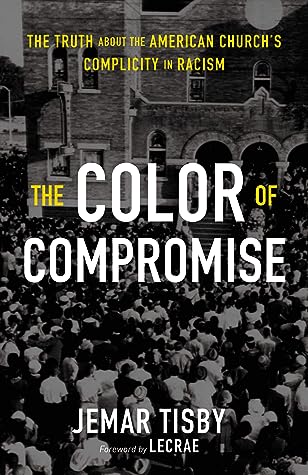
More on this book
Community


Kindle Notes & Highlights

by
Jemar Tisby
Read between
June 1 - June 20, 2020

The failure of many Christians in the South and across the nation to decisively oppose the racism in their families, communities, and even in their own churches provided fertile soil for the seeds of hatred to grow.
The refusal to act in the midst of injustice is itself an act of injustice. Indifference to oppression perpetuates oppression.
History and Scripture teaches us that there can be no reconciliation without repentance. There can be no repentance without confession. And t...
This highlight has been truncated due to consecutive passage length restrictions.
Racism can operate through impersonal systems and not simply through the malicious words and actions of individuals.
Historically speaking, when faced with the choice between racism and equality, the American church has tended to practice a complicit Christianity rather than a courageous Christianity. They chose comfort over constructive conflict and in so doing created and maintained a status quo of injustice.
white supremacy in the nation and the church was not inevitable. Things could have been different. At several points in American history—the colonial era, Reconstruction, the demise of Jim Crow—Christians could have confronted racism instead of compromising. Although the missed opportunities are heartbreaking, the fact that people can choose is also empowering. Christians deliberately chose complicity with racism in the past, but the choice to confront racism remains a possibility today.
We will surround the throne of the Lamb as a redeemed picture of all the ethnic and cultural diversity God created. Our skin color will no longer be a source of pain or arrogant pride but will serve as a multihued reflection of God’s image. We will no longer be alienated by our earthly economic or social position. We will not clamor for power over one another. Our single focus will be worshiping God for eternity in sublime fellowship with each other and our Creator.
Christians have been mandated to pray that the racial and ethnic unity of the church would be manifest, even if imperfectly, in the present.
Race is a social construct. There is no biological basis for the superiority or inferiority of any human being based on the amount of melanin in her or his skin. The development of the idea of race required the intentional actions of people in the social, political, and religious spheres to decide that skin color determined who would be enslaved and who would be free. Over time Europeans, including Christians, wrote the laws and formed the habits that concentrated power in the hands of those they considered “white” while withholding equality from those they considered “black.”
Christianity had inherent ideas of human equality imbedded in its teachings. If slaves converted to Christianity, would they not begin to demand their freedom and social equality?
While white soldiers and political leaders were declaring their inalienable right to independence, they were also enslaving countless women, men, and children of African descent. And the American church participated in and defended the contradiction between freedom and slavery embedded in the constitution of its young nation.
At the outset of the nineteenth century, the United States could have become a worldwide beacon of diversity and equality. Fresh from the Revolutionary War, it could have adopted the noble ideals written in the Declaration of Independence. It could have crafted a truly inclusive Constitution. Instead, white supremacy became more defined as the nation and the church solidified their identities.
At a key moment in the life of our nation, one that called for moral courage, the American church responded to much of the civil rights movement with passivity, indifference, or even outright opposition.
In Christian anthropology, saying that black lives matter insists that all people, including those who have darker skin, have been made in the image and likeness of God. Black lives matter does not mean that only black lives matter; it means that black lives matter too. Given the racist patterns of devaluing black lives in America’s past, it is not obvious to many black people that everyone values black life. Quite the contrary, the existential equality of black people must be repeatedly and passionately proclaimed and pursued, even in the twenty-first century.
Black lives matter presents Christians with an opportunity to mourn with those who mourn and to help bear the burdens that racism has heaped on black people (Rom. 12:15).
The longstanding failure among many white Christians to acknowledge ongoing discrimination embedded in systems and structures means black and white Christians often talk past each other. One group focuses on isolated incidents; the other sees a pattern of injustice. To properly assess and move toward a solution to racism in America, both perspectives are needed. Every person makes choices and is accountable for the consequences. At the same time, injustice imposes limits on the opportunities and choices people have. In the church, conversations about injustice should include an examination of
...more
Christian complicity with racism in the twenty-first century looks different than complicity with racism in the past. It looks like Christians responding to black lives matter with the phrase all lives matter. It looks like Christians consistently supporting a president whose racism has been on display for decades. It looks like Christians telling black people and their allies that their attempts to bring up racial concerns are “divisive.” It looks like conversations on race that focus on individual relationships and are unwilling to discuss systemic solutions. Perhaps Christian complicity in
...more
Jesus taught his disciples that if they are at the altar and remember their brother or sister has something against them, they should leave their gift. “First go and be reconciled to them; then come and offer your gift” (Matt. 5:24). Black people have endured innumerable offenses at the hands of white people in the American church. Injuries to the church body, as Jesus teaches, are so important that one should interrupt worship to go address the problem. Much of the American church has not yet considered racism to be a serious enough sin to interrupt their regularly scheduled worship, at least
...more
Many Christians today say they would have been active participants in the civil rights movement fifty years ago. Now, in the midst of a new civil rights movement, is their chance to prove it.
I am convinced that a fear of other people—what they will say, think, and do if we stand against racism—holds the church back from more aggressive action to bring about justice. Indifference certainly plays a role. Apathy has its part. But when confronted with a choice to oppose racism or to acquiesce to business as usual, people of God too often shrink back.
Jesus crossed every barrier between people, including the greatest barrier of all—the division between God and humankind. He is our peace, and because of his life, death, resurrection, and coming return, those who believe in Jesus not only have God’s presence with us but in us through the Holy Spirit. Therefore, we have the power, through God, to leave behind the compromised Christianity that makes its peace with racism and to live out Christ’s call to a courageous faith. The time for the American church’s complicity in racism has long past. It is time to cancel compromise. It is time to
...more
