
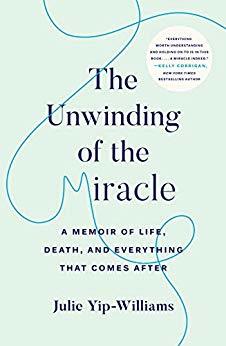
More on this book
Community


Kindle Notes & Highlights

Read between
October 9 - October 16, 2019

Dying has taught me a great deal about living—about facing hard truths consciously, about embracing the suffering as well as the joy. Wrapping my arms around the hard parts was perhaps the great liberating experience of my life.
But I do know that there is incredible value in pain and suffering, if you allow yourself to experience it, to cry, to feel sorrow and grief, to hurt. Walk through the fire
and you will emerge on the other end, whole and stronger.
You will understand that nothing lasts forever, not pain, or joy. You will understand that joy cannot exist without sadness. Relief cannot exist without pain. Compassion cannot exist without cruelty. Courage cannot exist without fear. Hope cannot exist without despair. Wisdom cannot exist without suffering. Gratitude cannot exist without de...
This highlight has been truncated due to consecutive passage length restrictions.
We are here to feel the complex range of emotions that come with being human. And from those experiences, our souls expand and grow and learn and change, and we understand a little more about what it really means to be human. I call it the evolution of the soul.
The worth of a person’s life lies not in the number of years lived; rather it rests on how well that person has absorbed the lessons of that life, how well that person has come to understand and distill the multiple, messy aspects of the human experience.
we will grieve not for what is lost but find strength in what remains behind, through the bonds of human sympathy born of common suffering, and in our faith in something greater than we can conceive of.
The sudden prospect of a shortened life and imminent death seems to have the power to do that. Relationships are accelerated—acquaintances can become intimates in an afternoon. Because there is no time to waste, and what is more important than intimacy?
These are the times in life when we feel almost more than we are capable of feeling. These are the moments when—paradoxically, as we are closest to death—we are most painfully and vividly alive.
mercurial nature of hope; it is like a fire in our souls, sometimes flickering weakly, like the flame of a single candle in the night, and sometimes raging mightily, casting a warm and brilliant light of limitless possibilities.
it’s funny how you can feel comfortable enough to tell a perfect stranger deeply personal things. Sometimes you just need someone to listen to you. Knowing that I would never see her one-on-one again and that she had no preconceived notions about me just made it easier somehow.
The sense that we ever had control over any of this seems nothing but a mockery now, a cruel illusion. And also, a lesson: we control nothing. Well, that’s not exactly true. We control how good we are to people. We control how honest we are with ourselves and others. We control the effort we have put into living. We control how we respond to impossible news. And when the time comes, we control the terms of our surrender.
For me, true inner strength lies in facing death with serenity, in recognizing that death is not the enemy but simply an inevitable part of life.
Perhaps isolation, at least emotionally if not physically, is what happens as you get closer to death, as you understand more powerfully than ever before that this journey to the end is one that must be made absolutely alone. It feels as if whatever comfort there is will be found within, rather than without, from private conversations with my innermost self and, when I can muster belief, the gods.
It is in the acceptance of truth that real wisdom and peace come. It is in the acceptance of truth that real living begins. Conversely, avoidance of truth is the denial of life.
