
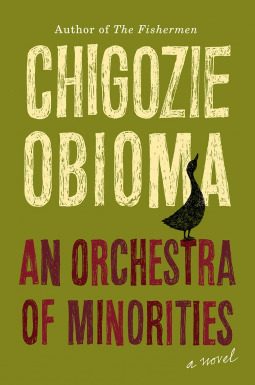
More on this book
Community


Kindle Notes & Highlights

This is why you, Chukwu, warn us against such journeys, especially at night! For when a foreign spirit embodies a person, it is difficult to get it out! This is why we have the mentally ill, the epileptic, men with abominable passions, murderers of their own parents and others!
But as he shifted his gaze, he caught the terrifying vision of a woman attempting to jump over the bridge.
I, his chi, was there when he saw his mother being taken out of the hospital, dead shortly after delivering his sister. This was twenty-two years ago, in the year the White Man refers to as 1991.
Most of what he said pivoted around the perils of loneliness and the need for a woman. And his words were true, for I had lived among mankind long enough to know that loneliness is the violent dog that barks interminably through the long night of grief. I have seen it many times.
My host mumbled the word twenty-four in feverish haste.
Yet a chi is constrained while in the body of its host. While there, it becomes nearly impossible to see or hear what is present or spoken in the supernatural realm. But when one exits one’s host, one becomes privy to things beyond the realm of man.
I flashed the image of the chicken and the vulture into his subconscious mind, for the easiest way to communicate such a mysterious event to one’s host is through the dream sphere—a fragile realm a chi must always enter with caution and great care because it is an open theater accessible to any spirit.
A neighbor’s hand in the death of his gosling had shut his heart to friendships.
When the White Man came, he brought good things. When they saw the car, the children of the fathers cried out in amusement. The bridges? “Oh, how wonderful!” they said. “Isn’t this one of the wonders of the world?” they said of the radio. Instead of simply neglecting the civilization of their blessed fathers, they destroyed it. They rushed to the cities—Lagos, Port Harcourt, Enugu, Kano—only to find that the good things were in short supply.
He fell in love with her. In time, it seemed that with one slingshot, she had silenced his grief—that violent dog that had barked relentlessly in this early night of his life.
house again, he sought to engage her in conversation. “What happened to you that night?” he said. “I was going to die,” she said and dropped her eyes to the floor. Her words softened his shame. “Why?” Without hesitation, she told him she’d woken up the morning of the day before to find the world she’d so carefully built crumpled into dusty ruins. She had been crushed for two whole days by an e-mail from her betrothed, which had announced that he had married a British woman.
he’d not understood all of it. Her command of the White Man’s language contained more words than he could comprehend.
For I have seen many times that people, after their beloveds have left them, try to reclaim them as one would attempt to reclaim property that had been stolen. Wasn’t this the case with Emejuiwe, who, one hundred and thirty years ago, killed the man who took his wife from him?
I feared that when the love had fully formed in his heart, it would blind him and make him deaf to my counsel. And I could see already that it had started to possess him.
“Mommy, she left home before Papa died. She, you know, she—how I should say it?—abandoned us.” He looked up to meet her fixed eyes. “She left because of a man no one wanted her to marry because the man is very old, old enough even to be her father. In fact, he take more than fifteen years to senior her.” “Ah-han! Why did she do that?” “I don’t know, my sister.” He gave her a sharp look to see if there was a reaction to what he had just called her. Then he said, “I don’t know, Mommy.”
My host was angry. But anger, in a situation like this, often becomes a multiparous cat who bears litters of offspring, and it had already birthed jealousy and doubt in him. For as he walked back to his van, he kept wondering why he was giving himself to a woman who did not seem to care about him.
She looked at him, her eyes firm against his own, unblinking. Then she turned away again. “You will meet them. I promise you that. But I know my parents. And my brother. I know them.” She shook her head again. “They are proud people. It will not be good. But you will meet them.”
“I don’t know. But—in fact—I don’t know. Maybe the way you tell it to me. But—I just see you, just a man who loves his fowls so much. So very much.” Ebubedike, my host’s thoughts swirled at this. Love, he thought. How could love be what she thinks about at this given moment after he’d just exposed himself as capable of such senseless brutality?
“Chinonso Solomon Olisa, you have been a great person, a godsend to me. Look at me, I have been through hell. You met me in the worst place. You met me, I was on the bridge. I was on that bridge because—because what?—because I was tired of the bad treatment. Because I was tired of being cheated and lied to. But God! He sent you into my life at the very appointed time. Look at me now.” She splayed her hands open for him to see. “Look at me, look at how I have been transformed. If anyone told me or even my mum that her daughter would be working in a poultry, touching agric fowl, who would
...more
Fear exists because of the presence of anxiety and anxiety because humans cannot see the future. For if only a man could see the future, he would be more at peace.
The role of the chi is to attend to higher matters, things which, by virtue of their magnitude, can affect the host in major or significant ways. It must also attend to supernatural matters which man, in his limitation, cannot handle.
“Surprise her, mehn, and you will see. You will see that you will not only gain her respect, but, I tell you”—Jamike licked his thumb with his tongue until a gasp of erhen erupted—“I swear to almighty God, Ndali will love you die!”
will. So even though I had worried that he was selling most of what he had, I had let him do this without interference. I did this also because I believed that the man who had come to him to help him had been a product of his gift of good luck, the bone from the garden of Chiokike.
“How can you sell everything, Nonso?” “I did it because I don’t want them to separate us.” “Yes, but you sold everything you have, Nonso,” she said again and turned to him, and he saw that she had again begun to cry. “For me, for me, why, Nonso?”
My host envied him. This man who had lost nothing, whose money had gone where he wanted it to, and who would study Computer Engineering at a European university. Tobe was lucky; he was worthy of envy, and he had nothing to be sad or angry about.
because they are not as powerful.” The rage in her voice cut deep into him. “They are making the same sound, Nonso. Listen, listen, it is the same sound they made when the hawk attacked them.”
“Like even now. You see? Why? Because they are umu-obere-ihe, minorities. See what the powerful have done to us in this country. See what they have done to you. And weak things.”
Just listen, Nonso.” She stood silent for a moment, then she stepped back a bit and snapped her fingers. “It is true what your father said. It is an orchestra of minorities.” She snapped her fingers again. “I feel for them, Nonso, for what we are doing to them, and it is a song of sorrow that they are singing.”
I’d try to give him hope that he could still find her. Think of it this way: love never dies. You see, in that film you saw, The Odyssey, in which the man returned after ten years to find his wife still waiting for him, the wife knew that her husband loved her and was just being kept away from her because of the circumstances of life. So she remained faithful through the years, refusing, no matter how much she was pressured, to betray him. Is this not the same situation with you? Is it not, simply, only four years? Only four years.

Was this necessary to mention?
When Jamike was almost done, when he’d read the part about his hopelessness in prison, his incarceration for a crime he did not commit, the horde of unwanted memories rushed into his head. At once the violent rage came upon him again. In terror, he seized the man and began to hit him. But the memory did not abate at all. It was as if the images held his two hands and forced him to see what he did not want to see, and hear what he did not want to hear.
found her!” “M.O.G., who, what have you found?” “Who else, my brother? Who else? The one you have been looking for. Ndali!”
again, I always told him to have faith like the white man of ancient times, Odysseus, in the tale he loved as a kid. In that tale, the man had been stopped from returning to his wife by an angry god.
“I am not saying I will hurt her, no. I love her too much to do that, even though I am angry, very angry with her. It is a strange, uncanny mix of feelings. Deep love that is beyond compare. But no, I will kill any man, her husband even, who lays a hand on her.”
As a child, a man’s life is ruled by constant fear. And once a person becomes an adult, fear becomes a permanent part of him. Everything a human being does is ruled by it. It is folly to ask, how may one be free from fear? Well, isn’t it fear itself—perhaps the fear of having one’s mind dominated by fear—that causes a person to ask such a question? Man must live by it.
