
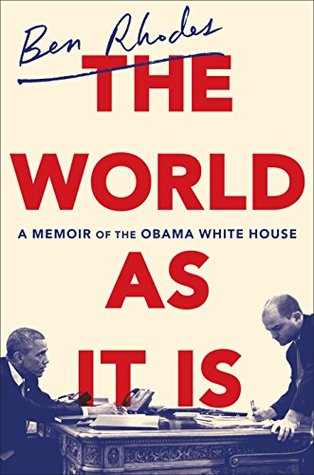
More on this book
Community


Kindle Notes & Highlights
by
Ben Rhodes
Read between
October 1 - December 26, 2018

Obama wanted to show his government how he went about making decisions, so we needed to understand what was happening in Afghanistan and Pakistan, define our interests, test what resources were necessary, weigh those needs against all of our other priorities at home and around the world, and then make a decision.

Obama's decision making process
There is always something sad about the last night of these trips. They consume you for weeks, they move you around—without sleep—for days. You stay in beautiful places, see strange things, meet famous people, and develop an intense camaraderie with the people you are with. But I felt like it was impossible to explain these things to people back home—my wife, my parents, my old friends. It was like you inhabited two parallel lives—one that made you who you were, and the other that was consuming that person, and transforming you into someone else.
I envy this
What does it mean to invade a country, topple its leader, face a raging insurgency, open a Pandora’s box of sectarian conflict across a region, spend trillions of dollars, kill hundreds of thousands of people, and permanently alter hundreds of thousands of American lives? Something in the character of post-9/11 America seemed unable, or unwilling, to process the scale of the catastrophic decision, and the spillover effects it had—an emboldened Iran, embattled Gulf states, a Syrian dictator who didn’t want to be next, a Russian strongman who resented American dominance, a terrorist organization
...more
This is where it all started
The overwhelming fear was that Friday would be a bloodbath, Fridays being the biggest protest days in Muslim communities, as it’s the weekend and people attend Friday prayers, where imams can stir up a crowd and extremists can take advantage of the chaos.
religion as a method of manipulation
“It is too easy for a president to go to war,” he said. “That quote from me in 2007—I agree with that guy. That’s who I am. And sometimes the least obvious thing to do is the right thing.” If he attacked Syria without congressional authorization, the Republicans would come after him, and it would be impossible to sustain any military engagement in Syria. If we got congressional authorization for an attack on Syria, everyone would be in on the action, and we’d have more credibility—legally, politically, and internationally.
Why they didn't go into Syria
If we couldn’t, we shouldn’t act.
I then watched as Obama became the first U.S. president to speak to an Iranian president since the Islamic Revolution of 1979.
what an enormous achievement the buffoon has fucked up
This illuminated for me his almost monkish, and at times frustrating, discipline in trying to avoid overreach in a roiling world while focusing on a set of clearly defined priorities. Core interests and allies defended. Old accounts like Cuba closed. New agreements forged. Stupid shit avoided. Our values advanced by how we lived them. Change that is incremental, but real.
Definition of his presidency
