
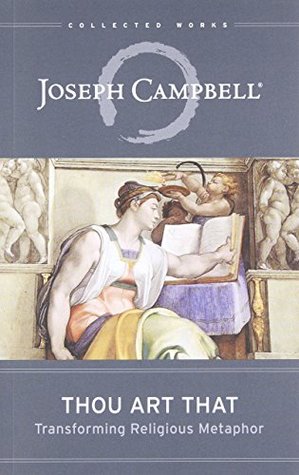
More on this book

Kindle Notes & Highlights

Started reading
July 21, 2024

It made me reflect that half the people in the world think that the metaphors of their religious traditions, for example, are facts. And the other half contends that they are not facts at all.
Metaphors only seem to describe the outer world of time and place. Their real universe is the spiritual realm of the inner life. The Kingdom of God is within you.
These images must point past themselves to that ultimate truth which must be told: that life does not have any one absolutely fixed meaning.
The Waste Land is that territory of wounded people—that is, of people living inauthentic lives, broken lives, who have never found the basic energy for living, and they live, therefore, in this blighted landscape.
For example, when disaster strikes, when you meet with a great calamity, what is it that supports you and carries you through? Do you have anything that supports and carries you through? Or does that which you thought was your support now fail you? That is the test of the myth, the building myth, of your life.
Eternity is neither future, nor past, but now. It is not of the nature of time at all, in fact, but a dimension, so to say, of now and forever, a dimension of the consciousness of being that is to be found and experienced within, upon which, when found, one may ride through time and through the whole length of one’s days. What leads to the knowledge of this transpersonal, trans-historical dimension of one’s being and life experience are the mythological archetypes, those eternal symbols that are known to all mythologies and have been forever the support and models of human life.
You cannot identify with God when you think of God as a fact. When you think of God as a metaphor for that which is the dynamism of life, and attach yourself to that, you are God.
How does the ordinary person come to the transcendent? For a start, I would say, study poetry. Learn how to read a poem. You need not have the experience to get the message, or at least some indication of the message. It may come gradually. There are many ways, however, of coming to the transcendent experience.
