
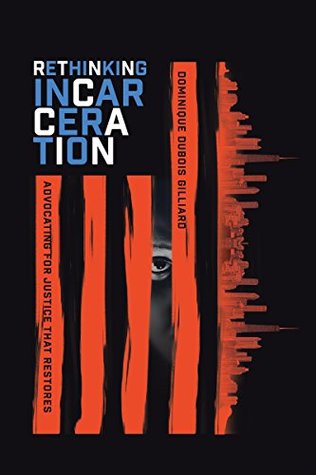
More on this book


Kindle Notes & Highlights
Read between
March 22 - March 25, 2019

the majority of people arrested for crack offenses are African American, the 100:1 ratio resulted in vast racial disparities in the average length of sentences for comparable offenses. On average, under the 100:1 regime, African Americans served virtually as much time in prison for non-violent drug offenses as whites did for violent offenses.23
When we study the life, teaching, and ministry of Jesus, we see a divergent response to stigmatization and marginalization. In Jesus, we see the living expression of God’s love, restoration, and reconciliation; he was literally faith expressing itself in love. Instead of avoiding, confining, and quarantining the sick, Jesus sought, touched, liberated, and reintegrated them into community.
In this pivotal moment, the church must collectively support the reallocation of medical funding. The clear majority of the people with mental impairments serving time need treatment, not incarceration. We cannot continue to incarcerate people who do not have the mental capacities to understand what they are being sentenced for. This is unethical and immoral! We also cannot entrust medical and reentry services to for-profit prisons. They will line their pockets as they negotiate exclusive governmental contracts. We have a responsibility as concerned citizens and followers of Jesus Christ to
...more
The court determined that Ciavarella’s commitment to “zero tolerance” was not what drove his overzealous conviction rate. Ciavarella’s convictions were primarily driven by an illegal agreement with his friend Robert Powell, the co-owner of the two private juvenile detention centers that Ciavarella’s convictions populated. Ciavarella was convicted of racketeering, along with other charges, and sentenced to twenty-eight years in prison. Ciavarella, however, did not act alone. This was yet another example of institutional injustice and systemic corruption.3 Robert Powell was sentenced to eighteen
...more
This highlight has been truncated due to consecutive passage length restrictions.
Implicit bias is also a prime example of how students are profoundly affected by adults’ inability to interrogate our own prejudices and cultural blind spots. When adults do not do this, statistics illuminate that young people suffer grave consequence. While we often believe that our inner thoughts have no bearing on our actions, science proves this untrue. For example, Ohio State University’s Kirwan Institute for the Study of Race and Ethnicity found that implicit bias is “an unconscious yet powerful contributor to school discipline disparities.”24
Michelle Alexander details the evolution and impact of the racialization of African Americans: Arguably the most important parallel between mass incarceration and Jim Crow is that both have served to define the meaning and significance of race in America. Indeed, a primary function of any racial caste system is to define the meaning of race in its time. Slavery defined what it meant to be black (a slave), and Jim Crow defined what it meant to be black (a second-class citizen). Today mass incarceration defines the meaning of blackness in America: black people, especially black men, are
...more
How we choose to discipline students is so important because suspensions have become the chief predictor of high school dropouts. The correlation between suspensions and dropout rates is strong, and the relationship between dropout rates and incarceration is undeniable. Youth who do not graduate from high school are eight times more likely to go to prison.28 Within federal and state prison populations, 41 percent do not have a high school diploma or GED. In local jails, 31 percent have not completed high school or its equivalent. And 68 percent of those in prison do not have a high school
...more
There is also a strong correlation between foster care and incarceration. This correlation intensifies when they are students of color or LGBTQI. Those in the foster-care system are three times more likely to be suspended or expelled than their peers. Fifty percent of children within the foster-care system are black or Hispanic. Twenty-five percent will end up behind bars within a few years of turning eighteen.30 Former foster-care children represent one of the largest incarcerated populations. For example, in California 70 percent of the incarcerated populace is former foster-care youth.31
SROs are not typically taught about adolescent psychology or trained to understand and contextually respond to the behavior of students, particularly students with mental illness or other special needs. In most states juvenile justice issues fill just 1 percent of the training hours at police academies.46 Nationwide, only twelve states mandate SROs to receive student-specific preparation before working in schools.47
Theologian Daniel Groody writes that “God’s concern for the poor and oppressed is one of the most central themes of the Bible. In the New Testament one out of every sixteen verses is about the poor. In the Gospels, the number is one out of every ten; in Luke’s Gospel it is one out of every seven, and in James, one out of every five.” He concludes, “From a Christian perspective, whenever a community ceases to care for the most vulnerable members of society, its spiritual integrity falls apart.”17
Early in our “Christian” nation’s history, penal substitution was understood to mean that all crime is generally understood as sin, and sin is an affront to God. Therefore all crime must be both punished and atoned for. Penal substitution therefore emphasizes the need for penalties, retribution, and recompense. This is the standard approach within our criminal justice system; justice comes through indictment, sentencing, and punishment. Punishment is seen as something that will correct unrighteousness and lead to the restoration of individuals and reconciled relationships.
Largely because of this penalty-centered view of justice, Western Christianity’s understanding of justice has become intrinsically intertwined with state law. Due to the complex and historic relationship between church and state in our nation, there is little distinction between committing a sin against God and committing a crime against the state. Christians largely see the state as morally obligated to punish offenders, exclusively responsible for criminal justice, and divinely ordained for human governance. Our criminal justice system has thereby become an ordained agent of “divine”
...more
Therefore, Lewis, like Augustine, Aquinas, and Calvin before him, saw punishment not only as a virtue but also the key to justice, accountability, and transformation in the offender. This meritocratic view of justice insists that punishment and reconciliation are codependent, that when wed they induce justice and right relationships. This theology has arrested the evangelical mind. We have been discipled to think that crime is sin, and sin fosters unrighteousness and separation from God, provoking God’s wrath. God’s wrath then necessitates punishment, and punishment leads to accountability,
...more
Our atonement theology is important because it expresses what we truly believe about God.

One of the problems with his approach here is that he is falling into the trap of believing that atonement theories are telling us everything about the atonement instead of giving us glimpses into the atonement thorough metaphors.
He is right that the metaphors do matter. I think he goes to far when he approaches the theories as singular instead of faceted.
Retribution, in isolation, is incapable of breeding true transformation; it merely induces vengeance and retaliation. However, when issued within the context of relational accountability, and done with a restorative paradigm, Scripture shows that measured retribution can be an important part of holding individuals accountable who commit relational violations. However, we must not lose sight of the fact that justice is ultimately manifested in the restoration of righteousness within relationships, not in the pain inflicted or the time served behind bars because of a punishment.
As Christians, the cross undoubtedly frames our understanding of divine justice. Christopher Marshall writes, “The logic of the cross actually confounds the principle of retributive justice, for salvation is achieved not by the offender compensating for his crimes by suffering, but by the victim, the one offended against, suffering vicariously on behalf of the offended—a radical inversion of the lex talionis [the law of retaliation, whereby a punishment resembles the offense committed in kind and degree].”
Thus, penal substitution is most problematic because it makes God’s response to sin too much like our own. It is a sort of recasting of God in our own image, as opposed to allowing the divinely inspired Scriptures to speak for God’s motives.
This is a point that needs more time. Our conception of how punishment and sin are handled is not the same as how god handled our sin. We are not Christ. We cannot be God the Father in a penal substitutionary metaphor.
Many Christians—given our individualistic society—disengage because they believe justice is merely the protection of individual rights. A fair number of Christians cling to this belief, even when guarding the rights of an individual comes at the expense of another person’s freedoms (think “stand your ground” laws). However, theologians such as Walter Burghardt argue that as covenant people, our definition of justice must differ from mainstream society’s. Burghardt explains that for Israel, justice and sin were both relational, and therefore the church today must realize that “biblical justice
...more
In embracing the biblical vision of shalom, Christians can begin envisioning, pursuing, and working to cultivate a criminal justice system predicated on mutual accountability rather than individual rights. We have the potential to assume responsibility not only for our own liberties but also for the life, dignity, and interests of others, especially “the least of these.” Within this biblical framework the church can come to understand that our identities are ultimately bound to one another, and that even those labeled as criminals are our brothers and sisters. Biblical justice calls us to make
...more
The church has adopted and supported a meritocratic ethic that declares people get what they deserve. This worldview has subconsciously fostered an unquestioning allegiance to the state, and it has led the church to unwittingly consent to and affirm that crime is primarily a legal offense committed against the state rather than a sin that relationally harms individuals and communities, infringing on the shalom that God intends for us all. Our understanding of God’s wrath colors our response to crime. We have read of God’s vengeance toward sin and legislatively translated it into zero-tolerance
...more
