
More on this book

Kindle Notes & Highlights

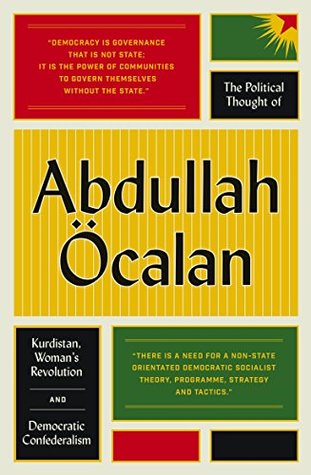
The Political Thought of Abdullah Öcalan: Kurdistan, Woman's Revolution and Democratic Confederalism
Read between
December 22 - December 26, 2023

If anything, I was slightly taken aback by his cult-like status. But my initial scepticism and reluctance to engage was replaced by a great sense of appreciation, respect, and excitement. I have come to recognise Abdullah Öcalan not only as a political leader who has been able to engage in self-criticism and change his positions radically, but also as a political
that the establishment of an independent nation-state does not increase the freedom of a people. In contrast, the state, in his view, is a source of much suffering and oppression in different contexts.
capitalism and patriarchy find their optimum expression within the nation-state and, in turn, shape its structure and fabric.
The ideological pillars of this consensus-oriented and multicultural political framework are ecology, more specifically a commitment to preserve the environment, as well as feminism, that is, a commitment to gender equality and justice.
Since 2003, the Democratic Union Party (PYD), which, although a separate political entity, shares ideological roots in the PKK, began to organise in Rojava and by 2005 started to pursue key ideas more practically, even if clandestinely. More recently, the Movement for a Democratic Society (Tevgera Civaka Demokratîk or TEV-DEM) has been established as an umbrella organisation to pursue the vision of democratic confederalism at the same time as Kurds in northern Syria have been involved in an armed struggle against ISIS,
Since the nation-state transcends its material basis – the citizens – it assumes an existence beyond its political institutions. It needs additional institutions of its own to protect its ideological basis as well as legal, economic and religious structures. The resulting ever-expanding civil and military bureaucracy is expensive and serves only the preservation of the transcendent state
The nation-state in its original form aimed at the monopolisation of all social processes. Diversity and plurality had to be fought, an approach that led to assimilation and genocide.
It aims at creating a single national culture, a single national identity and a single unified religious community.
It is often said that the nation-state is concerned with the fate of the common people. This is not true. Rather, it is the national governor of the worldwide capitalist system, a vassal of capitalist modernity which is more deeply entangled in the dominant structures of capital than we tend to assume: it is a colony for capital.
Nation-states which leave the phalanx of the capitalist system are overtaken by the same fate that the Saddam regime in Iraq experienced, or it will be brought to its knees by means of economic embargoes.
Assuming that we would compare the nation-state to a living god, then nationalism would be the correspondent religion. In spite of some seemingly positive elements, nation-state and nationalism show metaphysical characteristics.
The paradigm of a positivist or descriptive science forms another ideological pillar of the nation-state. It
Positivism can be circumscribed as a philosophical approach that is strictly confined to the appearance of things, which it equates with reality itself.
On the one hand, the sexism of the society of the nation-state strengthens the power of men; on the other hand, the nation-state turns its society into a colony through the exploitation of women. In this respect women can also be regarded as an exploited nation.
