
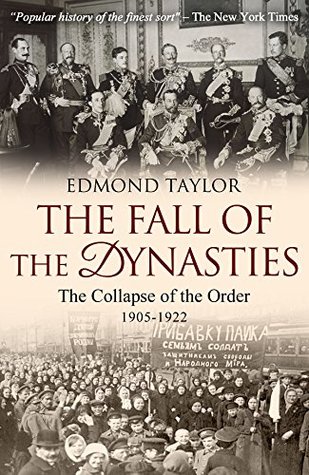
More on this book
Community


Kindle Notes & Highlights

looking pinched and taut. They are
This is Sarajevo today, and this — save for the faint scars left by Allied bombing in World War II — is how it appeared to Francis
Ferdinand in the clear morning sunlight, as his open-topped car, with the

Book written 1965+ o way they could have predicted at the time ISIS
Austria-Hungary was called the Dual Monarchy because it was not a nation but two separate and theoretically sovereign nations ruled by a common King-Emperor and linked by rather sketchy joint, or imperial, administrative services (including the army). This, however, is a gross oversimplification; in many respects Austria and Hungary were less like nations than like two associated empires. In
extremists always fear a moderate adversary.
Resolute, fearless, single-minded and ruthless, Princip was a type of political fanatic that has become only too familiar to us. The son of a peasant from a small village in Herzegovina, he had never known anything but poverty, yet from earliest childhood he burned with
thirst for education that was like a fever.
systems faced each other glittering
constituted the pillars of the traditional European order. There were four of them: the Hohenzollerns
in Germany,
Habsburgs in Austria...
This highlight has been truncated due to consecutive passage length restrictions.
the Romanovs in Russia, including Finland and most of Poland; and the
(Ottomans) in the Turkish Empire which in addition to modern Turkey, comprised Syria, Palestine,
Arabia, Mesopotamia and, up to 1912, Libya and substantial parts of ...
This highlight has been truncated due to consecutive passage length restrictions.
minor dynasties
Spain, Italy, Serbia, Albania, Montenegro, Rumania, Bulgaria, and Greece.
the biographer of Wilhelm II, himself
—
The coffeehouse culture that reached its apogee in Vienna before 1914 could flourish only in a peaceful world; to the Viennese, as to most other Europeans at the time, peace itself was something to be savored among
habitues in an atmosphere of mild and unhurried sociability, sugared to taste, and with plenty of schlag floating on it.
born in the pre-war Habsburg capital was illegitimate.
schlamperei,
It would be an error to conclude from such evidence that Vienna was a city of unbridled license,
but it was
unquestionably ea...
This highlight has been truncated due to consecutive passage length restrictions.
francs or marks as a traveler’s luggage
Pobedonostsev. Nicholas’ tutor
His enemies were rationalism, progress, liberalism, personal liberties, constitutions, parliamentary institutions and, above all, popular sovereignty, “the erroneous principle that ... all power comes from the people.” He
had failed to notice, or at least to understand, the increasing emphasis on scientific socialism rather than human rights in the Russian revolutionary movement, the steady rise of the Nihilists and the Leninists-to-be, with their cold pessimism, so like his own, and their evident bent toward dictatorship, only a little less openly expressed than his.
In the cities the revolutionary movement was generally less furious, but no less grave. The different socialist groups temporarily put aside their doctrinal quarrels, and in St. Petersburg even the moderate constitutionalists joined them for a while in an anti-regime co-ordinating committee — Soviet — whose designation was to become a revolutionary symbol. Elsewhere the Socialist-Revolutionaries, with their deep peasant roots, were the most important enemies of the autocracy, but in the capital the Marxist Social-Democrats, including Lenin’s Bolsheviks, played a star role, for the
first time in Russian history. Though he theoretically disapproved of it, Lenin himself slipped back from exile to help steer the St Petersburg Soviet into the course of all-out revolution.
The Russo-British crisis of 1878 introduced a new word — jingoism — into the English language when the British public began singing, “We don’t want to fight, but by jingo if we do, we’ve got the men, we’ve got the ships, we’ve got the money too” — and then, in a rousing tutti: “The Russians shall not have Constantinople.”
Once again the old world diplomacy displayed its genius for creating the irreparable while postponing the inevitable.
philosophy of revolutionary violence made them kindred spirits to those political “activists” of the extreme right and the extreme left who between them have contributed so much to shaping the contorted physiognomy of our age.
undercurrents in the Young Turk movement was embodied by a secret revolutionary organization in the army that called itself Vatan (Fatherland). Its members believed passionately in constitutionalism, in representative government, in education, in modernizing Ottoman social and
cultural life, and above all, in nationalism.
Mustapha Riaz, better known, because of his cocksure efficiency, by the nickname, Kemal (“Perfection”). Mustapha Kemal, whom history now remembers under still another name, Ataturk, joined Vatan when he was attending the army staff college in Constantinople. On his graduation in 1904 he was
he switched from Vatan to a more powerful and important conspiratorial group — the
Committee of Union and Progress.
Enver Bey,
condottiere.
Bosnian crisis of 1908-1909
Prussia was an obsessive ambition rather than an ideal; its service was a compulsion rather than a dedication.
Sounds like a framework for Hitler
The words have a sinister twentieth-century ring, and their note of almost hysterical commitment to a mission beyond one’s
strength has in fact been a recurrent theme in twentieth-century German history.
Baden,
at Versailles on January 18, 1871; the German Empire, including all the German states and the
freshly annexed French provinces of Alsace and Lorraine, was solemnly proclaimed in Louis XIV’s Hall of Mirrors, and the King of Prussia became Kaiser (Emperor) Wilhelm I.
There were several powerful, interlocking organizations working toward the same broad ends. The most important ones were the Pan-German League, the Colonial Society, and, above all, the Navy League — backed of course by the maritime and armaments lobbies — which both exploited and were exploited by the Secretary of the Navy Admiral Alfred von Tirpitz.
Grand Duchess Militsa,
