
More on this book
Community


Kindle Notes & Highlights


The old bucket has hung there through many autumns, and the leaves have fallen around it and some have fallen into it. Rain and snow have fallen into it, and the fallen leaves have held the moisture and so have rotted. Nuts have fallen into it, or been carried into it by squirrels; mice and squirrels have eaten the meat of the nuts and left the shells; they and other animals have left their droppings; insects have flown into the bucket and died and decayed; birds have scratched in it and left their droppings and perhaps a feather or two. This slow work of growth and death, gravity and decay,
...more
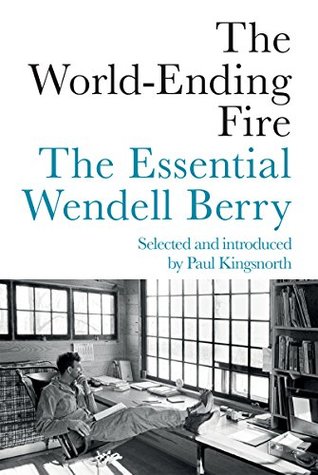
Wendell Berry’s formula for a good life and a good community is simple and pleasingly unoriginal. Slow down. Pay attention. Do good work. Love your neighbours. Love your place. Stay in your place. Settle for less, enjoy it more.
I am forced, against all my hopes and inclinations, to regard the history of my people here as the progress of the doom of what I value most in the world: the life and health of the earth, the peacefulness of human communities and households.
But one immediately reflects that the American Indian, who was ignorant by the same standards, nevertheless knew how to live in the country without making violence the invariable mode of his relation to it; in fact, from the ecologist’s or the conservationist’s point of view, he did it no violence. This is because he had, in place of what we would call education, a fully integrated culture, the content of which was a highly complex sense of his dependence on the earth. The same, I believe, was generally true of the peasants of certain old agricultural societies, particularly in the Orient.
...more
The idea was that when faced with abundance one should consume abundantly – an idea that has survived to become the basis of our present economy. It is neither natural nor civilized, and even from a ‘practical’ point of view it is to the last degree brutalizing and stupid.
Because they belonged to no place, it was almost inevitable that they should behave violently toward the places they came to. We still have not, in any meaningful way, arrived in America. And in spite of our great reservoir of facts and methods, in comparison to the deep earthly wisdom of established peoples we still know but little.
The difference between a path and a road is not only the obvious one. A path is little more than a habit that comes with knowledge of a place. It is a sort of ritual of familiarity. As a form, it is a form of contact with a known landscape. It is not destructive. It is the perfect adaptation, through experience and familiarity, of movement to place; it obeys the natural contours; such obstacles as it meets it goes around. A road, on the other hand, even the most primitive road, embodies a resistance against the landscape. Its reason is not simply the necessity for movement, but haste. Its wish
...more
We have lived by the assumption that what was good for us would be good for the world. And this has been based on the even flimsier assumption that we could know with any certainty what was good even for us.
We have been wrong. We must change our lives, so that it will be possible to live by the contrary assumption that what is good for the world will be good for us. And that requires that we make the effort to know the world and to learn what is good for it. We must learn to cooperate in its processes, and to yield to its limits. But even more important, we must learn to acknowledge that the creation is full of mystery; we will never entirely understand it. We must abandon arrogance and stand in awe. We must recover the sense of the majesty of creation, and the ability to be worshipful in its
...more
