
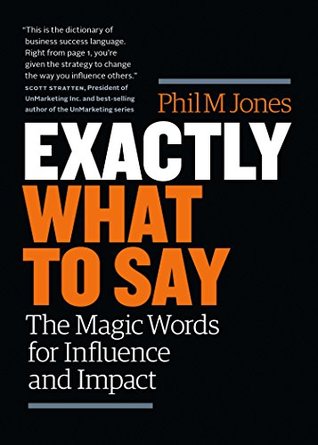
More on this book
Community


Kindle Notes & Highlights

Read between
August 8 - August 11, 2017

Magic Words are sets of words that talk straight to the subconscious brain. The subconscious brain is a powerful tool in decision-making because it is preprogrammed through our conditioning to make decisions without overanalyzing them. It works a little like a computer—it has only “yes” and “no” outputs and
People are motivated by one of two things: either avoiding a loss or acquiring a potential gain. They either want to go toward the
The real world tells us that people will work far harder to avoid a potential loss than they will to achieve a potential gain. Greater than that is the fact that the more contrast you can create between where somebody
does not want to be and where they hope to be, the more likely you are to get people to move.
By introducing a future scenario with the words, “How would you feel if...?” you allow the other person to time travel to that moment and imagine the emotions that would be triggered at that point. Choosing moments that trigger both positive and negative emotions will allow you to create a truth worth changing for.
What about this one: how would you feel if this time next year you were debt-free, living in your dream home and planning your next vacation?
Remember, the greater the contrast, the more likely you are to get that someone to move.
People make decisions based
on the images they see in their minds, so if you can place pictures in people’s minds, then you can use the results of those images to influence their decisions.
Just imagine how things will be in six months’ time once you
When would be a good time to speak next?
In all of these scenarios, please be certain that when you gain a reply, you work to schedule the precise next point of contact in order to keep control of the conversation in your hands. When you
Instead, swap that question with, “So, what do you like about it?”
By pushing for the negative scenario, you get people to rise to the positive or to tell you how they are going to fix the thing they said they were going to do.
Swap the phrase, “Do you have any questions?” with the improved, “What questions do you have for me?” The minute you assume an outcome, the easiest response for them to give is that they have no questions.
Instead, asking the alternative question, “What’s the best number to contact you at?” results in people effortlessly giving you the information you requested.
The rhythm of three makes for easy
listening for the other person, and by leaving your preferred choice until the end, you easily build the value of that option and load the choices so your preferred outcome stands out as a clear favorite.
“Of those three options, what’s going to be easier for you?”
So, start with, “You have three options,” finish with, “What’s going to be easier for you?”
To me, the primary job description of all sales professionals is to be “decision catalysts” in the lives of their customers and prospects, yet still the job can be more simply described as “professional mind-maker-upper.”
Now your role is to deliver them two choices and make one of them stand out as the easy option.
Getting them to provide evidence that supports your objective makes it harder for them to disagree with you.
You can use this set of words
to help avoid many common objections by gaining full agreement with something they may otherwise have tr...
This highlight has been truncated due to consecutive passage length restrictions.
Slip those kinds of statements into early conversations while holding eye contact with the other person, and just watch them nod back at you. When they do, this means they know that you know they agree with those concepts. This makes it an awful lot harder
The moment you apply a label to something, it becomes almost impossible for the other person in the conver-sation to shed that label.
By prefacing things with, “The good news is...,” you cause people to face forward with optimism and zap any negative energy out of the conversation.
Next time somebody tells you a reason why they do not want to do something, respond by saying, “That’s great.”
You do not ask them what they would like to do; you just tell them what happens next.
“What happens next is that we are going to take a few moments, complete some of your personal details and get things set up for you to receive everything in the quickest possible time.
Finishing this process with a question that is effortless to answer is the key to gaining a rapid response and a positive outcome.
Success in negotiating is all about maintaining control in a conversation, and the person in control is always the person who is asking the questions. By treating every objection you face as nothing more than a question, you can quickly regain control of the conversation by asking a question in return.
Before you make your mind up, why don’t we just run through the details one more time so you can know what it is that you are saying no to?
situations to isolate this condition and remove the barrier by responding with a powerful question that eliminates their argument. This is achieved by using the question structure, “If I can..., then will you...?”
“Would three bottles be enough for you?”
This use of words drives the recipient to answer the direct question, and “yes” becomes the path of least resistance.
“You wouldn’t happen to know...”
“... just one person...”
“... someone who, ust like you...”
“... would benefit from...”
say, “Don’t worry. I’m not looking for their details right now, but who was it that you were thinking of?”
It’s just that my experience tells me this statement rarely means they are heading away to do a detailed analysis of their decision. They are just pushing their decision away to another day.
Just out of curiosity, what needs to happen for you to make a decision about this?
Just out of curiosity, what is it that’s stopping you from moving forward with this right now?
Asking big, brave questions is exactly what you need to do to become a professional mind-maker-upper.
Give an answer that is simple, effortless, positive and uplifting,
and watch how it stuns people into a positive decision.
