
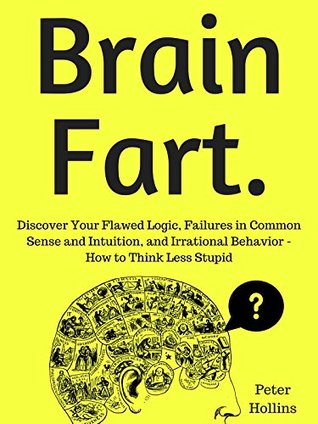
More on this book

Kindle Notes & Highlights

Read between
March 16 - March 16, 2020

The salesman was trying to pull one over our eyes and make us Brain Fart – have a momentary lapse in our collective judgment.
A profoundly flawed brain which makes suboptimal decisions. Frequent flaws and farts in logic and reasoning. In Brain Fart, I want to shine a flashlight into the depths of our brains and expose why we do what we do in such peculiar ways.
Free Will (Or Lack Thereof)
There’s not a person alive who prefers to think of themselves as a follower. We all like to imagine that we have free will and are actively making our decisions instead of the other way around.
In fact, we view followers with a negative slant. These are the people who are easily influenced by others and can even be manipulated into doing things they’re either unaware of, or uninterested in. Whatever the case, followers are not people that are seen in an attractive light.
Leaders are what we typically want to aspire to, and for good reason. They are prominent, and it is usually a positive and valuable descriptor for someone. If you want to compliment someone in a work setting, you would call them a leader, and if you want to insult someone, you would call them a follower.
Leaders blaze the trail and set the path instead of the other way around.
They are strong-minded and are driven by a set of morals and convictions. Above all else, they do what they want because they want it, not because someone has told them to do it.
The Asch Conformity Experiment
The first study that digs deep into the concept of dubious free will is the Asch Conformity Experiment.
Milgram’s Shock Experiment
Stanley Milgram’s experiment chronicled in his 1963 paper Obedience to Authority: An Experimental View is one of the most important and famous psychological experiments ever conducted.
The Stanford Prison Experiment
Superstitions are the first way we trend to put our faith into the unknown.
superstitions are behaviors or thought patterns that people engage in because there is the belief of a cause-and-effect relationship.
You engage in superstitious acts because you believe it will get you closer to a specific outcome.
Classical conditioning is the cause for many superstitions we hold throughout our lives.
Logic and Perception
Incorrect Logic
Logical fallacies are errors in thinking that occur because we see an argument and don’t examine it deeply enough to see that the argument isn’t actually very convincing.
a logical fallacy is when a reason to do something actually isn’t a reason at all, under all the flash and glitz.
Incorrect Perception
Incorrect perception is the second means by which people don’t think clearly. This is different from incorrect logic because incorrect logic makes people think 1 + 1 = 3 by accident, though they might know that it’s wrong.
Incorrect perception, typically known as cognitive bias, makes people think 1 + 1 = 3 and believe it to be true.
The first piece of incorrect perception lies in our tendency to measure by contrast.
The third cognitive bias that is detrimental to your thinking is the tendency to prefer simplicity.
The first cognitive bias is that humans tend to prefer simplicity. In fact, we trust something is more accurate the simpler it is. By contrast, we also distrust things the more complex they are, or the more hoops we seem to have to jump through.
The fourth cognitive bias that clouds our thinking is known as the Gambler’s Fallacy. The Gambler’s Fallacy is the feeling that there are predictable patterns in what are actually random sets of events.
Cialdini discussed six weapons of mass influence that underlie many of our actions and subtly persuade us into going a certain direction. You’ll see these most frequently in advertising, and you might just recognize some of them from the name only. His influence factors are: Social Proof Liking Reciprocation Scarcity Authority Commitment
Social proof is taking a cue from other people to make our decisions.
Liking takes something you’ve known your whole life and makes it an official quantity.
Reciprocation takes advantage of the fact that when someone is nice to us, we immediately feel an emotional debt and the compulsion to pay them back.
Scarcity fuels all attractive sales such as “limited time offer” or “prices shoot up at midnight.”
Authority figures are theoretically in their positions because they know best, so we should heed their words.
Commitment takes advantage of the fact that we all have a certain self-image about ourselves, and we like to act in ways which further that self-image.
Gamification is when you apply the principles that make games addictive to non-gaming contexts.
Fear in advertising in nothing new.
First, sex sells, and celebrities often represent a paragon of masculinity or femininity.
Faulty Memories
Memory is how we store and retrieve information for use, and there are three steps to creating a memory. An error in any of these steps will result in knowledge that is not effectively converted to memory — a weak memory, or the feeling of, “I can’t remember his name, but he was wearing purple …” Encoding Storage Retrieval
Encoding is the step of processing information through your senses.
Storage is the next step after you’ve experienced information with your senses and encoded it.
Sensory memory is the first level of memory, and it stores information for only an instant. Short-term memory is what we’re most familiar with, and it can retain information for roughly 20 seconds on average. Long-term memory is where memories become a real, physical manifestation as a result of neurons making connections.
The last step of the memory process is retrieval, which is essentially when you remember something.
A flashbulb memory is a memory that feels like you can reach out and touch it still.
False memories are on the extreme of the spectrum where it’s not a matter of remembering incorrectly or forgetting a few details — it’s about running with a narrative or emotion and making your memories fit, instead of observing the world and recording what you see.
Overconfidence
The Dunning-Kruger Effect is a psychological phenomenon you may have heard of. It’s where someone who is below average in a certain aspect believes themselves to be above average because they don’t know what they don’t know. They don’t have the requisite amount of exposure, context, or knowledge to recognize that they are inept or incompetent.
Jumping to Conclusions
Christopher Booker describes seven of the most prevalent types of narratives in his book, The Seven Basic Plots.
