
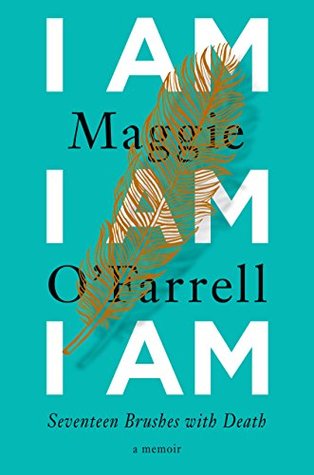
More on this book
Community


Kindle Notes & Highlights

Read between
January 9 - January 12, 2022

your veins, like an antibody. You learn fairly quickly to recognise the approach of these sudden acts against you: that particular pitch or vibration in the atmosphere. You develop antennae for violence and, in turn, you devise a repertoire of means to divert it.
I don’t know why he spared me but not her. Did she panic? Did she try to run? Did she scream? Did she make the mistake of alerting him to the monster he was?
Death brushed past me on that path, so close that I could feel its touch, but it seized that other girl and thrust her under.
We are, all of us, wandering about in a state of oblivion, borrowing our time, seizing our days, escaping our fates, slipping through loopholes, unaware of when the axe may fall. As Thomas Hardy writes of Tess Durbeyfield,
If you are aware of these moments, they will alter you. You can try to forget them, to turn away from them, to shrug them off, but they will have infiltrated you, whether you like it or not. They will take up residence inside you and become part of who you are, like a heart stent or a pin that holds together a broken bone.
That my guardian angel, glancing down from her cloud and seeing me cycle to my exams, perceived what might happen and let slip a celestial spanner that well and truly jammed my works.
That the things in life which don’t go to plan are usually more important, more formative, in the long run, than the things that do. You need to expect the unexpected, to embrace it. The best way, I am about to discover, is not always the easy way.
The people who teach us something retain a particularly vivid place in our memories. I’d been a parent for about ten minutes when I met the man, but he taught me, with a small gesture, one of the most important things about the job: kindness, intuition, touch, and that sometimes you don’t even need words.
Karen Blixen wrote, in her Seven Gothic Tales, “I know a cure for everything: salt water…in one way or the other. Sweat, or tears, or the salt sea.”
When Alice’s Adventures in Wonderland was read to me and Alice sighs, “Oh, how I long to run away from normal days! I want to run wild with my imagination,” I remember rising up from my pillow and thinking, yes, yes, that’s it exactly.
After he had sailed around the Mediterranean in 1869, Mark Twain said that travel was “fatal to prejudice, bigotry, and narrow-mindedness.” Neuroscientists have been trying for years to pin down what it is about travel that alters us, how it effects mental change. Neural pathways become ingrained, automatic, if they operate only by habit. They are highly attuned to alterations, to novelty. New sights, sounds, languages, tastes, smells stimulate different
synapses in the brain, different message routes, different webs of connection, increasing our neuroplasticity. Our brains have evolved to notice differences in our environment: it’s how we’re alerted to predators, to potential danger. To be sensitive to change, then, is to ensure survival.
“Foreign experiences increase both cognitive flexibility and depth and integrativeness of thought, the ability to make deep connections between disparate forms.”*
