
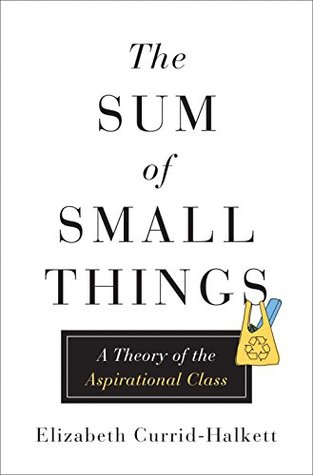
More on this book
Community


Kindle Notes & Highlights


A hand-wrought silver spoon, of a commercial value of some ten to twenty dollars, is not ordinarily more serviceable—in the first sense of the word—than a machine-made spoon of the same material. It may not even be more serviceable … One of the chief uses, if not the chief use, of the costlier spoon is ignored; the hand-wrought spoon gratifies our taste, our sense of the beautiful … the material of the hand-wrought spoon is some one hundred times more valuable than the baser metal, without very greatly excelling the latter in intrinsic beauty of grain or color, and without being in any
...more
Often the things we acquire and how we use them demonstrate this status to the world. There are obvious big-ticket items—large homes in the right zip codes, sports cars, fine china, and expensive watches. Yet, even manners convey a certain upbringing or way of life—sending handwritten notes rather than email, the way we place our utensils upon finishing a meal, having fresh flowers delivered to our beloved and so forth. Almost all of these behaviors suggest social position and rely on the use of visible goods and the skills for how to employ them in a particular way. Or, as Douglas observed in
...more
As H. L. Mencken rejoined, “Do I enjoy a decent bath because I know that John Smith cannot afford one—or because I delight in being clean? Do I admire Beethoven’s Fifth Symphony because it is incomprehensible to Congressmen and Methodists—or because I genuinely love music? Do I prefer kissing a pretty girl to a charwoman because even a janitor can kiss a charwoman—or because the pretty girl looks better, smells better and kisses better?”7
Veblen also snidely observed the use of gratuitous canes (which implied a man did not need to use his hands for labor) and corsets which, as they were so constraining, meant a woman could not possibly work.
Ironically, the demonstration of high social position (through consumption, leisure, and nonpecuniary practices) often manifested itself through the uselessness of objects and activity. Veblen also observed the phenomenon of “conspicuous leisure”—reading classics at Oxford, traveling abroad, participating in sports and doing nonfunctional things with one’s time, and “conspicuous waste”—gratuitous service workers or help around the house. The ability to use time for something with no obvious productive purpose was an option only for the upper classes. The lack of one’s own utility or the
...more
imitation in the aspirational sense—lesser quality versions of the elite’s goods intended to communicate status.
because so many people could afford luxury expenditures, such goods were no longer a mark of distinction. In fact, the display of wealth was deemed “passé” to a point that conspicuous consumption was no longer associated with the very wealthy, but rather with everyone else.
absence of an American aristocracy meant that possessors of money—“sheer, naked, vulgar”—were given entrance everywhere, thus forcing the truly elite to find more implicit marks of status than wealth and consumption habits.
Sure, the fake Prada handbags would, at times, fool even the most discerning eye, but real luxury—the actual luxury handbags, Lauren golf shirts, and Armani dresses—was still out of reach of the masses, both in terms of cost and exclusiveness. Their status rested on the aggressive logos emblazoned across the item, the bigger the better. You knew it was a Prada handbag because the shiny black and silver triangle placed overtly on every bag said it was so. The luxury logo was the leitmotif for the era’s over-the-top glamour, the rise of Wall Street money, and nouveau riche.
a number of brands established what are called “diffusion lines”—that is, authentic clothing and accessories produced by the fashion house at a much lower and affordable price point. The most prominent of these brands emerged in a flurry—Armani’s Armani Exchange (A/X) (1991), Ralph Lauren’s Polo (1993), and Marc by Marc Jacobs (2001). While linens and housewares were also being produced by diffusion lines (Laura Ashley, Ralph Lauren), clothing was particularly pivotal in this transformation and democratization of conspicuous consumption.
Globalization, mass marketing, mass production, and knockoffs have created a conspicuous consumption profile for many more people. This deluge of material goods would suggest that the barriers to entry into upper-class conspicuous consumption have been all but eradicated. The “stuff” once associated with a wealthy lifestyle—cars, multiple handbags, closets full of clothes—is seemingly accessible to mainstream society. At first blush, conspicuous consumption has been democratized.
upper class now maintains its exclusivity by attaining limited edition versions of goods. Whether artisanal cheeses or limited vintages of wine or Ferraris—regardless of the price point—the item in question accrues status by virtue of simply being scarce rather than merely expensive.
The disappearance of a wealthy, idle aristocracy and the rise of an educated, self-made elite (what some call a meritocratic elite) means that “leisure” is no longer synonymous with our upper classes. But there is a cost to this more egalitarian version of status.
the top socioeconomic groups have less time, not more, and these two variables, work and leisure, have a “reciprocal relationship”—time is influenced by production and the work required for these new forms of highly valued production. Today abundance of leisure no longer indicates higher status.32
In the mid-twentieth century, social and economic mobility was significantly tied to individuals’ loyalty to their institutions. During this era, institutional loyalty (e.g., working 40 years for Ford Motor Company or General Electric) was associated with ongoing promotion, raises, and the compensation to support a middle-class consumer lifestyle. People were valued, not for their Ivy League degree or desirability by competitors, but rather for their steady devotion to the institutions for which they worked and which supported them—the military, the government, companies, and unions.
The collapse of the manufacturing economy changed the currency of social and economic mobility quite considerably. Deindustrialization of Western economies (particularly within the United States and Great Britain) is largely explained by three key forces: oversaturation of the market (there are only so many dishwashers a household can buy), technology and automation (machines are low-cost and faster than people when it comes to factory lines), and globalization (labor costs are cheaper elsewhere and technologies in transport along with computers make it possible to outsource production to
...more
These jobs were well-paid but relatively unskilled, thus many members of America’s middle class achieved prosperity, material comfort, and economic and social security without birthright, and, antithetical to the current formula for upward mobility, without a college degree. The hemorrhaging of these factory jobs to developing countries and the closing up of factory shops meant that this stable middle class had lost its means for survival. Deindustrialization brought erosion to major urban centers (where many factories were located) and joblessness throughout huge swaths of the country.
The global economy had moved from producing widgets to producing ideas—those who were responsible for generating those ideas, what Robert Reich has called “symbolic analysts”37 or Richard Florida has termed the “creative class”—are the winners in the new economy.
They are not plutocrats or necessarily on top of the economic pyramid. Many who have acquired education and prize knowledge are indeed affluent labor market elites, but plenty are not. For this new class of people, knowledge is prized independently of its economic function. For bankers, lawyers, or engineers in this group, their education and specialized knowledge have enabled them to attain upward mobility in the world economy. But in general, those who have obtained knowledge—those with creative writing degrees from Yale, screenwriters who have yet to sell a screenplay, musicians and Teach
...more
This highlight has been truncated due to consecutive passage length restrictions.
Rich oligarchs and the middle class both can acquire “stuff,” but, for the aspirational class, it is members’ eagerness to acquire knowledge and to use this information to form socially and environmentally conscious values that sets them apart from everyone else—which is why a $2 heirloom tomato purchased from a farmer’s market is so symbolically weighty of aspirational class consumption and a white Range Rover is not.
There are wealthy aspirational class members—perhaps a partner in a law firm—who are amply spending on nannies, Ivy League tuition, and organic strawberries. Others within this group, such as an unemployed screenwriter or Rhode Island School of Design (RISD) trained artist, are barely able to economically participate in this world but use their insubstantial means to signify membership. The screenwriter too reads the New York Times and (perhaps irrationally and to his own economic detriment) also buys his organic strawberries at Whole Foods. He carries a canvas tote that displays a political
...more
In short, this new cultural and social formation is elite by virtue of the material and symbolic trappings required to be a member, but ultimately those who are members of this new cultural and social formation aspire to be their version of better humans in all aspects of their lives, with their economic position taking a back seat.
Aspirational class leisure, whether reading the Economist, listening to NPR, or taking a yoga class, is imbued with knowledge and productivity in the same spirit as work. Motherhood practices of the aspirational class suggest not simply money but extensive research into the perfect way to feed, console, and educate the under-three set.
Inconspicuous consumption also describes the aspirational class’s appropriation of certain behaviors and goods that don’t cost a lot and are not ostentatious but are becoming equally crucial to signaling social position. The choices to practice yoga, take kids to hockey rather than soccer, drink almond milk instead of regular milk, and reuse grocery bags every week are all signifiers of position that are not inherently more expensive than their alternatives but thought to be more informed. By turn, these behaviors become markers of status.
It is from our disposition to admire, and consequently to imitate, the rich and the great, that they are enabled to set, or to lead what is called the fashion. Their dress is the fashionable dress; the language of their conversation, the fashionable style; their air and deportment, the fashionable behaviour. Even their vices and follies are fashionable. —Adam Smith
from hunter and gatherer societies to the present day, most human beings have a desire to fit in and we often rely on social constructs to do so.
Material goods define who we are and where we stand in the social order.
In his 1957 book, The Hidden Persuaders, Vance Packard argued that the rush of consumer goods meant advertisers, marketers, and promoters needed to create consumer desire, perpetuating a cycle of materialism.2 Galbraith found this cycle disconcerting because as society became more absorbed by materialism, the superficial differences between the rich and the rest seemed much less distinct. The ostensible democratization of consumerism obfuscated inequality and essentially lulled society into thinking everyone had a slice of the pie and would mask real issues of wealth disparity.
First, the rich and upper middle class—that is, those in the top 1% and those in the top 5% and 10% income brackets—spend less as a percentage of their expenditures on conspicuous consumption relative to what the US average spends on the same goods, while the middle class—the 40th–60th percentiles—spends more. Second, as a share of their expenditures, the middle class is spending more on conspicuous consumption relative to their income while the wealthy (and the very poor) are spending less. Third, conspicuous consumption among the rich has been replaced by “inconspicuous consumption”—spending
...more
The conventional items of conspicuous consumption have become part and parcel of many Americans’ lives, and so the rich now disproportionately spend on fancy watches and jewelry and boats—luxury items with tremendous price tags that are impossible for the average American to afford. These are the new status items for the rich.
low-income families consistently rank as the highest spenders on funerals relative to their total expenditures, while the rich spend less than the national average on them for most of the years studied.
In comparison to the rich, who host and attend museum galas, charity events, and endless dinner parties, the poor are relatively limited in their avenues to engage in conspicuous consumption.
“For working class families the death, especially of a child or a breadwinner, traditionally has immense impacts. Also, poorer communities often have very high levels of social capital, and are reliant on that social capital for their survival. Most families spend considerable amounts of money on the performative aspects of the funeral—a necessary expense to show respect—as well as on the community aspect of the funeral—[for example] the Irish wake.” Sloane continued, “In addition, wealthier families … have a different attitude towards death, the dead, and funerals…. many keep it very private,
...more
blacks and Hispanics spend more of their income on conspicuous consumption than whites within the same income and education groups. Charles speculates that this finding is a result of discrimination: These minority groups are under greater pressure to visibly display their social position than whites or Asians. By demonstrating that they own a nice car, dress well, and so forth, they are able to signal their class. For minority groups with a history of being discriminated against, conspicuous consumption becomes a means through which they can efficiently demonstrate their social and economic
...more
