
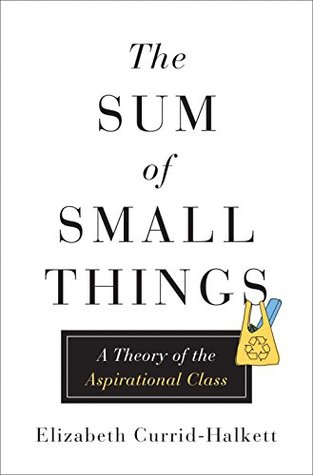
More on this book
Community


Kindle Notes & Highlights


Everything we do has social meaning. Our childhood, family life, income bracket, and concurrent social circles teach us how to go about our lives and interact with the world in big and small ways. Through both behaviors and material goods, we disclose our socioeconomic position, whether we like it or not.
Yet, even manners convey a certain upbringing or way of life—sending handwritten notes rather than email, the way we place our utensils upon finishing a meal, having fresh flowers delivered to our beloved and so forth.
In each of these decisions, big and small, they strive to feel informed and legitimate in their belief that they have made the right and reasonable decision based on facts (whether regarding the merit of organic food, breast-feeding, or electric cars). In short, unlike Veblen’s leisure class or David Brooks’s “bobos,”
Barthes argued that through the dominant values upheld by society we create “myths” around particular practices and consumer goods, which become “signifiers” of particular messages or dominant belief systems.
“Let’s say a baby feeds seven times a day and then a couple more times at night. That’s nine times for about a half hour each, which adds up to more than half of a working day, every day, for at least six months. This is why, when people say that breast-feeding is ‘free,’ I want to hit them with a two-by-four. It’s only free if a woman’s time is worth nothing.”
aspirational class parents see their children as developmental projects and initiate structured and cultivated modes of parenting to maximize their children’s future success. As Lareau notes in her book, these choices in parenting
They are so accustomed to being overproductive in their work lives that it carries over into their leisure time, including their intense and active focus on childrearing.
“sweating on purpose is becoming an elite phenomenon…. Where once ‘prosperous’ was a synonym for overweight, being fit (and thin with it) is a marker of status.”57 Or as the sociologist Harvey Molotch remarked, “Leisure once meant utter whiteness and lack of muscle tone. Now you need some affluence to have muscle tone.
Aspirational class productivity in leisure spills over into all facets of life. Some members are never able to just relax. Even watching television—Mad Men, Breaking Bad, Game of Thrones, or HBO’s latest epic—is about being a part of the cultural zeitgeist.
“What we all feel now is the constant pressure to know enough, at all times, lest we be revealed as culturally illiterate. So that we can survive an elevator pitch, a business meeting, a visit to the office kitchenette, a cocktail party, so that we can post, tweet, chat, comment, text as if we have seen, read, watched, listened.” Karl Taro Greenfield writes in the New York Times,
In other words, part of modern conspicuous leisure is a cultural and moral superiority directed toward those who don’t participate in these behaviors and an assumption that this lack of participation is always a choice.
With conspicuous leisure, we assume that if someone isn’t doing something it’s a moral choice. We ignore the socioeconomic limitations (or the freedom, for the affluent members of the aspirational class) of how people make decisions. Why is that person overweight or another less culturally aware?
Those who participate in the voluntary simplicity movement tend to sacrifice money in exchange for leisure time or to seek out nonmaterialistic and environmentally conscious forms of consumerism.
