
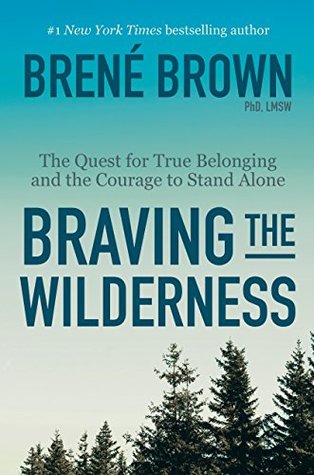
More on this book
Community


Kindle Notes & Highlights

by
Brené Brown
Read between
October 18 - October 26, 2020

You are only free when you realize you belong no place—you belong every place—no place at all. The price is high. The reward is great.
it became clear that it’s not something we achieve or accomplish with others; it’s something we carry in our heart. Once we belong thoroughly to ourselves and believe thoroughly in ourselves, true belonging is ours.
Belonging to ourselves means being called to stand alone—to brave the wilderness of uncertainty, vulnerability, and criticism.
The sorting we do to ourselves and to one another is, at best, unintentional and reflexive. At worst, it is stereotyping that dehumanizes. The paradox is that we all love the ready-made filing system, so handy when we want to quickly characterize people, but we resent it when we’re the ones getting filed away.
When we hear people referred to as animals or aliens, we should immediately wonder, “Is this an attempt to reduce someone’s humanity so we can get away with hurting them or denying them basic human rights?”
We don’t even bother being curious anymore because somewhere, someone on “our side” has a position. In a fitting-in culture—at home, at work, or in our larger community—curiosity is seen as weakness and asking questions equates to antagonism rather than being valued as learning.
We are complex beings who wake up every day and fight against being labeled and diminished with stereotypes and characterizations that don’t reflect our fullness. Yet when we don’t risk standing on our own and speaking out, when the options laid before us force us into the very categories we resist, we perpetuate our own disconnection and loneliness. When we are willing to risk venturing into the wilderness, and even becoming our own wilderness, we feel the deepest connection to our true self and to what matters the most.
I’ve also learned that the more we diminish our own pain, or rank it compared to what others have survived, the less empathic we are to everyone. That when we surrender our own joy to make those in pain feel less alone or to make ourselves feel less guilty or seem more committed, we deplete ourselves of what it takes to feel fully alive and fueled by purpose.
when we can’t acknowledge the pain of others while experiencing our own joy, we close our eyes, insulate ourselves, pretend that there’s nothing we can do to make things better, and opt out of helping others. This ability to opt out of suffering and injustice or pretend everything is okay is the core of privilege: Today I choose not to acknowledge what’s happening around me because it’s too hard. The goal is to get to the place where we can think, I am aware of what’s happening, the part I play, and how I can make it better, and that doesn’t mean I have to deny the joy in my life.
True belonging doesn’t require you to change who you are; it requires you to be who you are.
Stop walking through the world looking for confirmation that you don’t belong. You will always find it because you’ve made that your mission. Stop scouring people’s faces for evidence that you’re not enough. You will always find it because you’ve made that your goal. True belonging and self-worth are not goods; we don’t negotiate their value with the world. The truth about who we are lives in our hearts. Our call to courage is to protect our wild heart against constant evaluation, especially our own. No one belongs here more than you.
