
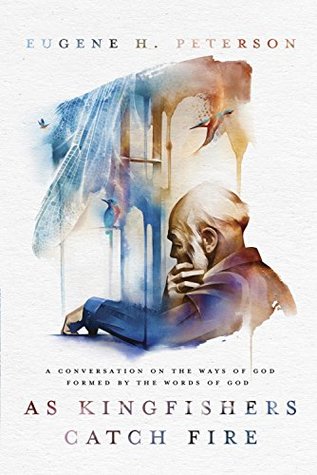
More on this book
Community


Kindle Notes & Highlights

Read between
July 6, 2017 - January 2, 2018

For those of us who are up to our necks in manure, which is to say, up to our necks in forgiveness, it is perhaps important to note that the forgiveness Jesus prayed for us is not preceded by any confession or acknowledgment of wrongdoing by the crucifixion crowd—or by any of us since. Preemptive forgiveness. Jesus prays that we be forgiven before any of us have any idea we even need it, “for they know not what they do” (Luke 23:34). No preconditions. Amazing grace.
No one is excluded; everyone is included. If you have any experience of being treated as unimportant or insignificant because you are a woman or a foreigner or a child or sick or handicapped or a newcomer or poor or a criminal or a failure or too young or too old, you don’t have to read very far in these books before you find that you are in on the action. You are named, you are loved, you are called, you are saved—you are in. You are included in God’s story as lived by Jesus.
The cross of Jesus is not an unfortunate episode that we should try to sweep under the rug, the skeleton in the closet of the gospel. This is the place of arrival, the goal.
Preaching must be anchored in God, God’s revelation to us in the Scriptures.
I take it as a given that all gospel preaching comes out of familiarity with and submission to Scripture.
All his mental processes are subdued and submissive to what has been handed to him by revelation in Scripture. The words of the scriptural revelation
Paul’s relation to Scripture was not as a student boning up for an exam, finding out what was there, but as a disciple of Jesus living the text.
It is easy for preachers to think they have to explain everything. Paul is comfortable with mystery, delights in mystery, accepts mystery.
The mystery Paul embraces is not the mystery of darkness that must be dispelled but the mystery of light that may be entered.
Do we like things tidy and neat, without loose ends and devoid of ambiguity? Ivory-tower intellectuals and rubber-hits-the-road pragmatists like things organized and orderly. That is not the kind of language we find in Paul.
Theological study in the academy is useful and important, but the actual practice takes place in congregations. Theology comes alive in conversations and prayers, in worship and community.
The play is a parable about our lives and the absence of God. We are tramps baffled by the absence of God and disturbed that, if he does come, we will miss him. We are unsettled by the gaping emptiness of God’s absence. We are anxious and insecure about what might happen if he should appear. Whether he shows himself or not troubles us to the depths. The possibility that he will show himself further threatens us with anxiety and confusion. Both God’s presence and absence present difficulties in the deepest parts of our lives.
Paul is telling his congregation of Christians in Rome that seeing God is not first of all a matter of intelligence or sincerity or honesty or sensitivity but quite simply a matter of looking in the right place, namely, at Jesus Christ, who lived practically in their neighborhood, just fifteen hundred miles or so away as the crow flies.
“Christ crucified.” The more you think about it, although brief, it is not a reduction but a concentration, not a blurring of reality but a focusing, not a watering down but a distillation.
Sometimes I get tired of it all. There is too much pain, too much suffering, too many questions I can’t answer, too much sin, too much misunderstanding. I want out. I want to live with less intensity. I fantasize about life as a gossip columnist so I won’t have to take anybody seriously or personally. I know enough of the seamy underside of people’s lives that I could probably make a pretty good living retailing to the nation what I know.
Christ was crucified. Nobody wants to start here. And especially we who come to church. We want to start with a big idea: God is love; there is purpose to life. Or a grand vision or a terrific proposal: “Let’s get America back to God.” Or a rousing challenge: “Be all that you are meant to be.” Or a shattering rebuke: “Repent or perish.”
Our society is cheapened by expectations of miracles: God as a supernatural shortcut so we don’t have to engage in the deeply dimensioned, endlessly difficult, soaringly glorious task of being a human living by faith.
But that is not how God wants us grounded. Not with miracles and signs—power without relationship, spectacular entertainment without relationship. And not with ideas and wisdom—knowledge without relationship, information without involvement. We preach Christ crucified.
Something actually happened. Not an idea we can ponder and study, not a power we can manipulate and put to use, but a fact. A historical, time-and-place fact. A person fact: Christ crucified.
We are not here because of a great idea or a set of answers that explain your life. We are here not to see some spectacular performance that will lift you out of a humdrum existence. We are here to receive Christ. We preach Christ crucified.
to tell the people that God is not angry or indifferent or impersonal, but that God loves us, and salvation is at the center of absolutely everything, and from that center all of life is freely lived.
We are preloved by God.
It is a matter of letting God do something for you: letting him love you, letting him save you, letting him bless you, letting him command you. Your part is to look and believe, to pray and obey.
Every Christian story needs sharing. We require a few other persons to whom we can tell our stories. Every story is different. But it is also the same, a kind of revelation, personal truth revealed.
There is no model conversion. There is no prescribed ritual, whether emotional or liturgical. We are all different. God is the same and has the same salvation to work in us, but he creates an original story every time.
Literalists, maybe especially religious literalists, have a difficult time with metaphors.
The sheer doggedness of growth is daunting, intriguing, delightful to contemplate.
So Paul doesn’t trust us to know exactly what he means by “grow up.” He makes sure he has “into Christ” in the sentence. Christ is what a mature adulthood looks like. Christ is what it means to grow up. If we don’t keep that in our minds, we are going to end up with something like a star athlete or popular movie star—not all bad, but not exactly what we were hoping for.
Christ defines our growth to true adulthood. The person of Jesus Christ, who lived thirty-three years on our planet, trains our imaginations in the meaning of mature adulthood. So we immerse ourselves in the Jesus story and find the shape of our lives defined by Jesus.
What I want to say is this: we don’t respond to what Paul is writing about—growing up into Christ—by focusing on our children or someone else’s children. It is I, it is you, that has to grow up.
There are a great many things we can do little or nothing about. The weather is out of our hands. Other people’s emotions are out of our hands. The economy is out of our hands. Mostly we have to live with what families or our bodies or our government hands to us. But there is one enormous difference that is in our hands: we can offer up the center of our lives to the great revealed action of God’s love for us. We can discover that each of us is an absolutely unique individual. We can cultivate the vitality and centering of life that develops out of risking our lives in a relationship with God.
I want to be with people who take all of me seriously, not just my soul. I want to know that the nitty-gritty of my life is taken seriously by the gospel, not just the state of my soul. I don’t want a religion that consists of soupy verses on Hallmark cards. I don’t want a religion of neat little slogans about sunsets and heartthrobs. I want something practical that gets into the working parts of my life, into my wallet and pocketbook, and leaves evidence on my check stubs. And named persons who know my name. People I can serve and who will serve me when I am in need.
We don’t all get the same feelings out of it. We don’t all get the same ideas out of it. We don’t all develop the same lifestyle out of it. We don’t all arrive at the same standard of living. But we all get the same God who takes us seriously, forgives absolutely, and loves eternally, who supplies all our need.
The gospel doesn’t impose a way of life on us from without and tell us that we have to live up to it. It creates a new life within and then encourages and directs us to the living out of
If Jesus makes it into our daily behavior, observers will begin to think there might be something to this after all. And we ourselves are not going to be satisfied for long with just talking about ideas and truths that don’t filter into the ordinariness of our living.
Before we start talking about our behavior, we need to rehearse Christ’s behavior on our behalf.
in any discussion of Christian truth, the first word has to be about God and his work in us. If we fail to maintain that priority, everything gets hopelessly muddled.
is the place where Christ is seated, where redemption is the central concern, where love is in operation, where grace is dispensed freely. In other words, our aspirations are not directed to a generalized upward direction but specifically to Christ as he rules our lives.
The image put before us is the ruling Christ, that we should “aspire to the realm above, where Christ is” (NEB). If this ruling Christ is alive in our aspirations and dreams, we will do things we never dreamed of doing before. Christ will be in our imaginations, in our purposes, in our goals.
The Christ life is no cheap legalism, no grim custodian of the rules of God.
What a wise faith-friend Paul is to Philemon. He knows that goodness cannot be forced. He knows that virtue cannot be squeezed out of a person. He knows that no amount of pressure, either mental or physical or emotional, can increase or stimulate or develop the life of faith in Christ.
When I know what is good for someone, I want to make the person do it. After all, it is for his or her own good. I want to develop a strategy that ensures it will take place. But that is always a mistake. Paul’s way is the only way, “that your goodness might not be by compulsion but of your own free will.”
The Lord of language uses language not to lord it over anyone but to enter relationships of grace and love, creating community and bringing it to maturity in prayer—person-to-person conversations that include the praying presence of Jesus.
The Revelation has 404 verses. In those 404 verses there are 518 references to earlier scriptures. But there is not a single direct quote; all the references are allusions. Here is a pastor who is absolutely immersed in Scripture and submits himself to it.
Pastors can’t be too careful in the way we use language, this sacred language, this word-of-God language.
The language of Jesus tells me something quite different: I become less. Instead of grasping more tightly, I let go. “Blessed are the poor in spirit” is one way Jesus said it (Matthew 5:3). “Those who want to save their life will lose it, and those who lose their life for my sake will find it” is yet another way (Matthew 16:25, NRSV).
Because Jesus did it, I can do it: reject the me-first prayer, reject the self-serving prayer, refuse to use prayer as a way to avoid God.
The glory that Jesus has been revealing in word and deed all his life is not a celebrity glory: “The hour has come for the Son of man to be glorified” (John 12:23). Hour here means “time to die.” It is time for the Son of Man to die so the Son of Man may be glorified.
The glory with which Jesus is glorified is not inspirational.
Jesus is the dictionary in which we look up the meaning of words.
