
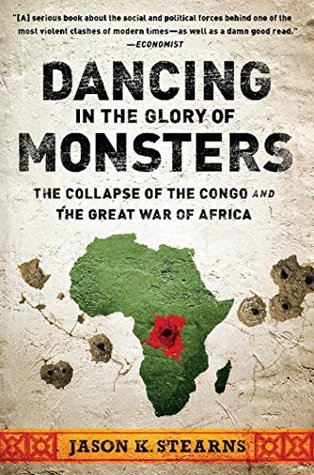
More on this book
Community


Kindle Notes & Highlights
Read between
January 20 - February 3, 2025

Since then, however, the Congo has been the victim of four hundred years of political disintegration.
The colonial authorities then handed over government to a Congolese people almost wholly unprepared to manage their vast state. There were a handful of lawyers and university graduates in the country; under Belgian rule, no African could become an enlisted officer in the army, and all important positions in administration were held by white foreigners. At the same time, Belgian business interests and cold war politics led to the external backing of military strongmen and the repression of nationalist mobilization.
This historical legacy weighs heavily on the present. Since independence, the story of political power from Joseph Mobutu to Joseph Kabila has been about staying in power, not about creating a strong, accountable state. This is understandable.
A central reason, therefore, for the lack of visionary leadership in the Congo is because its political system rewards ruthless behavior and marginalizes scrupulous leaders. It privileges loyalty over competence, wealth and power over moral character. Well-intentioned (albeit misguided) leaders like Wamba dia Wamba are spun to the outside of this centrifuge, while the more guileful ones stay at the center.
Spend some time in the Grand Hotel in Kinshasa, where politicians mingle and deals are struck, and you will realize that the welfare of the Congolese people is absent from their conversations, while court intrigues and battles for power are a matter of obsession.
This is not to say there is no ideology in the Congo. It is full of firebrand nationalists who are tired of the humiliation of being “the doormat of Central Africa, on which visiting armies clean their shoes,” as one friend griped. But the political system has failed to channel this ideology into responsible leadership. The only viable means of popular mobilization remains ethnicity, although even that has been...
This highlight has been truncated due to consecutive passage length restrictions.
No one factor has produced the kleptocratic, venal political elite.
Certainly social and educational issues also play a role. But it is clear that political elites react to incentives and that no
meaningful reform will result as long as these incentives are skewed against the creation of strong institutions. Buoyed by foreign support and revenues from copper, oil, and diamonds, the government feels little need...
This highlight has been truncated due to consecutive passage length restrictions.
Why empower nettlesome parliaments, courts, and auditing bodies if they will just tu...
This highlight has been truncated due to consecutive passage length restrictions.
But all development is deeply political.
But why should we help at all? First, because it is not just an act of joint humanity.
We owe it to the Congolese.

This resonates with Mbeki mostly
Most obviously because of the centuries of slavery, colonialism, and exploitation of rubber, copper, and diamonds, which benefited western companies and helped build Belgian cities. Those past injustices should be reason enough for feeling ...
This highlight has been truncated due to consecutive passage length restrictions.
Second, we should give Congolese an opportunity to decide on how to deal with their violent past. A key fallacy of international engagement has been the idea that justice is an impediment to peace in
It is precisely because many former warlords are still in power that diplomats have been wary of launching prosecutions.
At the time of this writing, in October 2010, the United Nations released a report summarizing the most egregious war crimes committed in the country between 1993 and 2003 and recommending that a special court be established.
This was most evident in dealing with Uganda and Rwanda. Throughout the conflict, donor aid made up for over half of the budget of Rwanda and over a third of that of Uganda. The largest providers were the European Commission, the United Kingdom, and the United States, governments that felt understandably guilty for not having come to Rwanda’s aid during the genocide.
When Rwanda reinvaded the Congo in August 1998, Washington and London protested but did not use their mighty diplomatic and financial leverage on Congo’s neighbors. “We did the right thing with Rwanda,” Sue Hogwood, a former UK ambassador to Rwanda, said. “We needed to help them rebuild after the genocide. We engaged and challenged them over human rights abuses, but they also had genuine security concerns.”
Rwanda did have security concerns. One of Kagame’s political advisors expressed a typical view to me: “When the United States was attacked on September 11, 2001, you decided to strike back against Afghanistan for harboring the people who carried out the attack. Many innocent civilians died as a result of U.S. military operations. Is that unfortunate? Of course. But how many Americans regret invading Afghanistan? Very few.”
This point of view does not allow for moral nuances.
Once we have established that the génocidaires are in the Congo, any means will justify the ends of getting rid of them, even if those means are not strictly related to getting rid of the génocidaires.
“The best way we can help is to stop feeding the killers who will then run away to look for other sustenance, leaving their hostages behind. If we do not, we will be trading the children in Tingi-Tingi against the children who will be killed and orphaned in Rwanda [by the killers when they return].”8 What he didn’t mention is that the only way to stop feeding the killers was to stop feeding the civilians as well.
The Congo war had no one cause, no clear conceptual essence that can be easily distilled in a couple of paragraphs. Like an ancient Greek epic, it is a mess of different narrative strands—some heroic,
some venal, all combined in a narrative that is not straightforward but layered, shifting, and incomplete. It is not a war of great mechanical precision but of ragged human edges.
The Congo’s suffering is intensely human; it has experienced trauma on a massive and prolonged scale, and the victims are our neighbors, our trading partners, our political confreres and rivals. They are not alien; they are not evil; they are not beyond our comprehension. The story of the Congo is dense and complicated. It demands that all involved think hard. This means diving into the nuts and bolts of Congolese politics and working to help the more legitimate and responsible leaders rise to the top. This means better, more aggressive, and smarter peacekeeping and conflict resolution; more
...more
We should not despair. If there is one thing I know after having worked on the Congo for a decade, it is the extreme resilience and energy of the Congolese people. As the eccentric singer Koffi Olomide sings, referring to his country, “This is hell’s system here. The fire is raging, and yet we don’t get burned.” With all of their hardships, one would imagine the Congolese to be less vibrant and more cynical. Yet they are not.
The ultimate fate of the country rests with the Congolese people themselves. Westerners also have a role to play, in part because of our historical debt to the country, in part because it is the right thing to do. This does not mean imposing a foreign vision on the country or simply sending food and money. It means understanding it and its politics and rhythms on their own terms, and then doing our part in providing an environment conducive to growth and stability.
