
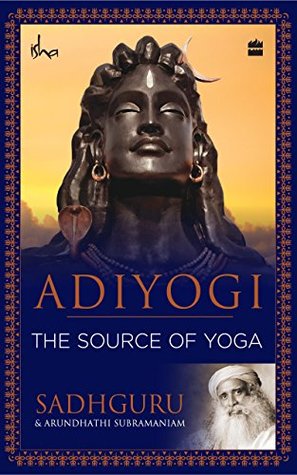
More on this book
Community


Kindle Notes & Highlights

Fundamentally, the basis of yoga is just this: to initiate a process of self-creation where the nature of your body, your emotion, your mind, your energy is consciously created by you. This is what Adiyogi did. He crafted his life in its entirety.
The goal of yogic practice is to light up all the 114 chakras. This transforms one into Chakreshwara, Lord of the Chakras. This can render a human being into proportions that are cosmic, enabling one to transform the inanimate into the animate, empowering one to create and manifest new lives and forms.
The ‘three cities’ continue to wreak havoc in human life. They seem deceptively lifelike, but are essentially unreal for they are not rooted on this planet. They are products of the human mind – ephemeral psychological realms. They are not the consequence of Prakriti, nature, but of maya, the human mind lost in its own hypnosis. The result is an endless cycle of pride, rage and avarice. Try as one might to destroy them, these flying realms are elusive; they take wing and escape from our grasp.
As you walk the path of yoga, pride, fury and greed gradually align themselves in a single direction. Pride arises out of a mistaken sense of significance of the self. When this self-importance is threatened, fury is the result, while greed is the fuel that fosters that self-importance. The three are, therefore, inseparable. Once these scattered energies are aligned, the guru shoots them down with a single arrow. The aspirant is then free of a life of psychological oscillation and fracture.
Adiyogi’s third eye is a potent symbol for ultimate spiritual perception. Two eyes can see only the duality of life; they cannot see the beyond. But when one begins to perceive that which lies beyond the physical world, the third eye is metaphorically said to have opened.
Devotion essentially means receptivity, a trait associated with the feminine dimension. You could be a man, but if you do not know the feminine within you, you will never experience authentic devotion.
If such a person envisions a certain form, that form just comes alive for him. This is not imagination. This is creation. If you can invest your very life energies into the process of imagination, it will become creation.
There are certain yogic practices that entail purifying and mastering the five elements in the human system. With advanced practice, one can attain bhuta siddhi – complete mastery over the elements. Such practitioners can live well beyond the normal span of human life.
This accounts for innumerable stories in the yogic lore of adepts who have lived for extraordinary lengths of time.

Study topic
Yogis do not aspire to worship god. Instead, they seek to embody the sacred themselves. They do not seek to adore the divine. They aspire instead to dissolve, to become one with divinity. The yogic culture is not god-oriented – and this is what makes it an invaluable contribution to a world ravaged by wildly conflicting definitions of the divine.
Adiyogi’s legacy offers you the licence to believe in the god of your choice, or not to believe at all. And if you do not find a god to your taste, it allows you the freedom to create one. That is how the Indian subcontinent arrived at an exuberant 330 million gods and goddesses at last count! To see the divine in a tree, rock or elephant is not considered absurd because every speck of creation is seen as a portal to the ultimate reality. These gods were not mere imaginary toys. Instead, this culture evolved a science of consecration, an entire technology of god-making. These deities are
...more
‘This is not the way to find fulfilment. Whether you have one child or a thousand, you are still not going to find the answer. Do not waste your life like this. Do not be led by the instincts of your sex and biology – that only offers a limited possibility. There is another way to fulfilment.’
If you have to make somebody a part of you, you must be willing to rip out a part of yourself. And this is what Adiyogi did. He tore out a part of himself and made his consort a part of him forever. Hence the iconic depiction of Adiyogi as Ardhanareeshwara – half-man and half-woman.
If you open up the self as a creature, all you see are anatomical parts. This is biology. If you open this body up as creation, however, you witness the entire cosmos. This is yoga.
Human beings can become whatever they want. Nature has given them this freedom. This means that from the moment of creation, human beings cannot evolve unconsciously. If they want to evolve, they have to evolve consciously.
‘But why?’ the sages persisted. ‘Why must this game from purposelessness to purpose to purposelessness be played out? What is the point of it all?’ Adiyogi laughed. Purpose is the need of the mind, he asserted.
A mind that has been castrated and domesticated, he implied, cannot see the point of a rampaging bull elephant, for it has lost the innate understanding of the wild where life is beautiful and purposeless all at once.
Life has no use at all, declared Adiyogi. It is simply a phenomenon. Little acts have purpose. But life is not framed within the narrow grid of utility. It is beyond frames. It is beyond grids. It is beyond utility. If you have a taste of this existence beyond purpose, of life beyond sense, you are enlightened.
A seeker, said Adiyogi, must, above all, be unwavering. He was the first to declare that if one stayed long enough with any emotion, liberation was inevitable. ‘Even if it is anger, just stay with it – you will get there. If it is love, stay with it – you will get there. The wise will choose pleasant emotions; that is always a more intelligent choice. But it does not matter. As long as you keep unwaveringly in any state, you will reach your destination.’
An advanced practitioner of yoga, however, seeks not merely to cleanse the elements but to master them. This mastery, known as bhuta siddhi, enables the yogi to integrate and dismantle the body at will. Many great yogis, referred to as nirmanakayas, have demonstrated this ability down the ages.
This is how many methods of yoga have been transmitted. The practitioner is not required to believe in it, or even know how it works. If one simply learns to use it, it is effective.
‘The basic principle is that the very things that can be your downfall in life can be used to raise yourself. If you simply change your perspective, what is down can be up.
‘What is good and bad, what is sacred and filthy, once you divide this in your mind, your existence is divided. Once you divide existence there is no possibility of freedom, of transcendence for you.
‘That’s what I did. Wanting to know life, I stared till my eyeballs popped at just about everything. The more attention I paid, the more complex it got. It is only when I closed my eyes for long periods of time that the universe yielded and blossomed within me.
Love is a pleasant way to be; that’s fine. But most people are trying to fulfil a certain sense of incompleteness by trapping someone in some emotion.
‘Right now, I’m telling you it’s a complete life, but you have not realized how complete it is. You’re living on the surface and you’ve decided it’s incomplete. So you start a whole circus and try to glorify and sanctify that circus. All because you’re unwilling to make the necessary effort to go deeper into yourself.’
