
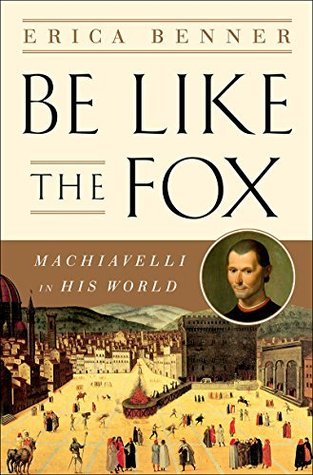
More on this book


Kindle Notes & Highlights


In the winter of 1538, an Englishman living in Italy travelled to Florence.1 Cardinal Reginald Pole was a devout adherent of the Church of Rome at a time when the English Reformation threatened to tear the Church apart. He had fled into self-imposed exile from his native shores after opposing King Henry VIII’s divorce from Catherine of Aragon, and settled in Italy.
In short, Pole declared, the book Cromwell so admired is full of ‘things that stink of Satan’s every wickedness’. Its author is clearly ‘an enemy of the human race’. The book that so appalled Cardinal Pole was the Prince, and the name of its author Niccolò Machiavelli.
Machiavelli gives readers an unforgettable image of how far princes will go to hold on to power – showing that the writer’s true intention in the Prince was to expose the perversities of princely rule.6 His purpose was to warn people who live in free republics about the risks they face if they entrust their welfare to one man.
Machiavellian. Know your own limits. Don’t try to win every battle. Treat other people with respect so you can get them on your side and keep them there; observe justice with enemies as well as friends; always uphold the rule of law. These are a few of Machiavelli’s less notorious but more closely argued maxims.
eye-catching maxims like ‘It’s better to be feared than loved.’
If we read all his works – which include political and military writings, histories, personal letters, diplomatic dispatches, poems, and plays – the main voice that comes through, with remarkable consistency, is quite unlike any of the Machiavellian ones we’ve come to expect.
Machiavelli loved a good conversation, and he could talk to anybody: his letters recount exchanges with friends and enemies, with millers and blacksmiths at his local tavern, and with the great male and female princes of his day.
The questions Machiavelli asks, and the answers he gives, are often surprising. When we listen to his own voice, instead of trusting too much in his ‘Machiavellian’ reputation, we begin to see a strong character, irrepressibly friendly yet often at odds with his fellow citizens, with a steely determination to change the corrupt world he lived in – and a belief that any individual, however weak or downtrodden, could do their bit to change things for the better. Throughout his life, he urged people to see themselves as free agents who could always hope to influence the course of events. ‘Never
give up’ is a characteristic piece of Machiavelli’s – though not textbook Machiavellian – advice.
The sickness spreads rapidly through the city, into military camps. No one knows its causes, or how to cure it. Folk wisdom links it to solar eclipses or phases of the moon. Some of the rich believe it is spread by vile practices found among the poor.5 When God strikes them down in their filth, He is sure, they hope, to spare the honest, industrious classes. Italy is full of doctors who understand other diseases, and apothecaries whose shops produce an astonishing array of medications, some more efficacious than others. But plague seems to mock all their scientific wisdom, both ancient and
...more
animosity, muffled only by the heroic labours of their diplomats, King Louis XII and Pope Julius II are preparing for what both sides now see as an inevitable clash of armies.
So he goes back to the earlier Church, to earlier crusades and pontiffs long dead. Nearly five hundred years ago, Niccolò writes in his histories, Pope Urban II found himself hated by the Roman people, and realized that Italy’s disunities made him insecure.22 Hoping to save his own skin and preserve the Church’s precarious rule in Rome, Urban made an inflammatory speech against the infidels, which for a while distracted people from their much worse troubles at home. These are some of the coolest deadpan tones found in any of Machiavelli’s works; he is now a true doctor of deadpan.
Like so many of its precursors, Pope Leo’s crusading plan fizzles out, leaving the Turks stronger than ever and Christendom’s internal rifts ever deeper. Then, in December 1521, news reaches Florence that sends the city into a ferment of uncertainty. At the age of forty-six, Leo has died of malaria.
have the lamentable duty of informing you that our father, Niccolò, died on the 22nd of this month, from pains in the belly caused by some medicine that he took on the 20th. He allowed Brother Matteo, who kept him company until his death, to hear the confession of his sins. Our father left us in the deepest poverty, as you know.
