
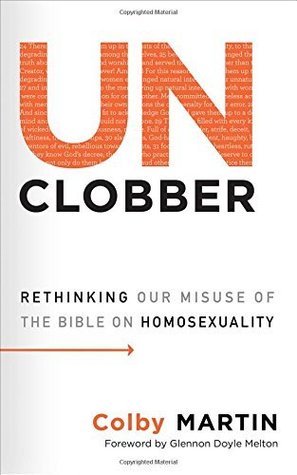
More on this book
Community


Kindle Notes & Highlights

by
Colby Martin
Read between
January 11 - January 15, 2021

The most repeated phrase in the Bible is “fear not.” And so, when we feel that something we are hearing doesn’t resonate with the God of love, we must raise our hands.
There are approximately six verses (out of 31,000) in Scripture that appear to reference same-sex sex acts, and our gay brothers and sisters have long felt the brunt of these six verses as the Christian church has historically used them to deny the LGBTQ community a seat at the Table of God, as full recipients of grace, and as full participants in the body of Christ.
the Bible you have held dear for so long has been leveraged to condemn an entire segment of the population based on the misuse of half a dozen poorly translated and poorly understood Bible verses.
If I can’t genuinely live into what I believe to be true, or if I’m forced to keep parts of myself hidden, or if I have to act one way even though my heart believes another, then basic fruits of the Spirit, such as joy, peace, and goodness, feel unreachable.
The church has been wrong before; let us not be so naive as to think it can’t happen again.
I believe that someone who identifies as LGBTQ can be just as much a fully committed follower of Jesus as you or I can. And I believe their love and commitment to God can be just as true as mine. And I believe that God’s posture toward them is the same as toward me: a loving parent toward a child.
The Law was designed to move people toward love of God, self, and neighbor. Therefore, any attempt to understand the laws today (and understand how we might attempt to apply them today, if at all), must be done within the context of moving people toward love.
An experience within the context of a relationship forced the early church to hold two truths together that seemed to be in conflict. Gentile people (seen as sinners and unclean) were professing allegiance to Jesus as Lord, and as a result were showing the fruit of God’s Spirit in their lives. This is the tension that many people have when loved ones in their lives identify as LGBTQ and are also card-carrying, Spirit-filled, fruit-producing followers of Jesus. The tension forces them to consider that maybe they have misused the Bible to condemn an entire people-group, denying them access to
...more
“There is no excusing you when you throw around judgments like that discourse I just recited, because when you judge the Gentiles you are condemning yourself!”
These concepts — a person’s sexual orientation, and egalitarian same-sex relationships — simply did not exist in the ancient world. So you would be hard-pressed to argue that this self-contained discourse in Romans 1:18–32 speaks against homosexuality as an orientation, same-sex sex acts engaged within the context of mutuality and love, or marriage between two people of the same sex.
The thread of what constitutes kata/para phusis is consistent: sexual intercourse between a man and woman is “according to nature” if, and only if, it is procreative. It wasn’t about the morality of the act.
Romans 1:26 has traditionally been seen as the Bible’s solitary place of condemnation against lesbianism. But this is neither what the text says nor how the early church understood Paul’s words.
Leader: Be brave All: Because you are a child of God Leader: And be kind All: Because so is everyone else
God is calling all of us — gay, straight, bisexual, transgender, queer — out of places of guilt and shame, and into a place of wholehearted, integrated living where we are rooted in God’s love for us, and committed to loving ourselves and our neighbor even when it comes to our sexual activities.
No matter who you are, or what journey you are on, know this: you are a loved and fully accepted child of God.
