
More on this book
Community


Kindle Notes & Highlights
by
Colby Martin
Read between
October 25 - November 3, 2021

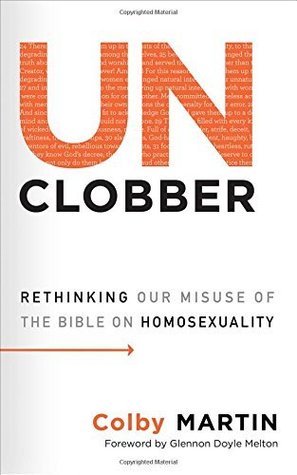
UnClobber is my attempt to say, in one word, that I do not believe that God stands opposed to those who are attracted to the same sex, or that God withholds divine blessing from a same-sex relationship. UnClobber came out of my desire to reverse the damage of the so-called “Clobber Passages.”
There are approximately six verses (out of 31,000) in Scripture that appear to reference same-sex sex acts, and our gay brothers and sisters have long felt the brunt of these six verses as the Christian church has historically used them to deny the LGBTQ community a seat at the Table of God, as full recipients of grace, and as full participants in the body of Christ.
I’m writing this book because when you know better, you do better. And I think the six passages in the Bible that have traditionally been used to reject an entire subset of our population have not been interpreted well, and therefore, have not been used well. I think it is time we rethink our misuse of the Bible on homosexuality.
The church has been wrong before; let us not be so naive as to think it can’t happen again.
God, I do not want my future self to be ashamed of my present self. I do not want to remain silent and do nothing about discrimination toward the LGBTQ community. As the world continues changing and we look back on these times 50 years from now and wonder how we could have gotten this issue so wrong, I do not want to have been one of the fear-filled silent ones.
I wonder how many other well-intentioned Christians haven’t looked at Genesis 19 in a while, leaving them with nothing more than a vague sense of, “That’s the story about God destroying cities because of homosexuality, right?” Wrong.
And yet, when understood properly, the entire point of Genesis 19 is that the people of God are called to be people who receive the outcast and the outsiders, not create them.
The only me that I knew was “pastor.” And yet, what if my position on homosexuality would deem me unfit to be one any longer? Who would I be if I weren’t a pastor?

I am not a pastor, but I have similar thoughts lately, as my differences with some of the theology of my denomination have become more difficult to ignore. As I consider leaving a church I have belonged to for 3 decades, I wonder…if I am not a Seventh-day Adventist, who am I?
When we take into account the way toevah was used in ancient Israel, then I can’t imagine a scenario where it makes sense to apply these laws to us today. Especially if we consider how Jesus redefined what it means to be in relationship with God. The Hebrew people, as part of the family of God, were given the Law as a way to live out their calling. Under the teachings, life, death, and resurrection of Jesus, however, we have been given a new way to live out our calling: faith. And we have been given a new way to understand the purpose and fulfillment of the entirety of the Law: Love God and
...more
Allow me to say that again: if you were a Jewish Christian in Rome, and you agreed in any way with the Jewish prejudices and erroneous beliefs about the plight of the Gentiles (as articulated in places like the Wisdom of Solomon, and now reiterated here in Romans 1:18–32), then Paul is calling you out as being the source of the problem.
In summary, the self-contained discourse that Paul utilized in Romans 1:18–32 was representative of the typical posture of Jews toward Gentiles. Paul argued that this sort of posture worked against the gospel, and he insisted that if the Jewish Christians in Rome resonated with the posture of the discourse, then they were the problem. They were just as guilty of suppressing God’s truth, via their judgmental beliefs, as they maintained the Gentiles were in their supposed unrighteous living.
It seems to me that, rather than Paul describing his opinion on ungodly living, he is doing as I’ve suggested: exposing the Jewish prejudice and leveling the playing field, in an attempt to foster reconciliation. On the other hand, we can keep going deeper into verses 26 and 27, and discover that they neither provide a blanket condemnation of homosexuality nor give biblical grounds to condemn any and all same-sex sex acts.
Women exchanging natural relations (i.e., procreative sexual acts) for those that are contrary to nature (i.e., non-procreative sexual acts) most certainly was intended to mean anal heterosexual sex with men, not sexual relations between two women. Up through the fourth century, church fathers who commented on Romans 1:26 understood Paul in this way. Not referring to lesbianism, but referring to men and women having sex in unnatural ways (that is, non-procreative sexual intercourse).
All that is to say, I have deep respect and high regard for the men and women who have labored over the centuries to translate the Bible into various languages. And yet … The words homosexuals and homosexuality have zero business being in the Bible.
So at the risk of being a broken record, was Paul condemning people born with same-sex attraction? No. Was he condemning any and all same-sex sex acts? No. Was he condemning sexual activity, engaged in by people of the same sex, that was either exploitive (such as pederasty) or economic (such as prostitution) in nature? It would sure seem so.
However, less commonly known, is that the Hebrew word saris, which is often translated as “eunuch,” was used in a far broader sense. It was a generic word that referred to those who would not or could not produce offspring, who were physically, mentally, or in any other way unable or unwilling to procreate. In other words, eunuchs were men who were either (a) castrated, (b) not aroused by women, or (c) men who chose celibacy.
This tells me that if Paul’s ultimate intent in these final two Clobber Passages was to make a blanket condemnation of men who were not attracted to women, he actually had language to do so.
We can assume that Jesus was well aware that the term eunuch applied to both males who were castrated (man-made) and those who had no inclination toward women (natural). His usage of it was no accident, and he seems well aware of the difficulty of his teaching. Jesus affirmed the ancient understanding of the different types of eunuchs, yet, just as with Paul, he offered no words of condemnation against the men (or their desires) who were born with no sexual attraction toward women.
Philip, following the leading of God’s Spirit, finds himself in the presence of a eunuch from Ethiopia. Whether man-made or natural-born, we do not know. But I don’t think that’s the point. The point is that this new thing that God is doing through Jesus has broken through the wall of the sexual “other,” a category of people that were previously outsiders from a Jewish perspective. Yet now, through the witness of Philip, a eunuch has come into relationship with God through Jesus Christ, and given the gift of baptism. He joins the rest of the family at the Table … with zero words of
...more
When it comes to homosexuality in the Bible, after revisiting the Clobber Passages, I’m convinced it is impossible to argue that the Bible condemns homosexuality as an orientation, or that it divinely prohibits two people of the same sex from experiencing a loving, committed, mutually honoring and respecting relationship. In fact, the most a non-affirming Christian could say against people who identify as LGBTQ would be something like this: the Bible condemns gang rape, sexual molestation, religious orgies, prostitution, sex slaves, and exploiting people for sex. To which we would all say …
...more
