
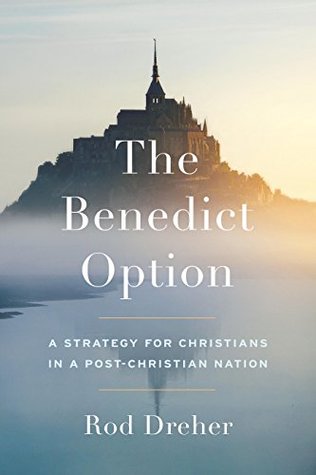
More on this book
Community


Kindle Notes & Highlights
by
Rod Dreher
Read between
July 19 - July 27, 2018

or most of my adult life, I have been a believing Christian and a committed conservative.
We seemed content to be the chaplaincy to a consumerist culture that was fast losing a sense of what it meant to be Christian.
I brought up the work of philosopher Alasdair MacIntyre, who declared that Western civilization had lost its moorings. The time was coming, said MacIntyre, when men and women of virtue would understand that continued full participation in mainstream society was not possible for those who wanted to live a life of traditional virtue. These people would find new ways to live in community, he said, just as Saint Benedict, the sixth-century father of Western monasticism, responded to the collapse of
Roman civilization by founding a monastic order.
Professing orthodox biblical Christianity on sexual matters was now thought to be evidence of intolerable bigotry.
The culture war that began with the Sexual Revolution in the 1960s has now ended in defeat for Christian conservatives.
have written The Benedict Option to wake up the church and to encourage it to act to strengthen itself, while there is still time.
We are going to have to learn habits of the heart forgotten by believers in the West.
In short, we are going to have to be the church, without compromise, no matter what it costs.
If the salt is not to lose its savor, we have to act. The hour is late. This is not a drill.
Alasdair MacIntyre said that we await “a new—doubtless very different—St. Benedict.” The philosopher meant an inspired, creative leader who will pioneer a way to live the tradition in community, so that it can survive through a time of great testing.
the then-pontiff said that the spiritual crisis overtaking the
West is the most serious since the fall of the Roman Empire near the end of the fifth century.
barring a dramatic reversal of current trends, it will all but disappear entirely from Europe and North America. This may not be the end of the world, but it is the end of a world, and only the willfully blind would deny it.
fixed by continuing to do what Christians have been doing for decades—especially voting for Republicans.

bullshit
It was the moment that the Sexual Revolution triumphed decisively, and the culture war, as we have known it since the 1960s, came to an end.
What they found was that in most cases, teenagers adhered to a mushy pseudoreligion the researchers deemed Moralistic Therapeutic Deism (MTD).3
“That is all finally being stripped away by the combination of mass consumer capitalism and liberal individualism.”
With a few exceptions, conservative Christian political activists are as ineffective as White Russian exiles, drinking tea from samovars in their Paris drawing rooms, plotting the restoration of the monarchy.
Nearly seventy years before Benedict was born, the Visigoths had sacked the Eternal City.
Saint Augustine, wrote his classic City of God, which explained the catastrophe in terms of God’s mysterious will and refocused the minds of Christians on the imperishable heavenly kingdom.
Theodoric, the Visigoth king who ruled Italy in Benedict’s time from his capital in Ravenna, was a heretical Christian (an Arian) but made a pilgrimage to Rome in the year 500 to pay his respects to the Pope.
Think of the decadence of Paris and Berlin after World War I,
He moved to the nearby forest and later to a cave forty miles to the east. There Benedict lived a life of prayer and contemplation as a hermit for three years.
In the third century, men (and even a few women) retreated to the Egyptian desert, renouncing all bodily comfort to seek God in a solitary life of silence, prayer, and fasting.
During Benedict’s three years in the cave, a monk named Romanus, from a nearby monastery, brought him food. By the time Benedict emerged from the cave, he had a reputation for sanctity and was invited by a monastic community to be their abbot. Eventually Benedict founded twelve monasteries of his own in the region. His twin sister, Scholastica, followed in his footsteps, beginning her own community of nuns. To guide the monks and nuns in living simple, orderly lives consecrated to Christ, Benedict wrote a slim book, now known as the Rule of Saint Benedict.
he originally wrote it not for the clergy but for laymen.
In these miserable conditions, the church was often the strongest—and perhaps the only—government people had.
Over the next few centuries, they prepared the devastated societies of post-Roman Europe for the rebirth of civilization.
We are governed not by faith, or by reason, or by any combination of the two. We are governed by what MacIntyre called emotivism: the idea
that all moral choices are nothing more than expressions of what the choosing individual feels is right.
MacIntyre said that a society that governed itself according to emotivist principles would look a lot like the modern West, in which the liberation of the individual’s will is thought to be the greatest good. A virtuous society, by contrast, is one that shares belief in objective moral goods an...
This highlight has been truncated due to consecutive passage length restrictions.
This state of mind approximates the condition known as barbarism.
Barbarians are governed only by their will to power, and neither know nor care a thing about what they are annihilating.
By that standard, despite our wealth and technological sophistication, we in the modern West are living under barbarism, though we do not recognize it.
Though not then a Christian, MacIntyre called on traditionalists who still believe in reason and virtue to form communities within which the life of virtue can survive the long Dark Age to come.
All of them are faithful orthodox Christians—that is, theological conservatives within the three main branches of historic Christianity—who know that if believers don’t come out of Babylon and be separate, sometimes metaphorically, sometimes literally, their faith will not survive for another generation or two in this culture of death.
They recognize an unpopular truth: politics will not save us. Instead of looking to prop up the current order, they have recognized that the kingdom of which they are citizens is not of this world and have decided not to compromise that citizenship.
Rod contradicts himself
“exile in place” and form a vibrant counterculture.
they recognize that the new order is not a problem to be solved but a reality to be lived with.
instead of on partisan politics,
We cannot give the world what we do not have.
He may be delivering a like judgment onto a church and a people grown cold from selfishness, hedonism, and materialism.
we are going to figure out how to make it through the storm and the fog to safe harbor, we have to understand how we got here.
The loss of the Christian religion is why the West has been fragmenting for some time now, a process that is accelerating.
Another way to put this is that the medievals experienced everything in the world sacramentally. We associate that word with church and rightly so. Baptism is a sacrament, for example, as is Communion. These are special rituals in which God’s grace is present in a particular way, effecting a real transformation on those participating in it. But sacramentalism had a much broader and deeper meaning in the mind of the Middle Ages. People of those days took all things that existed, even time, as in some sense sacramental. That is, they believed that God was present everywhere and revealed Himself
...more
had such potency to the medievals because God wasn’t present in a vague spiritual sense, like a butler watching silently over a manor house. He was there, writes Taylor, “as immediate reality, like stones, rivers, and mountains.”2 The specific sense in which He was present was a mystery—and a source of speculation and contention even back then—but that He was truly present was not disputed. The only reason the material world had any meaning at all was because of its relationship to God.
intellectually through faith and reason,
faith and reason as intellectual. exclude feelings, emotion, intuition, ...
Medieval Europe was no Christian utopia. The church was spectacularly corrupt, and the violent exercise of power—at times by the church itself—seemed to rule the world. Yet despite the radical brokenness of their world, medievals carried within their imagination a powerful vision of integration. In the medieval consensus, men construed reality in a way that empowered them to harmonize everything conceptually and find meaning amid the chaos. The medieval conception of reality is an old idea, one that predates Christianity. In his final book The Discarded Image, C. S. Lewis, who was a
...more
“metaphysical realism.”
