
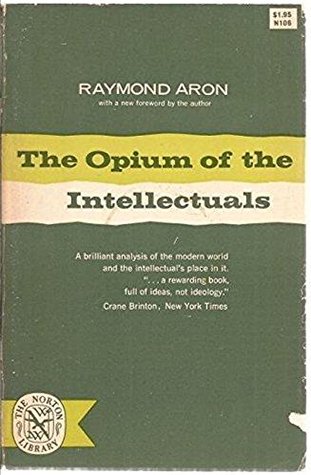
More on this book

Kindle Notes & Highlights

“Seeking to explain the attitude of the intellectuals, merciless toward the failings of the democracies but ready to tolerate the worst crimes as long as they are committed in the name of the proper doctrines,
Why are the ideologies of the proletariat and the Communist Party all the more successful where the working class is least numerous?
“The idolisation of history of which Marxism represents the extreme form teaches violence and fanaticism. History, correctly interpreted, teaches tolerance and wisdom.
Both American liberals and the Left in France and Britain share the same illusion: the illusion of the orientation of history in a constant direction, of evolution toward a state of affairs in harmony with an ideal.
In other words, nationalisation, in the way it has been carried out in France, in Britain or in Russia, does not protect the worker against his bosses, the consumer against the trusts; it eliminates shareholders, boards of directors, financiers—
nationalisation not only fails to abolish but actually accentuates the economic disadvantages of monopoly. What is more to the point is the fact that in this field the reforms of the Left end up by achieving a redistribution of power without either raising up the poor and the humble or casting down the rich and the powerful.
The Left strives to free the individual from immediate servitude; but it might end up by submitting him to the more dangerous servitude, remote in law but omnipresent in fact, of the all-powerful State. The bigger the area covered by the State, the less likely is it to be a democratic State, that is a framework for peaceful competition between relatively autonomous groups.
Against the impersonal despotism of the latter, conservatism becomes the ally of liberalism. If the brakes inherited from the past finally lost their hold, there would be nothing left to impede the advent of the totalitarian State. Thus an optimistic interpretation of history with the liberation of humanity as the ultimate goal is replaced by a pessimistic version according to which totalitarianism, the enslavement of mankind body and soul, is the inevitable result of a movement which begins with the abolition of ancient wrongs and ends with the destruction of every human liberty.
As soon as the Left comes to power it finds itself having to reconcile the desire for equality with the need ' for maximum production. As for the planners, their estimate of the value of their services will hardly be less than that of their capitalist predecessors.
Absolute equality, in a country such as England, would mean that the minority which maintains and enriches the cultural and scientific life of the nation would be deprived of the conditions necessary to its creative existenceJ)-
The men of the Left make the error of claiming for certain economic techniques a magic prestige which belongs in reality only to the realm of ideas: public ownership or full employment must be judged by their efficacy not by their theoretical moral validity.
The essentials of liberalism —the respect for individual liberty and moderate government —are no longer the monopoly of a single party: they have become the property of all.
The New Fabian Essays published in 1952 revealed a desire to alter the emphasis of Socialist policy towards eliminating wealth as such rather than fighting against poverty—towards liquidating the big fortunes which allow individuals to live without working, and extending public ownership in order to close the gap between the highest and the lowest wages.
When Winston Churchill, interpreting The Road to Serfdom in ihe context of an election campaign, made his famous remark about the Gestapo as the inevitable accompaniment of a planned economy, he frightened no one; in fact, he made most of the British electors laugh. A few decades or a few centuries from now, however, what looks to us today like an electioneering squib may seem to have contained a prophetic truth.
Capitalism in the sense in which Marx meant it, the capitalism of Wall Street or colonial big business, offers a better target for invective than this diversified, diffused capitalism, this bourgeoisie which includes much more than a minority of the nation, if one adds the would-be to the real ones.
The organising Left tends to become authoritarian, because free governments act slowly and are held in check by the opposition of private interests or prejudices, national, if not nationalist, because the State alone is capable of fulfilling its programme, and sometimes imperialist, because the planners inevitably tend to require more space and bigger resources.
Among those who followed the party of progress, some did their best to forget the terror, the despotism, the cycle of wars, all the blood-soaked vicissitudes of which the bright, heroic days of the storming of the Bastille or the Feast of the Federation had been the starting point.
Perhaps he would even acknowledge, though not without reluctance, that constitutional continuity since the eighteenth century has been, for Great Britain and the United States, a great good fortune. And he would readily concede that the seizure of power by Fascists or National Socialists proves that the same means—violence and single party government—are not good in themselves but can be used for abominable ends. But he would reaffirm his faith in one final Revolution, the only authentic one, which would aim not to replace one power by another but to overthrow or at least to humanise all
...more
Man ‘alienates’ himself by projecting on to God the perfections to which he aspires. God, far from being the creator of mankind, is himself merely an idol of the human imagination.
To which Francis Jeanson’s reply was at once clear and somewhat tortuous: “It is not a subjective contradiction which prevents me from expressing myself categorically on the subject of Stalinism, but a factual difficulty which it seems to me possible to formulate thus: the Stalinist movement throughout the world does not seem to us to be authentically revolutionary, but it is the only movement which claims to be revolutionary and it commands the allegiance, in this country in particular, of the vast majority of the proletariat; we are therefore at the same time against it inasmuch as we
...more
If revolt means pity and solidarity with the unfortunate, revolutionaries of the Stalinist type certainly deny the spirit of revolt. Convinced that they are obeying the laws of history and working for an end which is at once inevitable and beneficent, they become in their turn, and without any trace of guilt, tyrants and executioners.
The true ‘Westerner’ is the man who accepts nothing unreservedly in our civilisation except the liberty it allows him to criticise it and the chance it offers him to improve it.
Revolutions are born of hope or despair rather than of dissatisfaction.
On the domestic front, the first decade of the Fourth Republic has been an improvement on the last decade of the Third. Old-fashioned liberals, pointing to the deterioration of the currency and the expansion of bureaucracy, will be shocked by this verdict. Nevertheless, economic expansion even if it involves inflation is preferable to stagnation even if accompanied by a sound currency. Moreover, the deflation between 1931 and 1936, which was the inevitable result of the effort to maintain the rate of exchange of the franc, paved the way for the social troubles of 1936 and the economic errors
...more

Meh
A stagnant society and an ideologically-minded intelligentsia—the two phenomena may seem contradictory but are in fact inseparable.
The intellectuals would make their peace with the nation if and when it became more worthy of their ideal picture of it. If this reconciliation fails to materialise or takes too long to do so, the explosion which the revolutionaries profess to want, which the political parties deeply fear but do all in their power to provoke, the explosion which would rip off the bandages that conceal the nation’s sores, remains improbable but still possible.
No definition can trace precisely the limits of a category. At what stage in the hierarchy does the skilled worker cease to belong to the proletariat? Is the manual worker in the public services a proletarian even though he receives his wages from the State and not from a private employer? Do the wage-earners in commerce, whose hands manipulate the objects manufactured by others, belong to the same group as the wage-earners in industry? There can be no dogmatic answer to such queries: they have no common criterion.
The garage mechanic, a wage-earning manual worker, is in a different position and has a different outlook on society from the worker employed on an assembly line in a motor-car factory. There is no such thing as a quintessence of the proletariat to which certain wage-earners j belong; there is merely a category whose centre is clearly defined and its periphery vague.
The contempt with which the intellectuals are inclined to regard everything connected with commerce and industry has always seemed to me itself contemptible. That the same people who look down on engineers or industrialists profess to recognise universal man in the worker at his lathe or on the assembly line, seems to me endearing but somewhat surprising. Neither the division of labour nor the raising of the standard of living contributes towards this universalisation.
The proletarian is the slave who will overthrow his master, not for himself but for everyone. He is the living proof of inhumanity who will inaugurate the reign of humanity.
Deprived of the surplus-value which is accumulated by the capitalists alone, the worker is stripped, so to speak, of his humanity.
But it is not so much ignorance of the economic theorems of Marx which weakens the analysis of working-class alienation as the realisation that many of the workers’ grievances have nothing to do with the pattern of ownership, that they subsist just the same when the means of production belong to the State.
Let us enumerate the basic grievances: (1) inadequate pay; (2) excessive working hours; (3) the threat of unemployment; (4) discontent arising from the technical and administrative organisation of the factory; (5) the feeling of being in a rut with no possibility of advancement; (6) the consciousness of being the victim of a basic injustice, in that the system either does not allow the worker a fair share of the national wealth or refuses him any part in the management of the economy.
The Marxist interpretation of proletarian misery cannot but appear convincing to the proletarian. The cruelties and hardships arising from the wage system, from poverty, technology, the threat of unemployment, the lack of future—why not put it all down to capitalism since this vague word covers both the ‘relations of production’ and the method of distribution? Even in the countries where working conditions have been most improved, in the United States where private enterprise is in general accepted, there is still a prejudice against profit-making, a latent suspicion, always ready to spring to
...more
The Soviet regime places itself in the context of history. It wants to be judged not so much on what it is as on what it will be.
The ‘ideal’ emancipation, once the Socialist State is securely established, will approximate more and more to the ‘real’ emancipation.
In the eyes of the East German or Czech workers, who have known real liberties, ‘ideal’ emancipation is nothing but a hoax.
In the mid-twentieth century, there is no such thing as a world proletariat. If one supports the party of the Russian proletariat, one is against that of the American proletariat, unless one regards the few thousand Communists, the Negro or Mexican sub-proletariats, as the representatives of the American working class. If one supports the Communist- dominated French trade unions, one is against the German trade unions which are almost unanimously anti-Communist. If one bases oneself on the votes of the majority, one would have had to be Socialist in France in the ’thirties and Communist in the
...more
The Catholic faith is not incompatible with sympathy for Les EvDnements et la Foi the progressive parties, for the working-class movement, for the planned society, but it is incompatible with messianic Marxism because the latter sees the path of salvation in the historical process.
Technological progress, which replaces the hand by the machine and physical effort by ‘know-how’, does not ‘advance’ him.
The division of powers is the prerequisite of liberty.
In a regime such as the Third Reich, or in Soviet Russia, the leaders of working-class organisations are far more concerned with conveying the orders of the State to the wage- earners than putting the workers’ claims and grievances before the State.
The Left, which includes all the parties seated on one side of the hemicycle, which is credited with immutable aims, an eternal vocation, exists by virtue of the notion that the future is better than the present and that the direction in which societies must move is fixed once and for all. The myth of the Left presupposes the myth of Progress; it retains the historic vision of the latter, though without the same confidence—for the Left cannot help but find itself confronted with a Right which bars its way and is never conquered or converted. In the myth of the Revolution, this inconclusive
...more
The error is to attribute to the Revolution a logic which it does not possess, to see it as the logical end of a movement which is based on reason, and to expect it to produce benefits which are incompatible with its very essence.
Internecine violence is the negation, perhaps sometimes inevitable, of the mutual sympathy which should unite the members of a community. By uprooting tradition and mutual respect, it risks destroying the foundation of civil peace.
The common source of these errors is a kind of visionary optimism combined with a pessimistic view of reality. You pin your faith to a Left which constantly recruits the same men in the service of the same causes. You never weary of anathematising an eternal Right which is always defending sordid interests, always incapable of reading the signs of new times.
It is wrong to expect salvation from triumphant catastrophe, wrong to despair of victory in peaceful struggle.Violence allows a short cut to the ultimate goal, it liberates energies, encourages the rise of new talent, but also destroys traditional restraints on the authority of the State, and spreads the taste and the habit of forcible solutions.
Neither public order nor the power of the State constitutes the sole objective of politics. Man is also a moral animal and .1 society is human only in so far as it allows every one of its members to participate.
Societies are no more peaceable for having been rationalised by science; in fact they seem to be no more rational than those of yesterday.
One may count the percentage of individual incomes which fall below the decent minimum, but one has only to compare the division of wealth and the standards of government of a century ago with those of today to realise that the growth of collective resources makes societies more egalitarian and less tyrannical.
