
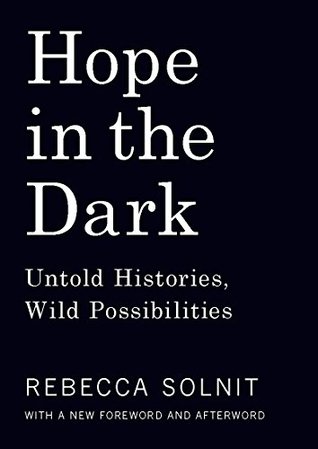
More on this book
Community


Kindle Notes & Highlights

Read between
March 17 - March 21, 2020

Cause-and-effect assumes history marches forward, but history is not an army. It is a crab scuttling sideways, a drip of soft water wearing away stone, an earthquake breaking centuries of tension. Sometimes one person inspires a movement, or her words do decades later; sometimes a few passionate people change the world; sometimes they start a mass movement and millions do; sometimes those millions are stirred by the same outrage or the same ideal, and change comes upon us like a change of weather. All that these transformations have in common is that they begin in the imagination, in hope. To
...more
But the despair was something else again. Sometime before the election was over, I vowed to keep away from what I thought of as “the Conversation,” the tailspin of mutual wailing about how bad everything was, a recitation of the evidence against us—one exciting opportunity the left offers is of being your own prosecutor—that just buried any hope and imagination down into a dank little foxhole of curled-up despair. Now I watch people having it, wondering what it is we get from it. The certainty of despair—is even that kind of certainty so worth pursuing? Stories trap us, stories free us, we
...more
Hope is not prognostication. It is an orientation of the spirit, an orientation of the heart; it transcends the world that is immediately experienced, and is anchored somewhere beyond its horizons. Hope, in this deep and powerful sense, is not the same as joy that things are going well, or willingness to invest in enterprises that are obviously headed for early success, but, rather, an ability to work for something because it is good, not just because it stands a chance to succeed. Hope and action feed each other. There are people with good grounds for despair and a sense of powerlessness:
...more
The focus on survival demands that you notice the tiger in the tree before you pay attention to the beauty of its branches. The one person who’s furious at you compels more attention than the eighty-nine who love you. Problems are our work; we deal with them in order to survive or to improve the world, and so to face them is better than turning away from them, from burying them and denying them. To face them can be an act of hope, but only if you remember that they’re not all there is. Hope is not a door, but a sense that there might be a door at some point, some way out of the problems of the
...more
Despair, bad news, and grimness bolster an identity the teller can affect, one that is tough enough to face the facts. Some of them, anyway. (Some of the facts remain in the dark.) The outcome is usually uncertain, but for some reason tales of decline and fall have an authority that hopeful ones don’t. Buddhists sometimes decry hope as an attachment to a specific outcome, to a story line, to satisfaction. But beyond that is an entirely different sort of hope: that you possess the power to change the world to some degree or just that the world is going to change again, and uncertainty and
...more
Walls can justify being stalled; doors demand passage. Hopefulness is risky, since it is after all a form of trust, trust in the unknown and the possible, even in discontinuity. To be hopeful is to take on a different persona, one that risks disappointment, betrayal, and there have been major disappointments in recent years. Other times that tale of gloom seems to come from the belief in a univocal narrative, in the idea that everything is heading in one direction, and since it’s clearly not all good, it must be bad. “Democracy is in trouble” is the phrase with which an eminent activist opens
...more
A game of checkers ends. The weather never does. That’s why you can’t save anything. Saving is the wrong word, one invoked over and over again, for almost every cause. Jesus saves and so do banks: they set things aside from the flux of earthly change. We never did save the whales, though we might have prevented them from becoming extinct. We will have to continue to prevent that as long as they continue not to be extinct, unless we become extinct first. That might indeed save the whales, until the sun supernovas or the species evolves into something other than whales. Saving suggests a laying
...more
