
More on this book
Community


Kindle Notes & Highlights
Read between
April 23 - April 26, 2025

it and programs like it tend to exoticize the schools they serve and downplay the assets and strengths of the communities they are seeking to improve. I argue that if aspiring teachers from these programs were challenged to teach with an acknowledgment of, and respect for, the local knowledge of urban communities, and were made aware of how the models for teaching and recruitment they are a part of reinforce a tradition that does not do right by students, they could be strong assets for urban communities. However, because of their unwillingness to challenge the traditions and structures from
...more
As long as white middle-class teachers are recruited to schools occupied by urban youth of color, without any consideration of how they affirm and reestablish power dynamics that silence students, issues that plague urban education (like achievement gaps, suspension rates, and high teacher turnover) will persist.
Too often, when these students speak or interact in the classroom in ways that teachers are uncomfortable with, they are categorized as troubled students, or diagnosed with disorders like ADD (attention deficit disorder) and ODD (oppositional defiant disorder).
This approach to teaching advocates for a consideration of the culture of the students in determining the ways in which they are taught. Unfortunately, this approach cannot be implemented unless teachers broaden their scope beyond traditional
She giggled as she admitted that she sometimes “uses the kids’ phrases on purpose” to get a reaction from her friends. This teacher, like many of her peers, exoticizes neoindigenous language, but still holds a general perception that it represents lowbrow antiacademic culture. Ironically, when teachers try to use neoindigenous language, they often find it challenging to do so properly. They fail to recognize the highly complex linguistic codes and rules one must know before being able to speak it with fluency—that is, in a way that teachers view as substandard! I make this point to stress that
...more
Students quickly receive the message that they can only be smart when they are not who they are. This, in many ways, is classroom colonialism; and it can only be addressed through a very different approach to teaching and learning.
The indigenous and neoindigenous are groups that have been victimized by different forms of the same oppression.
it is clear that many teachers in urban schools today share the misguided, though caring, impulse that maintained poor schooling at the Carlisle School. The work for white folks who teach in urban schools, then, is to unpack their privileges and excavate the institutional, societal, and personal histories they bring with them when they come to the hood.
The reality is that we privilege people who look and act like us, and perceive those who don’t as different and, frequently, inferior. In urban schools, and especially for those who haven’t had previous experience in urban contexts or with youth of color, educators learn “best practices” from “experts” in the field, deemed as such because they have degrees, write articles, and meet other criteria that do not have anything to do with their work within urban communities.
To be in touch with the community, one has to enter into the physical places where the students live, and work to be invited into the emotion-laden spaces the youth inhabit.
healing requires addressing both physical wounds and the “soul wounds.” Healing the physical wound occurs in a certain place, but healing the soul wound requires being in a space.
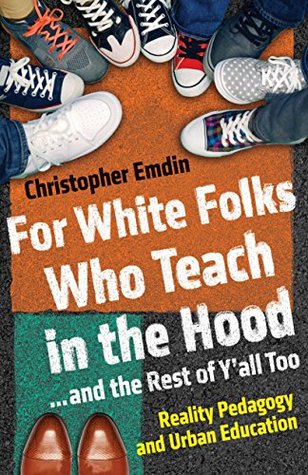
Reality pedagogy is an approach to teaching and learning that has a primary goal of meeting each student on his or her own cultural and emotional turf. It focuses on making the local experiences of the student visible and creating contexts where there is a role reversal of sorts that positions the student as the expert in his or her own teaching and learning, and the teacher as the learner. It posits that while the teacher is the person charged with delivering the content, the student is the person who shapes how best to teach that content. Together, the teacher and students co-construct the
...more

My thesis
Reality pedagogy focuses on privileging the ways that students make sense of the classroom while acknowledging that the teacher often has very different expectations about the classroom. This approach to teaching focuses on the subtleties of teaching and learning that are traditionally glossed over by teachers and administrators while addressing the nuances of teaching that are not part of teacher-education programs and crash courses that lead to teacher certification.
Our everyday conversations in our first year of teaching became reaffirmations of the categorizations we had developed on the first day.
this is where the association between being academically successful and “acting white,” studied by education researchers like John Ogbu, comes from.
The process of indoctrination was difficult, and I often rebelled against it.
I became conditioned to be a “proper student” and began to lose value for pieces of myself that previously defined me. My unabashed urbanness—loud, conspicuous, and questioning of authority—became lost. This was encouraged when I got into the teaching profession. When I took my first job in a school with students whose faces looked much like mine, the most memorable advice I received from an older teacher was, “You look too much like them, and they won’t take you seriously. Hold your ground, and don’t smile till November.” To be an effective black male educator for youth of color, I was being
...more
She was white and from a middle-class background and had seen pictures of her parents when they were in their twenties feeding poor children in Africa on missionary trips. She was chosen to teach in the school based on her good grades and “change the world” attitude as identified by a teacher-recruitment program that brought white folks to teach in the hood. A recent college graduate from a private liberal arts university, she was inspired by the idea of giving back to poor communities. She took the job to get the free master’s degree that many new urban teachers receive, but was drawn into
...more
White folks who teach in the hood are particularly prone to this sort of rote model. This is especially the case if they are convinced that having all students pass tests creates some form of equity. In these cases they are so married to a curriculum that is sold as the only path to passing the test that there is no willingness to deviate from it even if it is harming students. Furthermore, teaching to an exam and strictly following a curriculum makes it easier for these teachers to remain emotionally disconnected from students.
the persistence of achievement gaps proves that teaching that is not personalized and not hands-on (as is most teaching in traditional urban schools) does not equate to success on standardized exams. It also should lead to conversations about how these approaches to teaching actually support the persistence
To be an ally to the neoindigenous, the teacher must unpack the indoctrination that we have all been subject to. For white folks who teach in the hood, this may require a much more intense unpacking. For me, this meant taking the time to analyze why I was initially scared of my students and moving beyond that fear, acknowledging that getting to know my students and having them know me may alter the power structure and affect classroom management.
They may not be reaching the students, or inspiring them to value education, but they rest comfortably knowing that they are doing their job as defined by the school. The lessons are scripted and the students are quiet. One group of students trickles in begrudgingly at the sound of the bell, and the same group pushes out of the class hastily at the sound of another bell.
This vision of teaching doesn’t hide the fact that challenges in urban education persist because of our collective investment in maintaining a system that is intent on forcing brilliance to silence itself and then dealing with the varied repercussions. Once educators recognize that they are biased against forms of brilliance other than their own, they can finally begin to truly teach.
Pentecostal pedagogy gleans teaching practices from the black church and is a necessary model for teachers charged with engaging urban youth of color in classrooms but who have no training in what it means to be neoindigenous and alienated from traditional school culture.
to demonstrate the power of effective teaching. Pentecostal pedagogy is an approach to teaching that reminds us that teaching is not just telling students what you know; it is about knowing how to share what you know so that it can be optimally received.
Pentecostal pedagogy, and the hip-hop pedagogy that comes from it, is successful because it provides a safe space to identify, discuss, and express emotion. For the neoindigenous, this is a necessary prerequisite for being comfortable enough to learn within certain places.
By asking the question, the teacher (not by profession, but embodying what it means to be a teacher) opened up the space for dialogue that gave everyone an entry point into the discussion. He started with a joke that made everyone comfortable, and then asked a question that everyone could answer. When
urban education requires a different approach from that taken in traditional classrooms. Teaching in the hood requires a very different skill set that those coming into the hood must first recognize they lack, and then train to develop. The strategies that Marcus employs with his clients issue from Pentecostal pedagogy.
Infusing humor and story into the instruction, allowing the space for the release of tensions and frustrations, and welcoming the voices of the people you are sharing information with or providing a service to—these are tools used on the pulpit and in the barbershop, and should be used in the classroom as well. Marcus
They had organically created what the Brazilian educator and philosopher Paulo Freire described as a culture circle—where adults who were learning to read and write came together in an informal learning space and used their unique ways of speaking to become literate by sharing their understandings of the world and their place within it. The similarities between the hip-hop cypher and the culture circle speak to the universality of indigeneity and the ways that indigenous traditions have deep meaning for all marginalized groups.1 After seeing my students engage in the beautiful space they had
...more
the structure of the cypher could be merged with the culture of schools to create truly emancipatory new practices in classrooms. One of these emancipatory practices (which merges the culture circle and the cypher) is the cogenerative dialogue, or cogen.
Cogens are simple conversations between the teacher and their students with a goal of co-creating/generating plans of action for improving the classroom.2
My work with cogens has shown that they allow teachers to more effectively deliver complex subject matter to students from different cultures, because they allow teachers and students to bridge their cultural divides before addressing content. In instances where the youth and the teacher are from different cultural backgrounds, as is the case with most urban teachers and their students, effectively introducing and implementing the cogen in a way that replicates the structure of the cypher has proven to be effective in motivating neoindigenous students to engage in dialogues with teachers in
...more
Cogens, in their purest form, are structured dialogues about the inner workings of the social field participants coinhabit.
The most significant aspect of the cogen structure is ensuring that different demographics in the classroom are represented.
While students may have similarities in certain areas, it is their differences as revealed in the cogen that lead to rich dialogues.
Therefore, it is important for the teacher to be very deliberate about not only who is invited, but also how they are invited. The invitation process should be respectful of students, their time, and their status/reputation in the classroom. Teachers must remember that the
My suggestion is for the teacher to ask students about nonverbal cues that they can use in the classroom to signal that they are implementing a suggestion generated in the cogen. Students have suggested that the teacher give eye contact and a head nod or lightly place their hand on students’ desks to indicate the enactment of the cogen plan. Enacting these nonverbal cues allows students to recognize the moments when the teacher is attempting to connect to them, and valuing their voices as participants in the cogen.
I had become an outsider to the group, and over the course of the semester, I began to question my effectiveness as an instructor.
Coteaching in reality pedagogy requires that teachers acknowledge that they may be an expert in their content, or at teaching that content in another location/setting, but not at teaching it to the neoindigenous. The process also requires that teachers let their students know that they are not only students but teaching experts whose knowledge about how to teach has tremendous value.
When coteaching is enacted, students develop the agency or power to act in ways that challenge the oppression they are often conditioned to be silent about.
What part of the lesson struck you as most effective or memorable? What was said or done and how did it make you feel? If you were the person who was teaching, what is it about the lesson that you would do the same? What would you do differently and why? In what ways was this lesson similar to, or different from, previous lessons?
