
More on this book

Kindle Notes & Highlights

Nevertheless, tell me, O Philosopher, why you tremble — is it not merely death that you are in danger of, or imprisonment, or bodily suffering, or exile, or disgrace? What else? Is it any vice? Or anything of the nature of vice?
No longer engage in general discussion about the nature of a good man, but be a good man. Marcus Aurelius
There is great interest in Stoicism today. For good reason. Stoicism leads a way to living a virtuous, noble life.
I asked my father what his favorite quote was. “I grow old, ever learning new things,” a quote by Solon, he said.
Who was this half-mythical man at the beginning of Western democracy and what does he tell us?
The time of Solon—the Archaic Age, with Greece emerging from the Dark Ages after the Mycenaean times—was a time of seeding a new civilization and much of it remains in obscurity.
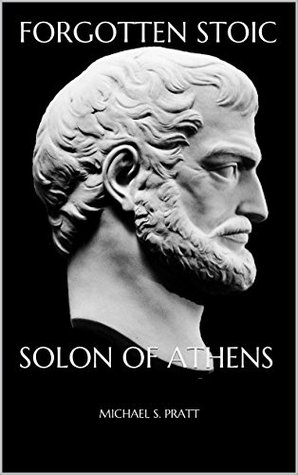
This book goes as far back as Solon to trace his influence on Stoicism.
Know Thyself and Nothing to Excess Solon as an Early Stoic—an Introduction
So says Solon the Greek—Athenian citizen, statesman, lawgiver and poet, who, “having suffered a thousand dangers” according to biographer Plutarch, still counsels us from more than 2500 years ago.
Solon lived from approximately 638 BCE to 558 BCE,[2] was a merchant in his youth, led Athens in war time, was a poet and herald, philosopher, archon (ruler) and lawgiver.
He reformed Athens at a time of great crisis, ended slavery and replaced harsh Draconian laws with a more human code, thus preparing the foundation for Athens’ democracy, the world’s first, as well as firmly putting Athens center-stage in art, literature and philosophy.
Solon’s advice is as simple, direct, and practical as that of the great Stoics that were to follow even more centuries later, such as Marcus Aurelius and Epictetus.
Socrates names the Seven Sages: Thales of Miletus, Pittacus of Mytilene, Bias of Priene, Solon of Athens, Cleobulus of Lindus, Myson of Chene (in Laconia) and Chilon of Sparta[3] as the sources for the Delphic maxims, noting that “only perfectly educated men were capable of uttering such expressions.”
The two most famous maxims attributed to Solon[4] are the most important ideas in philosophy ever since: ‘Know Thyself’ and ‘Nothing to Excess.’
Temperance has always been the hallmark of a Stoic.
Combining instruction on temperance and humility in one short statement, Solon says: Excess breeds hubris.
Hubris are actions resulting from a break with reality, a failure to maintain the proper mental state or attitude and shows itself as arrogance, an assault on our true character.
Solon, the Seven Sages, and Heraclitus, who lived a generation after Solon’s death, set a new bar for temperance—which was to become the organizing principle of a new social order in Greece, the reflection of their philosophy.
Self-indulgence, in the stark words of Heraclitus “stuffing yourself like cattle as most men do” is to be avoided.
Solon says: Calm the eager tumult of your hearts. You have forced your way to a surfeit of good things. Confine your swelling thoughts within reasonable bounds.
Heraclitus similarly says: It is not better for human beings to get all they want. It is disease that makes health sweet and good, hunger satiety, weariness rest.[7]
It is hard to fight against passion; for whatever it wants it buys at the expense of the soul.[8]
The conception of the word areté, or excellence, no longer held the same meaning of warlike valor, physical strength and prowess as it did in earlier times, but the word acquired a broader meaning and became infused with a new inner quality, a magnificence of character in the conduct of daily life.

Interesting internalisation of word
In Solon’s time, Greece was just coming out of the Dark Ages (the period from 1250-800 BCE)
For Athens a new beginning started with Solon who articulated a set of laws based on a new spiritual understanding, formulating a solution to the problem of the individual’s place in the community.
With Solon the Gods are no longer an excuse for our failure to live up to our ideals. This represented a new vision of man in relation to reality, to his cosmos.
Interesting
We read with some bewilderment of the about Greek heroes and Gods in Homer’s Iliad and Odyssey. The warrior-heroes are accountable to no one and are a law to themselves. Only the Gods can interfere. The Gods decide all things. Man has little choice it seems.
The idea that man, and not the Gods, would be to blame for bringing on his own life’s destruction was in effect a transformative shift in...
This highlight has been truncated due to consecutive passage length restrictions.
Solon’s time—Archaic Greece—is now increasingly seen by scholars as a very important age with deep changes in society.
Heraclitus was influenced by Solon and the Seven Sages (in two fragments he refers to and quotes Bias, mentions Thales as the first astronomer and also approvingly quotes Pittacus).
Every day for instance, we can remind ourselves of Solon’s maxims ‘Know Thyself’ or ‘Nothing to Excess,’ or any of the Delphic Maxims he and the other sages uttered (or as Aristotle suggests, gathered from earlier teachings), such as:
The pointed, aphoristic style of the early Greek philosophy and poetry shaped Stoicism; their simplicity is mirrored in the moral simplicity of Stoic principles.[17]
As Marcus Aurelius reminds us: The work of philosophy is simple and modest; do not lead me astray into pompous pride.[18]
Solon clearly had a Stoic character. He embodied a radical new ideal of moderation and humility at a critical time when greed had the upper hand and threatened to destroy Athens. He said: Excess breeds hubris.
Besides their short exhortations, the sages also educated through their actions.
As told by historian Diogenes Laërtius the sages were the original philosophers, because they pursued wisdom, the very meaning of the word philosophy.
Appendix 2 is a sampling of their instruction to us. As Socrates said: the wisdom of the Seven Sages is decidedly of a Spartan character—practical and instructive.
It is most difficult to know the measure of wisdom, which alone holds the end of all things. Solon, Fragment.
A man should be immune from external influences. A man should be unconquerable, looking up only to himself, and give form to his own life. His self-confidence is rooted in knowledge and knowledge in persistence.
Such a man was Solon. Aristotle, who credits Solon with establishing the Athenian democracy, describes Solon this way:
He was moderately furnished with externals, but having done the noblest acts and who lived temperately. For one can with but modest possessions do what one ought.
Solon said: Know Thyself
Heraclitus said likewise: It belongs to all men to know themselves and to keep their thinking sound.[21]
The one thing, the sole wisdom, the self that we should be knowing, is what the Stoics refer to as our ruling faculty. The ruling faculty is that part in us that is able to see ourselves as we really are, see how we live and work, and relentlessly fights for our true self, against all obstacles, in order to pursue a nobler course of action. This is knowing oneself—how to harness this driving force—a mere spark at first, then by efforts nourished into a flame and then a blazing fire and is the lesson of Solon’s exhortation: Pursue worthy aims.
We have to train our mind not to think like everyone else who is a slave to their emotions. Epictetus, who compares our state to that of a sick patient in a hospital, said:
Whoever then wishes to be free should neither wish for anything nor avoid anything which depends on others. If you do not observe this rule, you will be a slave of others.[23]
What is the Stoic way to do our work? How do we live and work? Marcus Aurelius provides us with some answers:
If thou workest at that which is before thee, following right reason, seriously, vigorously, calmly, without allowing anything else to distract thee, but keeping thy divine part pure, as if thou shouldst be bound to give it back immediately; if thou holdest to this, expecting nothing, fearing nothing, but satisfied with thy present activity according to nature, and with heroic truth in every word and sound which thou utterest, thou wilt live happy. And there is no man who is able to prevent this.[24]
Emotions can flare up faster than our attitudes can control (for now).
Inattention can take over the best intentions. We have to continually return to a quiet determined place within. That is why Solon said: Calm the eager tumult of your hearts.
