
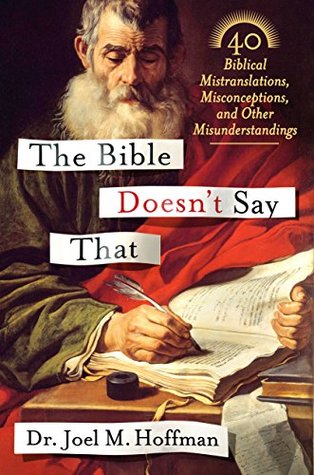
More on this book


Kindle Notes & Highlights

The Bible Doesn't Say That: 40 Biblical Mistranslations, Misconceptions, and Other Misunderstandings
Read between
March 9 - April 6, 2025

Is it really likely that the name of the man who allegedly ordered Jesus killed would be lost to history? Wouldn’t that man’s name appear prominently in the account, the same way Pilate’s name does?
Another historical problem with the account in the New Testament has to do with the custom of releasing a prisoner at Passover. In the New Testament, that practice forms the backdrop that highlights Pilate’s reluctance to kill Jesus. But there was no such custom. The rituals of Passover are well documented, because Passover was even more central in antiquity than it is now. And the Jewish insistence on justice is equally clear. So the alleged practice of releasing a prisoner seems to have been invented for the purposes of this story, and seems to fly in the face of established Jewish doctrine.
...more
So there were at least four competing schools of Jewish thought and practice at the time. Certainly the Sanhedrin—itself a body about which little is known for sure—couldn’t have represented all of the Jews, because they disagreed among themselves.
We generally hold soldiers culpable for misdeeds even if they were following orders.
The Ten Commandments seem to be a list of things that are wrong no matter what.
Even these clear and direct statements are not beyond the reach of revisionism. The clearest case is the commandment variously numbered 9, or 9 and 10: “Do not covet.” The Hebrew verb there (chamad) does not actually mean “covet” but rather means “take.” However, a related verb, nechmad—which shares the Hebrew root Ch.M.D—means “desirable.” Some people therefore thought that chamad, too, should have something direct to do with desire. But that’s not how language works. (For instance, “host” and “hostile” share a root in English, but a host doesn’t have to be hostile.) And other instances of
...more
Though the Ten Commandments are the most obvious case of direct statements in the Bible, they are far from the only place the Bible offers direct guidance, and, equally, far from the only place these direct statements are misunderstood today.
We also know that these ancient translations updated the text as they saw necessary. The Hebrew verb for “take” that we saw in the last chapter becomes “desire” in the Septuagint.
But even though those three verses give us the number “ten,” they do not use the word “commandment” in Hebrew, a fact concealed by the many English translations that nonetheless render the Hebrew there as “Ten Commandments.” As with Exodus 20, the Greek and Latin, like the original Hebrew, mention only “ten things” or “ten words.”
There was an important collection of ten things, and at least some of them were commandments, but the Ten Commandments that are so famous now are actually a result of later interpretation.
In short, the common phrasing “God so loved the world” misses the point of John 3:16, which is: “This is how God loved the world.…” In other words, John 3:16, in its original form, answers the question “How did God love the world?” The four-hundred-year-old common translation now gives the false impression that the verse answers the question “How much did God love the world?”
The sentence is not just about what truth will do. It conveys the impression that truth and freedom are two sides of the same coin, similar in unexplored ways. The verse doesn’t just answer “What will truth do?” or “What will free you?” It answers “How are truth and freedom related?”
Similarly, “live by the sword” tends to suggest a way of life, which is why it was so appropriate in the context of the death of the rapper we saw above, who was accused of systematic violence and of dealing drugs; the phrase would be less apt if, say, a pacifist folksinger had picked up a gun only once to defend his family and been shot to death in return.
Readers of the Bible—and readers in general—often don’t like to admit the existence of figurative speech, because it can seem less precise than literal meanings, and there’s a certain satisfaction in precision. But most language is figurative, and it’s frequently so clear that we don’t even notice the figures of speech.
The shepherd of the Bible was a brawny, fierce, brave fighter, nothing at all like our modern image of shepherd. Accordingly, Psalm 23 starts off with an image of God as a mighty warrior—nothing
Psalm 23, then, isn’t about shepherds at all, certainly not modern shepherds, but not really about ancient shepherds, either. The shepherd is just a convenient metaphor for might, and the Psalm is about God’s might producing feelings of satisfaction, safety, and tranquillity in the Psalmist.
So the English translation “heart” starts off by rejecting rational thought in favor of emotion, while the original starts off by specifically including both.
But, surprisingly, the original Hebrew word in Deuteronomy 6:5 (nefesh) doesn’t mean soul at all. It’s a general term that includes “flesh,” “blood,” and “breath.” In other words, the Hebrew word that we usually translate as “soul” is just the opposite of “soul.” It’s the body and the blood and the breath and everything else about being alive that is tangible.
There was barely any concept of life after death in most of the Old Testament, and there was nothing comparable to today’s notion of “soul.” Then, as the modern notion of a death-surviving soul became more popular—probably about two thousand years ago—a word was needed for it. While the Hebrew nefesh meant practically the opposite of “soul,” it was also commonly being used for “person.” This may be why the word was able to shift to mean not the body that a person has but something else that a person has: a soul.
Taken together, these two ancient words—nefesh and levav in Hebrew or kardia and psyche in Greek—combine to express the entirety of human existence, even stressing the observation that we all have parts that are visible and parts that are not.
Still, we do know that the first two words have little to do with the heart and nothing to do with the soul. Deuteronomy 6:5, Matthew 22:37, Mark 12:30, and Luke 10:27 are not about which parts of our humanity should be used to love God. They are about loving God with everything that makes us human.
The King James Version, based on the clear meaning of the Greek, therefore translates the Hebrew r’em as “unicorn.”
Marco Polo’s “unicorn” is widely believed to be a rhinoceros, which, after all, does have a horn on its nose. (The name “rhinoceros” comes from the Greek words for “nose” and “horn.”)
Septuagint
And from Deuteronomy 33:17, which talks about “the horns of the r’em,” it seems as though the animal had more than one horn (presumably two). Based on the little evidence we have, most people think the r’em was a bovine of some sort, which is why modern renditions tend toward “wild ox” for a translation.
So what we have is a Hebrew text with an animal whose species we no longer know for sure, and guidance from the Septuagint—the text that was used as the foundation of Christianity—that the animal is a unicorn.
And this is why Jesus in Matthew 21 arrives in Jerusalem on a donkey, with text that echos Zechariah 9:9: “Your king comes to you, triumphant and victorious, humble and riding on a donkey.” Matthew specifically notes the prophet’s words, “humble, and mounted on a donkey.” When John relates the same entry into Jerusalem (John 12:12–19), he just mentions the donkey. He doesn’t need to repeat “humble,” because his readers would have known that donkeys represented humility.
Both the “sea monsters” and the “dragons” in our English translations of the Old Testament come from the same Hebrew word, tanin. (Elsewhere that word gets translated as “snake” or “serpent,” as in Exodus 7:9–10, when Moses turns his staff into a snake.)
The “dragons” of Psalm 74:13 are water creatures—snakes, serpents, or even whales—not the fire-breathing flying creatures that we call dragons in English.
The ancient view was different. Animals still came in two varieties, but they were “common” and “extraordinary.”
By contrast, it’s all but impossible for modern readers to think about unicorns or dragons and ignore their most obvious feature: They don’t exist. Yet to correctly understand the ancient text, we modern readers have to do just that. We have to ignore the (modern) distinction between real and imaginary, and focus on the ancient impact of unicorns and dragons.
For that matter, kings nowadays rule over countries, but there weren’t even any countries in the Bible. There were cities and collections of cities. In that sense, kings in the Bible were like mayors or governors.
To come from a family of musicians, now, is different than to come from a family of warriors, which is different again than coming from a family of lawyers. To be part of the Davidic line is to be all three.
A plowshare—now unfamiliar to most industrial readers in the West—is a sharp edge used to till the land. (The word “share” comes from an original root meaning “to cut,” an etymological history we see in the related word “shear,” as well. A “share” was an instrument for cutting, especially the part of a plow that cuts the earth. From its relation to cutting, a share came to mean also the parts of something that was cut up, which is where we get stock shares. And the verb “to share” in the sense of “divvy up” comes from allocating those parts.) And a sword, of course, is a sharp-edged blade used
...more
Verse 2:4 does not begin with the imagery of peace and war but rather with a prophecy about God as final arbiter: “God will judge between the nations and shall arbitrate for many peoples,” and only then “will they beat their swords into plowshares.”
This whole passage is a vision about the future. Isaiah even tells us so himself in the verses that open that chapter: “This is what Isaiah prophesied … In days to come, the mountain of the Lord’s house will be established … and all nations will stream to it.” Verse 2:4 is about what will happen “in days to come.” This is why the NRSV captions the entire passage “the future house of God.”
Certainly, one way to interpret Isaiah’s prophecy here is that we should work to build the ideal that the ancient prophet envisions. We should take the first steps and start dismantling our weapons. However, an equally compelling way to read the text is that we should keep building swords and other weapons until God’s role as arbiter is finally established, because these instruments of war are
necessary parts of civilization until God takes over and makes them irrelevant. Though this second reading strikes many people as less satisfactory, it has just as much basis in the text.
This is not to say that the traditional interpretation is wrong. Religious traditions that use these lines to promote peace over war have every right to do so, and people who read or sing these ancient words to protest violence are aligning themselves with solid religious tradition. But let us be clear: This is a matter of tradition, not “what Isaiah says” and certainly not “what the Bible says.” In its original context, this famous passage is just part of a vision of what Israel will be like when God establishes a cosmic court of justice. What we do until then is up to us.
This is precisely why we draw a line between what the Bible originally said and what its words have been made to say.
We find an abridged version of the same account in Luke 4:4: “It is written, ‘One does not live by bread alone.’” The phrase was apparently so well known that Luke didn’t even have to finish the quotation.
This is a case of something that is actually very common. The New Testament is quoting the Old Testament out of context. Here the leap from “whatever God says” to “God’s words” is explained by the expression “motza of God’s mouth,” which normally means “whatever God says” but which, out of context, might mean “God’s actual words.” A passage that started off by asserting that one can live on any food that God declares edible morphed into a statement about living on God’s very declarations.
The meaning is essentially the same, and both the Hebrew and the Greek phrases refer to manna. But the appearance of the Greek rima (“word”) means that Matthew can quote the text accurately and still change the meaning completely.
In particular, Bible translators, too, sometimes think that Deuteronomy 8:3 and Matthew 4:4 must match exactly, so they change their translation of Deuteronomy 8:3. This is why the NRSV translation of Deuteronomy 8:3 reads, “one does not live by bread alone, but by every word that comes from the mouth of the Lord,” relegating the more accurate “by anything that the Lord decrees” to a footnote. The motivation seems to have been to make Deuteronomy and Matthew match more closely than they actually do. But the editors have thus done a terrible disservice to their readers. The translation—and most
...more
(The clearest English example of a merism is the phrase “young and old,” which includes not just children and the elderly but everyone in between.)
This kind of accurate-but-out-of-context quotation is a central feature of the New Testament, and understanding it is part of understanding not just Christianity but also rabbinic Judaism and other, lesser-known traditions like the Qumran Cult that gave us the Dead Sea Scrolls.
“Who is the voice crying in the wilderness?” has three answers: In the Old Testament, there is no such voice, because the voice isn’t in the wilderness. In the New Testament, the voice is John the Baptist. And in the context of Christianity, it’s again John the Baptist.
His point is that it wasn’t enough for Abraham to believe in God. He had to act on his belief, too.
The Old Testament citations were similar to these snippets, but also much more powerful, because in addition to using only a few words to create a complex image in the mind of the reader, the quotations were of holy scripture. By bringing them into the New Testament (which wasn’t scripture yet), the authors incorporated the divine into their work. This is why the Jews did the same thing with their early-first-millennium-A.D. texts like the Midrash and worship services—the difference being that for the Jews their secondary texts were never considered on a par with the Old Testament. (This is
...more
Where our translations say “fulfills”—based on a naive four-hundred-year-old understanding of language—we should read “matches.”
