
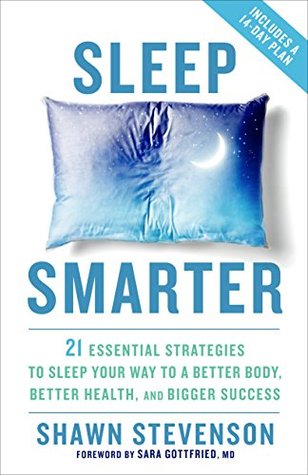
More on this book
Community


Kindle Notes & Highlights


Here are just some of the things that are affected by your sleeping position: •Bloodflow to your brain •Stability of your spine •Hormone production •Joint and ligament integrity •Oxygen supply and efficient breathing •Muscular function and healing •Heart function and blood pressure •Digestion and cellular metabolism
One of the most important facets of your sleeping position is maintaining
the integrity of your spine.
The downside of sleeping on your back is the greater likelihood of snoring and sleep apnea. This is partly because when we sleep on our backs, gravity can force the base of the tongue to collapse into the airway, obstructing normal breathing.
some research shows that lying on your stomach can help prevent minor snoring and some symptoms of sleep apnea.
If you’re going to sleep on your belly, then ditch the pillow, because you really don’t need it.
Side-sleeping can be a quick fix for snoring and can help to improve breathing, more so than lying on your back.
Plus, sleeping on your side (the left side in particular) has been reported to ease troublesome digestive problems like acid reflux and heartburn.
Sleeping on your arm for too long can cut off bloodflow and nerve function.
Consumer Reports states that you need to replace your mattress every 7 years,
Many people are shocked to find out that most mattresses contain toxic foams and synthetic fabrics, and are treated with chemical flame retardants that off-gas and lead to a whole host of health problems.
Boric acid: Has known carcinogenic properties.
Melamine resin (contains formaldehyde): The US Environmental Protection Agency (EPA) classified formaldehyde as a probable human carcinogen under conditions of prolonged exposure.
just because you can’t smell something doesn’t mean that it’s safe.
make the decision to purchase a mattress for yourself or your family, be sure to follow my recommendations in the Sleep Smarter bonus resource guide at sleepsmarterbook .com/bonus.
Research at the Medical College of Georgia in Augusta found that meditation lowered blood pressure and reduced the risk of heart disease and stroke.
Numerous studies also demonstrate that meditation can reduce chronic pain and associated inflammatory biomarkers.
Meditation has proven to be good for your brain,
The American Academy of Sleep Medicine published research showing that meditation is an effective treatment for insomnia.
Another study, published in the journal Medical Science Monitor, found that advanced meditators have higher baseline melatonin levels than nonmeditators.
jumping right to drugs to treat insomnia is associated with organ damage, hormone disruption, and significant chemical dependency.
Delta waves (1 to 3 Hz): The delta frequency is the slowest of the frequencies and is experienced in deep, dreamless sleep. It is also seen occasionally in very experienced meditators. The delta state is critical to the body’s healing processes. Much of our regeneration and healing happen in this brainwave state, making getting enough deep sleep critical to our survival.
Have you ever wondered where weight goes when you lose it? Research has found that some of the weight is expelled through water and some through heat, but a big portion of it is eliminated by your breath.
You can flip on your parasympathetic nervous system at will, and even be able to be more in control of your thoughts.
Short, shallow breaths are connected to stress and anxiety. Deep, rhythmic breaths are connected to relaxation and control.
Breathe deep, relax, and remember how powerful you are to change your state.
Most of the time our thoughts are scurrying off into the future thinking about all of the things that we could and need to do
You can turn just about anything into a sensory-filled mindfulness meditation. Mindfulness is really about noticing and tuning in to things in the here and now.
One of the best times for meditation is when you’re already close to the alpha and theta brain waves. This would be as soon as you wake up in the morning, or right before bed at night.
The Journal of Health Psychology published a study demonstrating that doing a daily qigong practice (pronounced chee-gong) for just 1 month was enough to increase sleep duration and other factors of psychological well-being.
Tai chi is often described as “meditation in motion,” and it’s another excellent practice to consider.
Chamomile: This herb has been used for thousands of years to treat everything from skin disorders to heart disease to inflammation.
chamomile flavonoids have significant anti-inflammatory properties and trigger COX-2 enzyme activity that reduces physical pain. The study also asserts that chamomile can be used as a mild sedative and sleep inducer.
The sedative effects appear to be due in large part to a particular flavonoid called apigenin. This compound is abundant in chamomile tea, and it binds to certain GABA receptors in the brain, naturally calming nervous system activity.
Apigenin has also been found to be a very potent anti-cancer compound.
apigenin is protective against a wide variety of cancers (including cancers of the breast, digestive tract, skin, and prostate)
chamomile can help calm the nervous system, relax muscles, and set you up for a better night’s sleep when you need it.
Chamomile is an excellent tea to have before bed.
Kava kava: This is actually the national drink of the beautiful island of Fiji.
Kava kava is well known for its sedative properties and is commonly used to treat sleeplessness and fatigue.
300 milligrams of kava kava may improve mood and cognitive performance. Several additional studies show that it’s effective for reducing the signs and symptoms of anxiety (wh...
This highlight has been truncated due to consecutive passage length restrictions.
The most important sleep-related data on kava kava demonstrates that it may help to improve sleep quality and decrease the amount of time needed to fall asleep. Preparing a cup of kava ...
This highlight has been truncated due to consecutive passage length restrictions.
Valerian: This traditional herb is the strongest of the three herbs I recommend ...
This highlight has been truncated due to consecutive passage length restrictions.
It’s indicated for individuals who have a difficult time falling asleep, and it also pro...
This highlight has been truncated due to consecutive passage length restrictions.
5-HTP is a neurotransmitter precursor to serotonin. In our bodies,
people who took 5-HTP went to sleep quicker and slept more deeply than those who took a placebo. Researchers recommend 200 to 400 milligrams at night to stimulate serotonin, but it may take 6 to 12 weeks to be fully effective.
Some people swear by the sedating effects of GABA to help manage stress. If GABA is of interest to you, 500 milligrams in the evening is a good place to start. Also, consider looking into the GABA precursors picamilon and phenibut.
L-tryptophan is actually the precursor to 5-HTP.
there are several foods that are rich in tryptophan, like turkey, chicken, pumpkin, sunflower seeds, co...
This highlight has been truncated due to consecutive passage length restrictions.
One of the main issues with melatonin supplementation is that it can potentially down-regulate your body’s natural ability to utilize melatonin on its own.
