
More on this book


Kindle Notes & Highlights

Read between
July 24 - August 11, 2022

The problem, ultimately, was not weak signals but weak responses to signals.
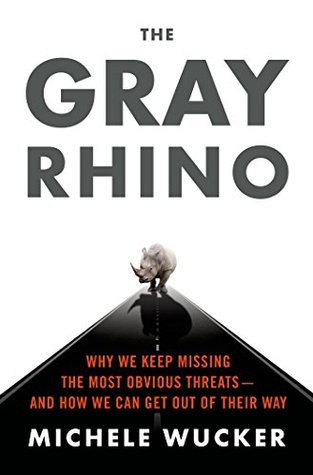
A Gray Rhino is a highly probable, high-impact threat: something we ought to see coming, like a two-ton rhinoceros aiming its horn in our direction and preparing to charge.
Danger rarely comes as a complete surprise; instead, it follows many missed opportunities for taking precautions, reading and responding to warning signals.
This is the central paradox of Gray Rhino threats: rise to the threat too soon, while the threat is on the horizon, and your hands are tied; rise to the threat when you can access the resources you need, and the cost is astronomical, whether it’s a matter of softening the blow or picking up the pieces.
Most Gray Rhinos are not the case of signals that were too weak but of listeners determined to ignore them and systems that encourage and accept as normal our failure to respond.
There are many other reasons that we fail to respond in time to warning signals: the quirks and foibles of human nature, including the plain old impulse to procrastinate; cultural taboos against raising the alarm; our bias toward overweighting positive outcomes and discounting negative ones; groupthink, or the tendency of people to reinforce the prevailing wisdom and ignore information that counters the story they have come to recognize.
humans place unreasonable demands for accuracy on prognosticators, even though we know how uncertain predictions can be.
If we cannot predict with a reasonable probability of success, we can hardly be expected to respond appropriately; there would be no such thing as a “probable” threat.
humans are hardwired to see the world through rose-colored glasses. We are inclined to overestimate the likelihood of positive events and to discount the likelihood of negative events.
Where data is unreliable—China’s GDP growth, for example—analysts turn to proxies like electricity usage, which are more trustworthy.
The first and most insidious of these biases is groupthink: the tendency of insular groups to miss signals of any threats outside their normal expectations.
three factors determined how accurate the forecasters were. First were psychological factors: “inductive reasoning, pattern detection, open-mindedness and the tendency to look for information that goes against one’s favored views, especially combined with political knowledge.” Second was the forecasting environment, including training in probabilistic reasoning and team discussion of rationales. Finally, not surprisingly, effort made a difference; the more time forecasters spent deliberating their predictions, the better they did.
A 2007 report from the not-for-profit organization Catalyst found that companies with the highest percentage of women board directors outperformed those with the least by 53 percent. A 2013 Thomson Reuters study found that companies with no women on their boards performed worse than gender-diverse boards. Yet only 17 percent of the companies analyzed report having a board consisting of 20 percent or more women.
One of the first questions leadership should ask is whether the organization has set up a structure that brings in a mix of perspectives and gives room to opinions that challenge the status quo.
Having a certain level of comfort when facing uncertainty is a huge asset in environments where frequent changes happen, especially when the only easily predictable aspect of those changes is that unexpected obstacles will appear regularly.
the average life span of a Fortune 500 corporation is only forty to fifty years.
“We have not won any war. We keep winning battles but the war is always going to be out there,”
we believe we are better at dealing with anticipated threats than we really are.
the core emotion behind financial crises is not greed but fear: the fear of missing out.
Ebola was rooted in a crisis that was much larger than the medical challenges that arose: a problem of governance; perverse incentives; misdirected resources; failure of disease surveillance and response; a decision-making process that was warped first by inertia and then by the emotional intensity of the moment; a lack of ownership and agency from the most grassroots levels to the sterile halls of multinational organizations. The people with the resources that could have helped didn’t notice until Ebola threatened their own.
The CDC estimates that only 16 percent of countries are fully prepared to address health threats.
When it was first created in 1934, the concept of Gross Domestic Product was a new way to guide policymakers, who before then had been driving blind.
every twenty minutes U.S. users toss one ton of cell phones.
The Intergovernmental Panel on Climate Change, which aggregates the views of leading scientists, predicts that extreme weather events will occur more frequently because of changes in the atmosphere caused by global warming.
