
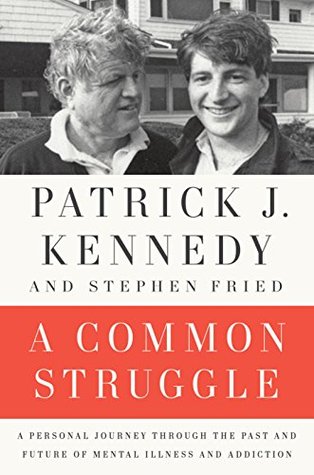
More on this book


Kindle Notes & Highlights

Read between
July 11, 2023 - November 16, 2025

I promised myself I would have the most transparent recovery and treatment ever, all but donating my brain and its diseases to science while I was still living. I wanted to aggressively tie my personal story to my ongoing legislative fight for mental health parity—an effort to outlaw the rampant discrimination in medical insurance coverage for mental illness and addiction treatment. And winning the parity fight would be the first step to overcoming all discrimination against people with these diseases, their families, and those who treated them.
QNPoohBear liked this
Most of the challenges of mental illness and addiction feel incredibly unique and private when, in fact, they are remarkably common: nearly 25 percent of all Americans are personally affected by mental illness and addiction every day, one-third of all U.S. hospital stays involve these diseases, and they have a huge impact on everyone else.
QNPoohBear and 2 other people liked this
When you’re good at self-medicating, you can abuse just about anything.
Everyone finding out wasn’t such a bad thing. In fact, everyone finding out was probably the only reason I was still here.
“The cross is a lot easier to bear if you’re not bearing it alone.” I actually had to stop myself from saying “Amen.”
These are chronic illnesses. So far, we have no cures. Only medical treatments, meetings, research, spirituality, hope, and belief in a common struggle.
The fight to save “beautiful minds” can get pretty ugly.
I have watched debates by top scientists, policy analysts, treatment professionals, drug manufacturers, and insurers and then, just weeks later, sat in group therapy commiserating with fellow inpatients about the same problems from a wholly different vantage point.
As a politician, as a patient, and as a member of a family haunted by mental illness and addiction, I have waited my entire life for this moment. But I also know that since we weren’t sure this moment would ever come, we are largely unprepared for it.
OUR SECRETS ARE our most formidable adversaries. The older I get, the more I see secrecy as “the enemy within,” which blocks recovery not only for individuals but for society itself.
They remind me every day of our most underappreciated treatments for these illnesses: love and faith. They also remind me of the biggest reason to fight for mental health parity.
More than half the people who have been diagnosed with any mental illness do not get treatment at all. It is time for this to change.
These struggles are much more common than most people realize, but too many of us still face them alone, if we face them at all. That isn’t necessary, it isn’t healthy, and it isn’t how any of us want to live our lives.
a rising psychotherapist who actually used medication pretty sparingly, if at all, the way it was supposed to be used: to help treat symptoms and enhance talk therapy, not to replace it.
The internist took me a little more seriously than the ER docs had and did a full-body scan. And that’s when they found it.
all this great medical stuff that sounded terrifying to everybody else but actually gave me this strange kind of peace. There was something wrong, there was something they could do, but, more important, I had something that I wasn’t ashamed of.
Joe Jr. had died in what now might be seen as one of the first military drone accidents.
at that time it was harder to know the difference between intellectual disability and severe mental illness, and people with one or the other (or both) were all being warehoused in the same shamefully run institutions. My Uncle Bobby loudly referred to them as “snake pits,” which certainly fit in with the rhetoric of the day.
(This is also a big part of the reason why so many Americans with mental illness are now housed in prisons.)
The prejudice against mental illness and addiction is as old as medical care itself.
By separating out those with intellectual disabilities, people with mental illness and addictions were actually more easily labeled as mostly responsible for their own problems and willfully going out of their way to not solve them.
QNPoohBear liked this
I can now see my father suffered from PTSD, and because he denied himself treatment—and had chronic pain from the back injury he received in a small plane crash in 1964 when he was a very young Senator—he sometimes self-medicated in other ways.
QNPoohBear liked this
My dad never stopped working for others who were suffering, and he experienced a great many moments of joy and triumph. But his own anguish was palpable and unspoken. And since he was the more emotionally available of my parents, I derived most of my emotional foundation from his strength and his turmoil.
QNPoohBear liked this
the only thing that would make him drop everything—and he had a lot of everything—was if one of us was sick. And the very minute we were no longer sick, he was sucked back into being a senator.
When we raced in foul weather, there was lots of salt water and salty language. Those experiences not only broadened my vocabulary, but they also built my self-confidence.
While some of our trips were the height of personal, private time, I look back on some of the bigger, more involved family trips now with a little more of an eye for everything that was going on.
my grandmother’s international doll collection was stored—all those glass or button, unblinking eyes staring out at us from floor-to-ceiling cases. I would never tell my Gramma how many nightmares I had about those dolls or how, when I was in uncomfortable social settings and felt disconnected or judged, I was reminded of their stares.
There were framed posters, bumper stickers, pillows, oh my god, the pillows—it was like walking into a recovery gift shop.
I didn’t really understand then how important the fellowship and community of recovery could be in combating the isolation of these illnesses.
He even mentioned to the press that I had lost a tooth during the visit (completely unrelated to the rice wine) and said, “You have left a part of you behind. You must come back.”
and I am still amazed that, given how irritating any kind of smoke was for my asthma, I still insisted on smoking pot to keep up with the older kids.
The question is only whether your symptoms—however you got them—have reached the point where they are preventing you from living a normal life.
The notion that mental illness and addiction are directly “caused” by bad parenting was rejected years and years ago—but the news just doesn’t seem to have reached enough people yet.
QNPoohBear liked this
the strongest predictors of mental illness and addiction are clearly genetic in nature, and bad parenting can’t “turn” someone schizophrenic or bipolar.
QNPoohBear liked this
the biggest challenge facing us today is to get people to realize that what they think they understand about this is incorrect, and there is finally some good science to prove that.
(In recovery, a “slip” is a one-time or brief substance use that interrupts but doesn’t completely compromise treatment and sobriety; a “relapse” is more sustained use, after which you generally have to start again. When people casually use the word “relapse” I think they forget that for addicts their natural state is to be using substances.)
It’s no wonder we were always taught to keep everything a secret, even things that didn’t need to be secret. (That’s how shame grows in children who are too young to even know what shame is.)
QNPoohBear liked this
If she had heart disease and they were talking about going mountain climbing, it would make sense to consult expert cardiologists beforehand. Why not have such frank discussions about alcoholism and mental illness?
The commission’s deliberations went on for more than a year and drew an incredibly broad cast of characters, most of whom agreed on almost nothing. This was partly because, in an attempt to be broadly “inclusive” at a time before a true medical understanding of mental illnesses had emerged, every social, ethnic, and gender issue that might produce psychological stressors was included in their discussions.
Some people still refer to the DSM as “the bible of mental health,” though it’s actually more of an encyclopedia; in the late 1970s it wasn’t culturally powerful enough to be widely known as either. It was known mostly because in 1973 homosexuality was removed as a mental illness and replaced by the category of Sexual Orientation Disturbance for those seeking therapy about gender issues.
the rise of directed, short-term “cognitive” psychotherapies—which focused not on your past, but on reinforcing your ability to function in the present and see the future—was suggesting a new role for diagnosis and the different forms of treatment.
Without ever breaking the rules of confidentiality, he had been a healthy sounding board and reality check for me with my parents from my earliest diagnosis with asthma. When my parents couldn’t handle my emergency calls—and even when they could but didn’t know what to do—Larry
“For me, a few hours ago, this campaign came to an end. For all those whose cares have been our concern, the work goes on, the cause endures, the hope still lives, and the dream shall never die.”
JFK’s words speak to great American youthful hope, but my dad’s words speak more to the reality of what is required to get back up and continue after life fails to cooperate, loved ones are taken, hopes are dashed, all appears lost. The older I get, the more “the work goes on, the cause endures” resonates in my day-to-day life.
They addressed the complex issue of demand with Nancy Reagan’s reductive “Just Say No” campaign. While presumably well-meaning, the campaign also spent millions trying to reinforce the idea that addiction was a character flaw—something you could stop by “just saying no”—and not a disease. This became, inadvertently, one of the most destructive and stigmatizing efforts ever undertaken by the federal government in the area of addiction or mental health. It reinforced, to an entire generation, that not being addicted, not being mentally ill, was as easy as “just saying no” if you only had the
...more
It also laid the groundwork for the problem we still experience today: we now have a handful of medications that can be successful in helping treat addiction, but some people are refusing to use them because they think you’re supposed to “just say no” to them, too.
While acknowledging that “you have both lived through tragedy,” the writer went so far as to suggest that unless my mother made “contact with God as he is (not as she wants him to be)” the result could be “the loss of a mighty good president for the U.S.A.” Whoever wrote this unsigned letter has not made contact with the compassionate god I worship.
basically said that his children were the deciding vote against another campaign. While he did talk to Teddy, Kara, and me a lot about whether or not to run, in retrospect I think the press was encouraged to overplay this—almost as if we were making the decision and not my father. Since I had already learned quite a bit about politics, I vaguely understood then—and better understand now—what was really going on. The whole idea of asking us what we thought has really been misinterpreted by people who don’t understand politics.
I was like the son who wanted every day to be “take your kid to work day.”
