
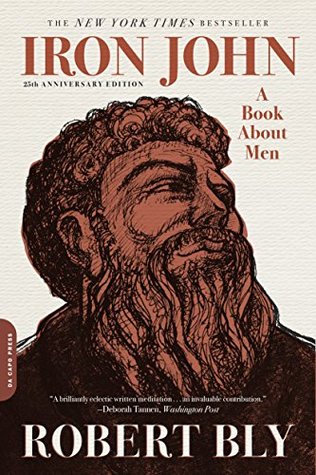
More on this book
Community


Kindle Notes & Highlights


The dark side of men is clear. Their mad exploitation of earth resources, devaluation and humiliation of women, and obsession with tribal warfare are undeniable. Genetic inheritance contributes to their obsessions, but also culture and environment. We have defective mythologies that ignore masculine depth of feeling, assign men a place in the sky instead of earth, teach obedience to the wrong powers, work to keep men boys, and entangle both men and women in systems of industrial domination that exclude both matriarchy and patriarchy.
There’s a general assumption now that every man in a position of power is or will soon be corrupt and oppressive. Yet the Greeks understood and praised a positive male energy that has accepted authority. They called it Zeus energy, which encompasses intelligence, robust health, compassionate decisiveness, good will, generous leadership. Zeus energy is male authority accepted for the sake of the community.
Beatings, slaps in the face, verbal batterings are injuries. Blows that lacerate self-esteem, puncture our sense of grandeur, pollute enthusiasm, poison and desolate confidence, give the soul black-and-blue marks, undermining and degrading the body image . . . these all make a defilement. They damage and do harm.
Having no soul union with other men can be the most damaging wound of all.
If we have no story, we cannot take hold of the wound. We either climb above it, so far up that we can’t reach down to take hold of it, or we become the wound, get stepped on by something so huge we see only the ground below us.
We sense there is some sort of spirit that loves birds and the animals and the ants— Perhaps the same one who gave a radiance to you in your mother’s womb. Is it logical you would be walking around entirely orphaned now? The truth is you turned away yourself, And decided to go into the dark alone.
At thirty-five his inner stove begins to produce ashes as well. All through his twenties, his stove burned with such a good draft that he threw in whole nights until dawn, drinking parties, sexual extravagance, enthusiasm, madness, excitement. Then one day he notices that his stove doesn’t take such big chunks anymore. He opens the stove door and ashes fall out on the floor. It’s time for him to buy a small black shovel at the hardware store and get down on his knees. The ashes fall off the shovel and onto the floor, and he can see the print of his bootsoles in the ashes.
The patriarchy is a complicated structure. Mythologically, it is matriarchal on the inside, and a matriarchy is equally complicated, being patriarchal on the inside. The political structure has to resemble our interior structure. And we know each man has a woman inside him, and each woman has a man inside her. The genuine patriarchy brings down the sun through the Sacred King, into every man and woman in the culture; and the genuine matriarchy brings down the moon, through the Sacred Queen, to every woman and every man in the culture. The death of the Sacred King and Queen means that we live
...more
The inner King is the one in us who knows what we want to do for the rest of our lives, or the rest of the month, or the rest of the day. He can make clear what we want without being contaminated in his choice by the opinions of others around us. The inner King is connected with our fire of purpose and passion.
A man whose King is gone doesn’t know if he has the right to decide even how to spend the day. When my King is weak, I ask my wife or children what is the right thing to do.
The process of bringing the inner King back to life, when looked at inwardly, begins with attention to tiny desires—catching hints of what one really likes. William Stafford describes that as taking in our fingers the end of the golden thread. We notice the turns of thought, or language, that please us. One remembers at forty or fifty what sort of woman or man we really like. What were the delights we felt in childhood before we gave our life over to pleasing other people, or being nurses to them, or doing what they wanted done?
We could say that in the walled garden, as in the alchemical vessel, new metals get formed as the old ones melt. The lead of depression melts and becomes grief. The drive for success, an insistent tin, joins with Aphrodite’s copper, and makes bronze, which is good to make both shields and images of the gods. The enclosed garden then suggests cultivation as opposed to rawness, boundaries as opposed to unbounded sociability, soul concerns as opposed to outer obsessions, passion as opposed to raw sexuality, growth of soul desire as opposed to obsession with a generalized greed for things.
The physical warrior, when well trained, can go through a door, and in the next room will meet the dark-minded, hot warrior. Literature describes Celtic and Viking warriors who went “too far” into that world, following the clawed hand; and men and women cooled them down and reintroduced them with great care to the human community again. We let our warriors go berserk, and then simply discharge them out into the streets.
Most women in the West see no reason to distinguish the warrior from the soldier or the soldier from the murderer. It was a madness associated with the warrior that—during the last war—destroyed the very fabric of culture which it was once the job of the warrior to preserve. Women in other countries may see that differently. A Russian woman from Kiev, whose generation of women have lived for many years without men their own age, said to me, “All the young men who were left after the battle for Kiev went to Moscow to defend it. Not one came back.” She went on, “I know that women in the United
...more
We can talk, then, of living between the opposites. To live between means that we not only recognize opposites, but rejoice that they exist.
Living in the opposites does not mean identifying with one side and then belittling the other. The aim is not that a man, for example, should choose the male role and then regard the female as the enemy.
I am suggesting then that two contemporary trends have come together. One is the increasing emphasis in the American culture on the adult man’s inadequacy, even his absurdity, and the second is the woman’s increased awareness of her own interior emotional richness.
Out of shame over his inadequacy, and in some fear of being pulled over onto the mother’s side before he has stabilized himself as a man, the boy finds in himself an inexplicable anger, a rage that prevents the mother’s dream of a delicate man from becoming real. This anger may exhibit itself when the teenage son talks ugly to his mother in the kitchen. This is his private form of heavy-metal lyrics, bewildering to her. The inexplicable anger may turn up later in hundreds of other ways: isolation, workaholism, or the deeds of a thoughtless Don Juan or James Bond who rip off women sexually, and
...more
The lack of mythology, too, particularly the loss of Greek mythology in the culture at large, and the relegation of fairy tales to children, contributes to the inability of mothers to see what is happening. It’s as if many women are shrewd about the dark or negative side of the Sacred King but naïve about the negative side of the Great Mother.
A traditional way of differentiating guilt from shame is this: Shame, it is said, is the sense that you are an utterly inadequate person on this planet, and probably nothing can be done about it. Guilt is the sense that you have done one thing wrong, and you can atone for it. Some sons called on too early will feel both shame and guilt.
When a young man is red, he shows his anger, he shouts at people, he flares up like a match with a sulfur tip, he flushes red with anger, he fights for what is his, stops being passive, walks on the balls of his feet, is a red hawk, is fierce. Of course no one trusts a red man very far.
If we take nothing else away from the Iron John story, we could usefully take this idea that the young male moves from red intensity to white engagement to black humanity. Each man is given three horses that we ride at various times of our lives; we fall off and get back on.
No one gets to adulthood without a wound that goes to the core.
The Wild Man, we could also say, represents the positive side of male sexuality. The hair that covers his whole body is natural like a deer’s or a mammoth’s. He has not been clean shaven out of shame, and his instincts have not been so suppressed as to produce the rage that humiliates women. The Wild Man’s sexuality does not feed on the feminine or pictures of the feminine; it resonates also to hills, clouds, and ocean. The native American has much Wild Man in him, and it comes out in love of ordinary things. Lame Deer mentions over and over in his autobiography that the Indian experiences the
...more
I believe there is a special figure in men who leads them down into one of their great strengths—the power to grieve. There is a grief in men that has no cause. We can feel it in Bach, Rembrandt, Goya, Homer. I don’t mean that women do not feel grief; but a man’s grief has a separate tone to it. Yet in our culture a man gets very little permission to grieve.
in general he doesn’t know whether to be ashamed of being a man or not.
