
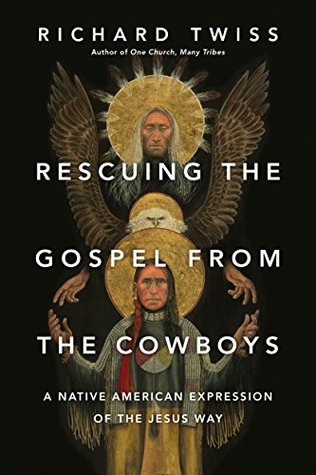
More on this book


Kindle Notes & Highlights

Read between
December 11 - December 26, 2018

contextualization is not a principle, formula or evangelistic strategy. Contextualization is a relational process of theological and cultural reflection within a community—seeking to incorporate traditional symbols, music, dance, ceremony and ritual to make faith in Jesus a truly local expression.
Relative to this book, syncretism is a theological term that carries the idea of mixing religious beliefs together. For some this is a matter of critical concern because these are not just any beliefs, but what are perceived as incompatible or opposing beliefs—not just surface or behavioral beliefs, but essential worldview perspectives.
We know that Christ is not distorted but people’s perceptions certainly can be. “Now we see things imperfectly, like puzzling reflections in a mirror, but then we will see everything with perfect clarity. All that I know now is partial and incomplete, but then I will know everything completely, just as God now knows me completely” (1 Cor 13:12). If we can only, at best, see “puzzling reflections,” then perhaps we can never totally escape distortion. I am suggesting in light of the arguable definitions of “what is and what isn’t” syncretism, that mixing is a normative process of positive change
...more
While theologians and church leaders attempt to define syncretism with “relative objectivity,” I don’t see this being possible because the conversation is situated within, thus prejudiced by, Western reductionist categories. Native North American ministry leaders have never seriously studied its meaning outside these Western categories and are thus predisposed to consider syncretism to be synonymous with biblical heresy.18
The mixing of Euro-American culture with the gospel—from Plato to Andrew Jackson to Ronald Reagan—is considered permissible and orthodox. Brian McLaren sees counteractive syncretism, when used in typical ways by white Euro-American male theologians, as intended to attack the mixing of any cultural heritage (other than their own) with the gospel. For him the result “is the mixing of Platonic categories with the biblical witness (as the creeds exemplify—dependent as they are on terms like ‘homoousios’ and ‘hypostasis’) without claims of syncretism, but Native American stories and culture cannot”
...more
A short time ago I met with a non-Native colleague who is actively involved in full-time Native ministry as a Bible teacher for a Native Christian organization. While discussing the controversy and challenge of doing contextualization, he said to me, “I barely know my own white culture, let alone Native culture, so I am just going to stick to teaching the Word of God and you can teach about culture.” His pejorative comment reflects a Western dichotomy that is problematic for us. Reyburn comments on a nearly identical comment made by a missionary in Africa who said, “We are here only to present
...more
in crosscultural situations, worldview clashes have made it difficult for new ideas to naturally emerge—or to allow the living out of the gospel in a unique cultural context. This is often a reflection of a sense of superiority in the change agent (missionary), which, in social-change innovations, affects the adoption and the diffusion rate due to the perception that adoption will alienate people from their traditional knowledge entirely.43 Tinker would assert, however, that today “an Indian pastor is more likely than a white missionary to criticize the paganism of traditional spirituality”
...more
For years missiologists have said a truly Indigenous church would be like a three-legged stool—self-governing, self-supporting and self-propagating—not just a Western missions church attended by Indigenous people.64 William A. Smalley debunks the notion of the three-legged stool, calling it a false diagnosis and axiomatic in much missionary thinking.65 Kraft agrees with this westernized notion of the Indigenous church: “The mere fact of self-government, self-support, and self-propagation does not ensure that the church in question is ‘Indigenous.’ The indigeneity (if present at all) lies in
...more
This highlight has been truncated due to consecutive passage length restrictions.
Scot McKnight, in his book A Community Called Atonement, finds the source of this tension to be the conglomeration of Euro-American scholars, ministers and lay folk who have, over the centuries, used their economic, academic, religious and political dominance to create the illusion that the Bible, read through their experience, is the Bible read correctly.1 If self-revelation is the work of Creator and Creator’s engagement with people and nations, then crosscultural communication never occurs in isolation, in a cultural vacuum, but by definition occurs in a crosscultural context. Human
...more
African scholar Ngũgĩ wa Thiong’o describes this reality from his point of view, the colonized one: But the biggest weapon wielded and actually daily unleashed by imperialism . . . is the cultural bomb. The effect of a cultural bomb is to annihilate a people’s belief in their names, in their languages, in their environment, in their heritage of struggle, in their unity, in their capacities and ultimately in themselves. It makes them see their past as one wasteland of non-achievement and it makes them want to distance themselves from that wasteland. It makes them want to identify with that
...more
Colonialism imposed its control of the social production of wealth through military conquest and subsequent political dictatorship. But its most important area of domination was the mental universe of the colonized, the control, through culture, of how people perceived themselves and their relationship to the world. To control a people’s culture is to control their tools of self-definition in relationship to others. For colonialism this involved two aspects of the same process: the destruction or the deliberate undervaluing of a people’s culture, their art, dances, religions, history,
...more
In my first fourteen years of embracing Jesus, I conformed to the expectation to accept interpretations of the Bible that said “old things had passed away and all things had become white”—regarding my following Jesus in the context of Native ways of music, dance, drumming, ceremony and culture. In reference to my Native culture, I was informed that the Bible said, “Touch not the unclean thing,” or “come out from among them and be separate,” or “what fellowship does light have with darkness?” This meant I needed to leave my Indian ways behind me because I had a new identity in Christ and it was
...more
After the Revolutionary War, various states in the newly formed United States of America immediately began adopting constitutions and enacting statutes in which they asserted their superiority over Indians. In 1813 the Pennsylvania Supreme Court stated that Indians could not own real property since “not being Christians, but mere heathens [they are] unworthy of the earth.”70
Lending a philosophical framework for Manifest Destiny were certain worldview assumptions about land. “For Europeans, land not occupied by recognized members of Christendom was theoretically land free to be taken. When practically possible, they did so. The Christian colonizers of the Americas . . . conceived the territory itself as sacred.”78 As so many have noted, this was “the New Canaan—a land promised, to be reconquered and reworked for the glory of God by His select forces, the saving remnant in the wilderness.”79
Treaties with Indians, as the governor of Georgia unflinchingly put it, “were expedients by which ignorant, intractable, and savage people were induced without bloodshed to yield up what civilized peoples had a right to possess.”80
The first Christian missionaries in America used the Old Testament Exodus narrative to rationalize the decimation of Native populations by viral epidemics that had devastated the inhabitants of coastal communities before their arrival. “John Winthrop [1587–1649; four-term governor of Massachusetts Bay Colony] claimed in 1629 that ‘God hath consumed the natives with a great plague in those parts,’ and thus Puritan settlers had a ‘warrant’ to settle in New England.” Another example of this type of thinking is revealed in this quote: “In Pequot War descriptions, Puritan victors exulted in the
...more
A few months after I had begun living at a Christian training center north of Anchorage, I began to wonder how my Lakota heritage could be part of my new Christian experience—especially after having recently come through the AIM experience. Six months earlier I hated white people and Christianity, and now I was a Christian and supposed to love them. So one afternoon I asked one of the pastoral leaders how I was supposed to relate to my Native culture as a Christian. I distinctly remember him opening the Bible he was carrying. He read from Galatians 3:28 where Paul said, “There is neither Jew
...more
This highlight has been truncated due to consecutive passage length restrictions.
“Then in 1987 I was speaking with a tribal woman one day and I said, ‘I am part Indian’ and she said, ‘Which part, your leg? You either are or you aren’t.’ So that was the day I embraced my culture. “I am learning every day to embrace who I am, and that is critical. Jesus says he is going to meet you right where you are at and he will take care of the rest, so we have to embrace those things.
Speaking of this kind of “heart language,” using different terminology, Kraft notes that the longer a people or group utilizes a majority of foreign forms, the longer Christianity will remain a foreign religion, which I think is particularly true of music: When the [Native] Christians think of the Lord as their own, not a foreign Christ; when they do things as unto the Lord meeting the cultural needs around them, worshiping in patterns they understand; when their congregations function in participation in a body, which is structurally Indigenous, then you have an Indigenous Church. Note that
...more
In light of hundreds of years of colonization and missions history, the Native leaders best suited as innovators to introduce and negotiate new contextualization efforts are multicultural people who can navigate the Anglo, Native, urban and reservation cultural worlds as interpreters. It is important to understand this because of the historical tension typically confronting these types of people in a colonial context. They are often misunderstood by both sides, while playing a critical role, for better or worse, as cultural brokers or interpreters within a governing dominant culture.
