
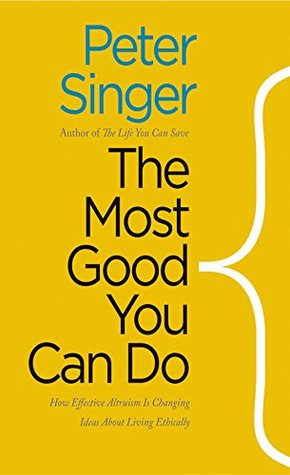
More on this book
Community


Kindle Notes & Highlights
by
Peter Singer

Effective altruism is based on a very simple idea: we should do the most good we can. Obeying the usual rules about not stealing, cheating, hurting, and killing is not enough, or at least not enough for those of us who have the great good fortune to live in material comfort, who can feed, house, and clothe ourselves and our families and still have money or time to spare. Living a minimally acceptable ethical life involves using a substantial part of our spare resources to make the world a better place. Living a fully ethical life involves doing the most good we can.
Quoting scientific studies that show the risk of dying as a result of making a kidney donation to be only 1 in 4,000, he says that not making the donation would have meant he valued his life at 4,000 times that of a stranger, a valuation he finds totally unjustified. He even told Ian Parker, the author of the New Yorker profile, that the reason many people don’t understand his desire to donate a kidney is that “they don’t understand math.”
Abhijit Banerjee and Esther Duflo, professors of economics at MIT, who founded the Poverty Action Lab to carry out “social experiments”—by which they meant empirical research to discover which interventions against poverty work and which do not. Without such evidence, Duflo points out, we are fighting poverty the way medieval doctors fought illness by applying leeches.3 Banerjee
When he expressed his views about poverty, his friends would retort, “If you believe that, why don’t you just give most of your money to people starving in Africa?” His friends thought that this conclusion was absurd, but Toby asked himself, “If my money could help others much more than it helps me, then why not?”
“If we can prevent something bad, without sacrificing anything of comparable significance, we ought to do it.”7 Aaron
She told her father of her decision, and he replied. “It doesn’t sound like this lifestyle is going to make you happy,” to which she responded, “My happiness is not the point.” Later,
Julia admits to making mistakes. When shopping, she would constantly ask herself, “Do I need this ice cream as much as a woman living in poverty elsewhere in the world needs to get her child vaccinated?” That made grocery shopping a maddening experience, so she and Jeff made a decision about what they would give away over the next six months and then drew up a budget based on what was left. Within that budget, they regarded the money as theirs, to spend on themselves. Now Julia doesn’t scrimp on ice cream because, as she told the class, “Ice cream is really important to my happiness.”
Ben West points out that even from a selfish perspective, earning to give allows you to have things that people believe make them happy, like money and a high-status job, while still getting the fulfillment that comes from knowing you are helping to make the world a better place.
The consequentialist notion of complicity does have implications that many people will reject. It implies, for instance, that the guards at Auschwitz were not acting wrongly if their refusal to serve in that role would have led only to their replacement by someone else, perhaps someone who would have been even more brutal toward those who were about to be murdered there.
Writers like de Waal and Jeremy Rifkin have seized on the idea of empathy as, to use de Waal’s words, “the grand theme of our time.”4 Rifkin believes that civilization has spread the reach of empathy beyond the family and the community so that it covers all of humankind.5 Barack Obama has said we should talk more about “our empathy deficit.”6 Shortly after he was elected president of the United States, Obama received a letter from a young girl suggesting a ban on unnecessary wars. In response he told the girl, “If you don’t already know what it means, I want you to look up the word ‘empathy’
...more
A test used by psychologists to assess empathy, the Interpersonal Reactivity Inventory, measures four distinct components: 1.Empathic concern is the tendency to experience feelings of warmth, compassion, and concern for other peope; 2.Personal distress is one’s own feelings of personal unease and discomfort in reaction to the emotions of others; 3.Perspective taking is the tendency to adopt the point of view of other people; and 4.Fantasy is the tendency to imagine oneself experiencing the feelings and performing the actions of fictitious characters. The first two refer to what one feels about
...more
Effective altruism does not require the kind of strong emotional empathy that people feel for identifiable individuals and can even lead to a conclusion opposed to that to which this form of emotional empathy would lead us. In one study, people were shown a photo of a child and told her name and age. They were then informed that to save her life, she needed a new, expensive drug that would cost about $300,000 to produce, and a fund was being established in an attempt to raise this sum. They were asked to donate to the fund. Another group was shown photos of eight children, given their names
...more
In a study of the role of emotion in moral decision making, subjects were presented with so-called trolley problem dilemmas in which, for example, a runaway trolley is heading for a tunnel in which there are five people, and it will kill them all unless you divert it down a sidetrack, in which case only one person will be killed. In a variant, the only way to stop the five being killed is to push a heavy stranger off a footbridge. He will be killed, but his body is heavy enough to stop the trolley and save the five. In three different experiments, those who made consistently utilitarian
...more
In response to those who think that what the world most needs is an expansion of empathy, Bloom writes, “Our best hope for the future is not to get people to think of all humanity as family—that’s impossible. It lies, instead, in an appreciation of the fact that, even if we don’t empathize with distant strangers, their lives have the same value as the lives of those we love.”
Charlie Bresler, the unpaid executive director of The Life You Can Save, has told me, “I truly do not believe in ‘altruism’—I believe the life I am saving is my own and that I should have started doing this kind of work much sooner!”
The survey shows a correlation, not causation, and it seems that the causation can run both ways because people who are happy are more likely to give to help others.10 This

prisao felicidade
