
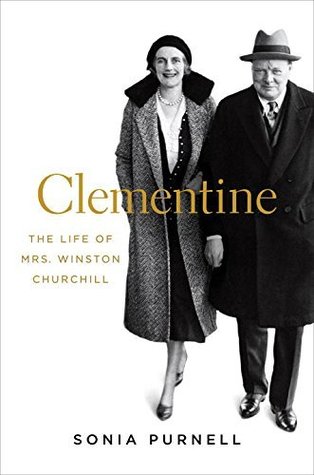
More on this book
Community


Kindle Notes & Highlights


“armed to the teeth for life’s encounter” but “also strangely vulnerable” and in want of “protection.”
Yet she was more powerful and in some ways more progressive than many of her modern successors. The struggles she endured still resonate—not
“There is no job description for the Prime Minister’s spouse because there is no job.
no other president or prime minister’s wife has played such a pivotal role in her husband’s government.
Clementine was enraptured by her mother’s ability to spin comfort out of the least promising circumstances,
her natural rebelliousness provoked her to give her daughters what were then unusual freedoms.
has recently suggested—though her thesis is much disputed—that he might even have been Jack the Ripper.)
she was in the main trying to protect herself in a world that was both cliquey and savage.
she should have been a queen,
“ambition was the motive force and he was powerless to resist it.”
statesman, he declared, should be able to depend “upon the love, the insight, the penetrating sympathy and devotion of his wife.”
Still the best is to be true to oneself—unless you happen to have a vy tiresome self!”22
“I feel so safe with you & I do not keep the slightest disguise.”
Women were, in his view, lesser beings who were unjustifiably “cocksure”;
Winston did not care for women to venture their own views—with the exception of Clementine
Clementine saw it as heroic to be denigrated for helping the poor and she exulted in watching Winston’s popularity with the working classes soar as a result.
“her inner reserve never left her, and throughout her life, she fended off attempts to make intimate relationships.”
“At times I think that I could conquer everything—and then again I know that I am only a weak fool.”
Mary thought in any case that the Dog was “kennelled” by his love for Clementine and the confidence she now brought to him.48
She still underestimated Clementine but confessed to being fascinated as to what Winston’s wife “could do with him.”
she had “decided to give her life totally” to Winston. She would “live for him”11 and could only really be happy when it was clear that he needed her.
“None of us,” he would say, “can do anything without power.”
“stoic fortitude with which women bear the most agonising sorrows.”
To see Winston torn from his naval work, he said, was like watching Beethoven go deaf.
only Clementine’s unbreakable loyalty preserved Winston’s “sanity” in the First.
Later Winston would say that if it had not been for painting he could not have withstood the strain.
Clementine seemed to lack both the inclination to coax her out of her shell and the strength to keep her children in order.
She was, in effect, an early twentieth-century amalgam of special adviser, lobbyist and spin doctor, and she became widely admired on the political circuit.
“All one needs is core common sense but to be born with trousers instead of petticoats!”
never scold a husband, otherwise “he will only go where he is not scolded.”
I feel confidence in your star.”
T]he beauty & strength of your character & the sagacity of your judgment are more realised by me every day.”
My] greatest good fortune in a life of brilliant experience has been to find you, & to lead my life with you . . . I feel that the nearer I get to honour, the nearer I am to you.”
Her new position of authority gave her the chance to advance her feminist beliefs.
Clementine was honing impressive leadership skills.
instinctive sympathy for the worker’s point of view.
He was keen for her to know that he was a fair and compassionate commander.
More than seven million British women worked during the First World War, many of them for the first time.
Being unhappy brings Him to my thoughts but only, I fear, becos’ I want to be comforted not becos’ I want Him for Himself.”
We are still young, but Time flies, stealing love away, and leaving only friendship which is . . . not very stimulating or warming.”56
As Violet later put it, while Winston certainly had “vision” he lacked “antennae.”2
But a buoyant Winston was also a selfish and dictatorial one.
but it was she who had the foresight to look to the future and the need for him to reinvent himself as a man of peace, as well as of war.
“I think you will find real scope in the new world opening out to women, & find interests wh will enrich yr life,”14
But total war had brought about a social revolution. British society was never to be quite so unequal again and women, including Clementine, were no longer seen as hysterical weaklings. They led more of their lives outside the home than ever before; they were more visible and more demanding of respect.
Clementine’s unfailing eye for Winston’s own best interests could sometimes blind her to the bigger picture.
“My Darling, you have been the great event in [my life]. You took me from the straitened little by-path I was treading and took me with you into the life & colour & jostle of the high-way.”3
For all of his wife’s efforts to persuade Winston to recast himself as an advocate for peace, he had willfully chosen a course that had led him to be painted as a warmonger.
Clementine struggled to see a way out; Winston simply assumed there would be one.
hints that she began to harbor doubts about the viability of her marriage at this point.
