
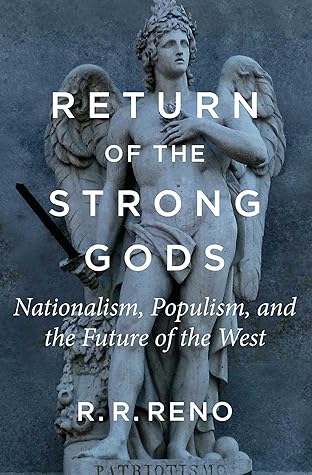
More on this book
Community


Kindle Notes & Highlights

by
R.R. Reno
Read between
December 1, 2024 - January 28, 2025

A uniquely Western anti-Western multiculturalism deprives people of their cultural inheritance.
We continue to define ourselves culturally, even spiritually, as anti-totalitarian, anti-fascist, anti-racist, and anti-nationalist. I call the atmosphere of opinion that sustains these anti imperatives the “postwar consensus.” Although there has been political contention between the left and the right, it has been a sibling rivalry. As I will show, the postwar left fixed its attention on moral freedom and cultural deregulation, seeing them as natural extensions of the anti-authoritarian imperative, while the postwar right focused on economic freedom and market deregulation for similar
...more
a fundamental judgment: whatever is strong—strong loves and strong truths—leads to oppression, while liberty and prosperity require the reign of weak loves and weak truths.
We need to face the challenges of the twenty-first century, not the twentieth. This will not be easy. Today, the greatest threat to the political health of the West is not fascism or a resurgent Ku Klux Klan but a decline in solidarity and the breakdown of the trust between leaders and the led. Fearful of strong loves and committed to ever-greater openness, the postwar consensus cannot formulate, much less address, these problems. Unable to identify our shared loves—unable even to formulate the “we” that is the political subject in public life—we cannot identify the common good, the res in the
...more
Popper sees any form of transcendence as implicitly totalitarian. The recognition of something higher than the individual sets up a suprapersonal authority. If I can know what it means to be human, then I have a standard by which to judge individual behavior, and it is just such a standard, Popper argues, that is characteristic of a closed society. Long before the invention of words such as “logocentrism,” Popper denounced strong truth-claims as threats to freedom and midwives of totalitarianism.
According to Popper, the quest for a higher truth “is born of fear, for it shrinks from realizing that we bear the ultimate responsibility even for the standards we choose.”14 Since we often cannot endure the “strain” of freedom, we are tempted to invent truths and pledge our troth to them, setting ourselves on the road back to totalitarianism.
As George Marsden explains in his account of postwar politics in the United States, The Twilight of the American Enlightenment: The 1950s and the Crisis of Liberal Belief, an older liberal consensus based on natural rights gave way to a liberal consensus about the importance of consensus.
Hayek is not as precise as Popper, but he intuits that resistance to collectivism requires an anti-metaphysical stance. Since the basic principle of individualism is individual liberty, we must resist anything that compels our choices, even holding at arm’s length the compelling character of solid and significant moral truths. “There is nothing in the basic principles of liberalism to make it a stationary creed,” Hayek writes.27 The essence of individualism is the freedom of every individual to be “the ultimate judge of his ends.”28 I must have the liberty to decide what is good or bad for me.
...more
Today, the great books of the Western tradition are more neglected than critiqued.
The reductive explanations of the social sciences neuter the existential power of truth. Beliefs and convictions become preferences and interests. As a consequence, by the late twentieth century, the political-cultural significance of the social sciences, brain science, and sociobiology came to parallel rather than contradict the humanities’ preoccupation with race, class, and sex. Reducing the human condition to economic interests or “selfish genes” has the same political and cultural effect as multiculturalism. Both disenchant and weaken, serving the ideals of an open society. This
...more
The traumas of 1914–1945 explain this consensus. The entire cultural establishment wanted to forestall the development of the authoritarian personality.
Brown outlined the basic program that still dominates culture in the West. We see it at work in postmodern academic theory, which reigns in universities and provides the intellectual underpinnings for multiculturalism. This theory teaches that social norms and cultural ideals are manifestations of primitive impulses and instinctual urges: sexual desires, will to power, self-interest, lust for domination, class oppression, and so forth. Even our selfish goals—to look thin or to dress for success—get analyzed as social constructs, serving, perhaps, to sustain patriarchy, “late capitalism,” or
...more
the anti-metaphysical therapies of disenchantment that so many regarded as necessary to drain away the energizing sources of ideology and authoritarianism became a noble enterprise, the very essence of true humanism. The smaller our worlds, the more vacant our metaphysical dreams, the more arid our moral vocabularies, the more peaceful, decent, and accepting we become.
Friedman’s political ecumenism reveals an important commonality between the postwar right and left. The postwar right emphasizes economic deregulation and the need to open up more space for free economic choices, while the postwar left focuses on cultural deregulation, Camus’s concern. But they are united in their pursuit of an open society, differing only in focus and emphasis.
in the eyes of the modern economist, multiculturalism mischaracterizes the interests that give order to society. The cultural theorists think in collective terms: the interests of the powerful, the interests of capital, the interests of the cisgendered, the interests of white males, and so forth. But economists and multiculturalists both pursue disenchantment, which transforms truth into meaning—and then meaning into preferences, impulses, and urges, which today’s economists interpret in individualistic terms, unlike the proponents of multiculturalism. This difference is significant, but what
...more
“cultural theory,” the highbrow form of multiculturalism.
Derrida’s methods of deconstruction seized the imaginations of American academics for reasons that should now be clear.
Although it was not obvious at the time, Derrida’s philosophy destroyed the intellectual credibility of Marxism.
contrary to its mythology, the rebellion of ’68 was not revolutionary. The attacks on traditional authority led to liberations of many sorts, but they enhanced the therapies of disenchantment, clearing away older loyalties or devotions that impeded the expansion of market exchange and its reliance on spontaneous order. The women’s movement freed women to pursue their own desires without the hindrance of older norms of motherhood and wifely duty. They entered labor markets in record numbers. Gay liberation was supposed to overturn the bourgeois order, but in fact the gay lifestyle has become
...more
Unrestrained by the existential threat of communism, the Western postwar consensus tended toward pure negation, leaving us a utopian dream of politics without transcendence, peace without unity, and justice without virtue.
(It is a signal characteristic of “hermeneutic philosophy” to say we can no longer believe in something rather than arguing that it is false.)
The educational culture of the West manifests a pattern of weakening. We no longer think of higher education as the source of strong truths. It is instead devoted to critique and reduction.
The mainstream political outlook in the West has become more and more technocratic. We are told we need experts and scientists who can sort out a fact-based approach to life.
The rhetoric of “weakening” dovetails with the neoliberal economic and cultural project of porous borders and infinite fluidity, a restless utopianism that is always looking for another boundary to overcome, as the present mania for transgenderism demonstrates.
no culture survives without strong gods. This is as true for an open society as a traditional one. A society lives on answers, not merely questions; convictions, not simply opinions. The political and cultural crisis of the West today is the result of our refusal—perhaps incapacity—to honor the strong gods that stiffen the spine and inspire loyalty. We are subjected to the increasingly shrill insistence that “critical questioning” is the highest good and “diversity is our strength.” We are told that every motif of weakening, dispersion, and disenchantment serves the common good because it
...more
The architecture of the open society is borderless. It is an architecture of “lightening,” unburdened by history and very nearly weightless, expressing reductive mathematical and biological truths. It follows John Rawls’s prescription of keeping comprehensive doctrines out of the public landscape.
Populism is more than a rebellion against outsourcing, political correctness, and too many foreigners. It is a rejection of the postwar consensus.
diversity makes sense only within the postwar consensus, with its fusion of the imperatives of an open economy and an open culture. The concept came to prominence after the Supreme Court invoked it in Regents of the University of California v. Bakke (1978). Justice Lewis Powell’s plurality opinion declared a “diverse student body” a legitimate goal for an educational institution because it enhances the learning environment,
Diversity is a slogan of the open society. It isn’t a principle. It’s a therapy. One does not learn about diversity; one is trained in it.
Islam is not, and so need not be feared—or so they imagine. The logic of multiculturalism, therefore, is paradoxically Eurocentric. It exists only to address our particularly Western nightmares of concentration camps and lynchings.
In his important book Coming Apart: The State of White America, 1960–2010, Charles Murray documents the trend toward dysfunction on the lower rungs of society. Well-to-do Americans have handled fifty years of openness reasonably well, but cultural deregulation has been hell on the bottom 30 percent.
Recent dustups over the supposedly racist implications of advocating marriage, thrift, and a good work ethic reveal the logic of cultural deregulation. The goal is to strip society of norms, leaving unsheltered those who cannot afford to live in well-appointed enclaves that covertly sustain modified bourgeois norms for the rich and their children. In the open culture, the lives of ordinary people become more disordered and less functional. Civic solidarity is undermined and fears about discrimination fester. When racial tensions increased during Obama’s eight years as president, commentators
...more
But insofar as this vast nation is united as a “we,” politics in America, however messy, is about governing a people rather than the technocratic management of various interests.
meaning. This project cannot be opposed solely on political grounds, as if nationalism alone can overcome the “destiny of weakening.” We need strengthening motifs across the board. A man who cannot affirm the border between male and female will find it difficult to defend a border between nations.
