
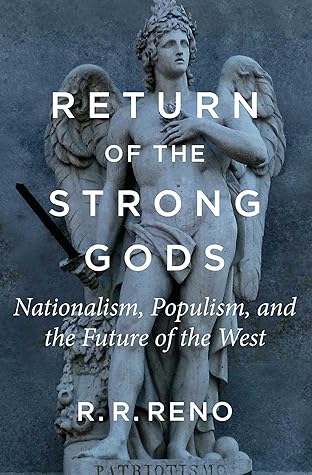
More on this book
Community


Kindle Notes & Highlights

by
R.R. Reno
Read between
August 19 - August 24, 2025

After 1989, we did not relax our vigilance. On the contrary, people began to monitor pronouns and search for “microaggressions” to punish.
This is absurd. It is not 1939. Our societies are not gathering themselves into masses marching in lockstep. Central planners do not clog our economies. There is no longer an overbearing bourgeois culture bent on “exclusion.” Bull Connor isn’t commissioner of public safety in Birmingham. Instead, our societies are dissolving. Economic globalization shreds the social contract. Identity politics disintegrates civic bonds. A uniquely Western anti-Western multiculturalism deprives people of their cultural inheritance. Mass migration reshapes the social landscape. Courtship, marriage, and family no
...more
Nor is the cultural influence of the postwar consensus confined to the left. The same insistence on openness and weakening is found in libertarianism as well, which seeks cultural deregulation so that individuals are not constrained by shared norms.
By “strong gods,” I do not mean Thor and the other residents of the Old Norse Valhalla. The strong gods are the objects of men’s love and devotion, the sources of the passions and loyalties that unite societies.
Distorting the healthy intuition that the economy, politics, and culture should be ordered to the common good, fascism stokes a fevered desire for unanimity that cannot tolerate dissent. Communism turns the desire for justice into a rigid, brutal ideology. Racism and anti-Semitism express communal fears that become punitive and murderous.
In the pages to follow, I will show how anti-fascism and anti-totalitarianism inspired a general theory of society. That theory has many forms, some explicit, others tacit. But it is characterized by a fundamental judgment: whatever is strong—strong loves and strong truths—leads to oppression, while liberty and prosperity require the reign of weak loves and weak truths.
We must stop acting as if it were 1945.
The postwar consensus, however fitting in its earlier stages, is decadent.
Today, the greatest threat to the political health of the West is not fascism or a resurgent Ku Klux Klan but a decline in solidarity and the breakdown of the trust between leaders and the led.
In the twenty-first century, oligarchy and an unaccountable elite pose a far greater threat to the future of liberal democracy than does the return of Hitler.
But the members of our leadership class cannot recognize the crisis of solidarity that threatens the West and fuels populism. They compulsively refocus attention on the problems the postwar consensus was constructed to fight: fascism, racism, conformism, and the authoritarian personality. Mention the erosion of the middle class, and someone is sure to observe that concerns about renewing solidarity amount to dangerous nostalgia.
Donald Trump, Viktor Orbán, and other populist challengers are not choirboys or immaculate liberals. But their limitations are not nearly as dangerous to the West as the fanaticism of our leadership class, whose hyper-moralistic sense of mission—either us or Hitler!—prevents us from addressing our economic, demographic, cultural, and political problems.
The West is careening toward crisis not because of a defect deep within modernity. Our troubles do not stem from William of Ockham, the Reformation, John Locke, capitalism, or modern science and technology. It is true that there are atomizing, deracinating, deconsolidating trends in modernity. Many historians, philosophers, and social critics have pointed them out. But it is always so. The fall of man left every civilization, every era under the law of entropy, which is why renewing shared loves and unifying loyalties is one of the primary arts of leadership.
The very title expresses anti-fascist aggression. But the ambition is negative and open, seeking meaning and “realism,” not truth. Young people need to be liberated from restrictive, punitive ideas about sex, the researchers argue, as well as overwrought patriotism and ready appeals to authority. They call for a new consensus, the open society consensus, which will allow the next generation to live more naturally, more humanly, and more peacefully, freeing the West from its long history of hate, oppression, and war. It was new gospel, and it won many believers.
Although he does not say it explicitly, Hayek implies that there is always greater freedom for the individual when the social consensus about right and wrong is weakened. The prerequisite of cultural deregulation and the reign of the weak gods was already evident in John Stuart Mill’s defense of individualism, On Liberty, published nearly a century earlier.
Hayek was concerned about the economic inefficiencies of central planning, but the first principle of his individualism was individual liberty, understood as the greatest possible scope for action, unhindered by transcendent obligations or the commands of higher authorities.
Reducing the human condition to economic interests or “selfish genes” has the same political and cultural effect as multiculturalism. Both disenchant and weaken, serving the ideals of an open society.
The postwar right emphasizes economic deregulation and the need to open up more space for free economic choices, while the postwar left focuses on cultural deregulation, Camus’s concern. But they are united in their pursuit of an open society, differing only in focus and emphasis.
These projects—economic deregulation and cultural deregulation—are not at odds with each other. They reinforce each other, as Friedman often noted. Both presume and encourage the therapies of disenchantment. After all, man is a social animal, as anyone who is remotely observant recognizes. We are religious animals and philosophical animals, as well, drawn to greater loyalties, shared projects, and higher aims, which Friedman, like the liberal tradition more broadly, sees as a threat to social peace.
The culture of freedom envisioned by Hayek and Friedman paradoxically encourages the careful and minute management of culture. We must be educated to believe that there are no common goods, only individual interests. In this pedagogy, the ideologies associated with multiculturalism become allies, not enemies, of the postwar conservatism Friedman inspired. They assist in the moral goal of expanding market order, for they habituate us to believe that there are no higher truths to rally around.
He became famous because he made disenchantment the theoretical basis of culture, laying the foundations for the fusion of economic and cultural deregulation that characterizes mainstream, establishment politics today, whether center-right or center-left. Derrida’s singular contribution was turning the historical contingency of the postwar consensus into a timeless, anti-metaphysical truth.
Derrida isn’t interested in that at all. Instead, he wants to dismantle claims to knowledge and point the way toward a radically disenchanted world in which one cannot know anything stable, permanent, universal, or transcendent.
The trajectory is plain to see. The more our leadership class has championed diversity and multiculturalism, the more powerful identity politics has become. Those who gravitate toward “identity” have the correct intuition that solidarity requires a shared loyalty. Because the relentless pursuit of the open-society agenda deprives them of a strong civic identity, they fall back on race, sex, sexual orientation, or some other “identity,” a process that reinforces and is reinforced by the postwar consensus. Identity politics accentuates the differences that diversity and other therapies of
...more
In his denunciation of “collectivism,” Hayek taught that notions such as national character or “destiny” lead to serfdom.
When talking to a smart graduate student in Cambridge, Massachusetts, doing work in social policy, I was not surprised to discover that he could not formulate a reason to give preference to an unemployed worker in Ohio over someone in Senegal who wants to migrate to the United States. More and more voters in the West sense this strange inability among our leadership class to affirm their loyalty to the people they lead. And so voters suspect, correctly, that those who lead are not willing to protect them from economic competition or cultural displacement. Their leaders will not do what leaders
...more
When the ruling class ignores or derides the unsettled populace (“deplorables,” “takers,” “racists,” “Islamophobes,” “fascists,” and so forth), the restlessness jells into an adversarial mood. A populist gains political power on the strength of this adversarial stance. He opposes the governing consensus, attacking its political embodiment, the establishment.
In the undying twentieth century, the establishments of the West exacerbate our most pressing problems, all of which reflect a crisis of solidarity, rather than addressing them. Marriage is collapsing among working-class Americans. In the face of this reality, it borders on insanity to fix political attention on transgender bathrooms and other symbols of cultural deregulation. An epidemic of death by drug overdose is damaging communities and shattering families, and our leaders are pushing for marijuana legalization. As the suicide rate among unemployed men rises, we launch a crusade for
...more
When seventy thousand football fans rise for the national anthem, their reverence is repaid with pride—pride in their country. I find myself increasingly impatient with those who despise patriotic ceremonies and traditions. Invariably educated and well-off, they have personal assets and achievements to be proud of. But most Americans are not so self-satisfied. Their proudest achievement is the freedom of their country; their most precious possession is their citizenship; their most important contribution to self-government is their loyalty. Patriotism renews the bond of the “we.” True, only a
...more
