
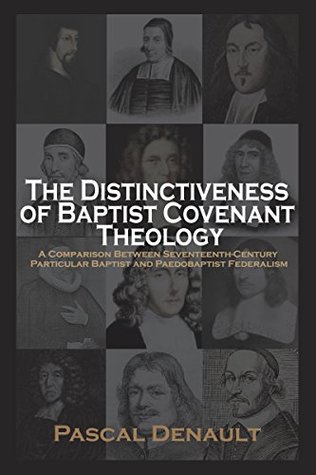
More on this book
Community


Kindle Notes & Highlights

Read between
March 5 - March 24, 2022

We propose that covenant theology is that distinctive between Baptists and paedobaptists and that all the divergences that exist between them, both theological and practical, including baptism, stem from their different ways of understanding the biblical covenants. Baptism is, therefore, not the point of origin but the outcome of the differences between paedobaptists and credobaptists.
Before asking the question “Who can be baptized?” there was a more fundamental question, namely: “Who is in the covenant?” This is the most fundamental consideration in defining the Baptists’ identity
The very natures of the gospel and of the church were at the heart of this debate.
The issue that made them Baptists was to know who makes up the people of God.
The terms of the covenant of works (Lev. 18.5) were repeated, not to make a new offer of eternal life, but to remind Israelites of the terms of the original covenant of works.
We think it is precisely this point, the notion of the covenant of grace, which is the root of everything that is at issue between Presbyterianism and the Baptist movement.
The covenant of grace, in Reformed perspective, is the covenant that includes all of the saved of all time, from the creation of the world until the last judgment. All those who were objects of God’s grace were in the covenant of grace.
By distinguishing the substance from the administration, the paedobaptists could consider a place for the non-chosen within the covenant of grace and thereby make a place for the natural posterity of believers and give them the right to baptism.
The organic unity of the covenant of grace was and remains the cornerstone of paedobaptist theology.
The Baptists did not deny the principle of natural posterity under the old covenant. However, they considered the importation of this principle under the new covenant to be a fallacy dependant on an artificial and arbitrary construction of the covenant of grace.
Blake once again defends the mixed nature of the church by trying to prove that the New Testament names as believers, saints, disciples, and Christians people who are not regenerated. For example, he considers that the five thousand men converted at Pentecost belonged to the visible church and yet, although they all professed the faith, they were not all regenerated. Simon the magician would be an example of one of these believers who were not saved. Blake also gives the example of the nonbelieving spouse who is called a saint by virtue of the believer (1 Cor. 7:14); he thereby deduces that
...more
The Baptists saw a unity of substance in the covenant of grace from Genesis to Revelation, but they didn’t see this same unity between the old and the new covenants.
The Baptists believed that before the arrival of the new covenant, the covenant of grace was not formally given, but only announced and promised (revealed).
If Westminster federalism can be summarized as “one covenant under two administrations,” that of the 1689 would be, “one covenant revealed progressively and concluded formally under the new covenant.”
The Baptists believed that no covenant preceding the new covenant was the covenant of grace. Before the arrival of the new covenant, the covenant of grace was at the stage of promise.
The new covenant did not exist as a covenant before Jesus Christ; however it did exist as a promise (cf. Jer. 31:31). The covenant of grace revealed to Adam, and then to Abraham, was the new covenant promised. Therefore, before Jesus Christ, the new covenant did not exist as a formal covenant, but then neither did the covenant of grace.
Benjamin Keach, one of the main Baptist theologians of the second half of the seventeenth century, concurs with this view of the covenant of grace when he describes its four sequences: 1. It was first decreed in eternity, 2. It was secondly revealed to man after the fall of Adam and Eve, 3. It was executed and confirmed by Christ in his death and resurrection, 4. It becomes effective for its members when they are joined to Christ through faith.125 The particularity of this ordo salutis is the distinction between the revelation and the execution of the covenant of grace. Those who were saved
...more
We have already seen that the Baptist reading of the covenant of grace (one covenant revealed progressively and formally concluded under the new covenant) was explained by the exegesis of Hebrews 8:6: Before the new covenant, the covenant of grace was only revealed; when the new covenant was introduced, it was νενομοθέτηται. This verb is used only twice in the Holy Scriptures: once to speak of the promulgation of the old covenant (Heb. 7:11) and a second time to relate the promulgation of the new covenant (Heb. 8:6). These two covenants were established (νενομοθέτηται) on two completely
...more
On the paedobaptist side, the covenant of grace is everything that is after the fall. It is established as of Genesis 3:15 and concretized by two covenants: these two covenants are substantially the covenant of grace. Consequently, these two covenants are simply seen as administrations and not as covenants in themselves;
On the Baptist side, it was considered that the old covenant was not a covenant of grace nor even an administration of it. Nevertheless, the covenant of grace was revealed progressively under the old covenant. The arrival of the new covenant marks the full revelation of the covenant of grace which passes from the state of promise to the state of a covenant accomplished and sealed in blood.
With it ends the mixed nature amongst the people of God and the era of infancy (Gal. 4:3) characterized by the shadows of reality (Col. 2:17; Heb. 8:5; 10:1). This break in no way affects the continuity of the covenant of grace, which is henceforth the only covenant through which God has a people; this covenant is the new covenant.
it is undeniable that the paedobaptists practised paedobaptism on the basis of a covenant where baptism did not exist.142 The only reason that explains this hermeneutic—questionable to the Baptists—is the Presbyterian model of the covenant of grace.
In short, the main hermeneutic consequence of the one covenant under two administrations model is the levelling and amalgamation of both testaments.
There is a continuity because the covenant of grace was revealed starting in Genesis 3:15 until its full revelation in the New Testament, but there is also discontinuity because the covenant of grace was not concluded before the death and resurrection of Christ; the formal covenants that preceded this event had a different substance and were, therefore, abolished and replaced by the new covenant.
Presbyterian federalism considers the covenant of grace on two levels: its spiritual substance and its natural administration.
This distinction allowed the Presbyterians to state that the covenant of grace contained both regenerated believers (internal spiritual substance) and people who professed the faith but were not regenerated (natural external administration). Paedobaptism requires this mixed nature since it justifies the inclusion of the posterity of believers in the covenant.
Consequently, for Presbyterians there were two ways to enter into the covenant of grace: one could enter when one was born or when one was born again.
For the Baptists, only faith constituted a valid entry into the covenant of grace. They did not consider the covenant of grace to be concluded simply with the elect, but with the converted elect.
The paedobaptists did not purport to be in the covenant of grace as the natural descendants of Abraham, but as his spiritual descendants; however they practised a spiritual ordinance (baptism) on the basis of natural generation.
if therefore the naturall seed of Abraham could not at all pretend to new Testament Ordinances a right by that title, much less the adopted seed by any such way of natural generation.”
Presbyterian federalism extended the reach of the mediatorship of Christ to all the members of the covenant, but limited its salvific efficacy to the elect. Consequently, within the sphere of the covenant of grace, Presbyterian federalism was comparable to Arminianism.
We believe that the tendencies compromising the gratuitousness of the covenant of grace such as Neonomism, the New Perspective on Paul, the Federal Vision, etc., are naturally derived from the Presbyterian federalism which carries within it the germ of a conditional covenant of grace.
The Baptist understanding rested on another fundamental distinction: one between the phase in which the covenant of grace was revealed and the phase in which it was concluded. The revealed phase corresponded to the period preceding the death of Christ and the concluded phase corresponded to the time that followed. Therefore, Baptists considered that no other covenant besides the new covenant was the covenant of grace. They still recognized that the covenant of grace had been revealed under all the covenants since the fall, but distinguished between the actual substance of these covenants and
...more
There is no doubt that the covenant concluded in the Sinai desert determined the old covenant, but did it initiate it?
We believe the establishment of the old covenant started before the arrival of the Sinaitic covenant. This covenant was concluded on the basis of a covenant between Abraham and God (cf. Exo. 2:24; 3:15–16; 6:4–8).
what having God as one’s God implies must be determined based on the terms of the covenant by which God commits to being God for his people.
Only the terms of the covenant concluded in the Sinai desert can tell us that to which God was committing by promising to be the God of Israel.
The great distinction between Petto’s thinking consisted in completely isolating the Abrahamic covenant as a covenant of grace. According to him, the covenant concluded with Abraham offered the grace of salvation (Gal. 3:18) and, evidently, included the natural posterity of its members.
the covenant of grace was revealed to Abraham, but the formal covenant that God concluded with him was not the covenant of grace. What is more, the text (Gal. 3:17–18) does not affirm that God gave his grace to Abraham through the covenant, but through the promise. In other words, the Abrahamic covenant contained a promise; this promise was the revelation of the covenant of grace.
In agreement with the covenant of works, the old covenant demanded obedience to the law of God in order to obtain the blessings promised,238 but contrary to the covenant of works, the old covenant was based on a sacrificial system for the redemption of sinners which pointed to the mediation of Christ.239 In this way, the old covenant was at the same time a type of the covenant of works in Adam and a type of the new covenant in Jesus Christ.
Benjamin Keach, in which he stands in awe before the unconditional nature and the effectiveness of the blessings that the new covenant gives to all its members: It is a Full Covenant; because in it there is the Mediators Fullness Communicated to all such that are united to him as the effects thereof, ‘tis not a Creature-Fullness that is in Christ; no, but the Fullness of God: For it pleased the Father that in him all Fullness should dwell; — in him dwelleth the Fullness of the God-head Bodily: The Fullness of the God-head dwells as truly in the Son, as in the Father; and of his Fullness do all
...more
This highlight has been truncated due to consecutive passage length restrictions.
the reformers had to reconcile the biblical gospel with a national church model inherited from the Christendom of the Middle Ages. Indeed, the paedobaptist covenant theology fit perfectly this incongruity.
