
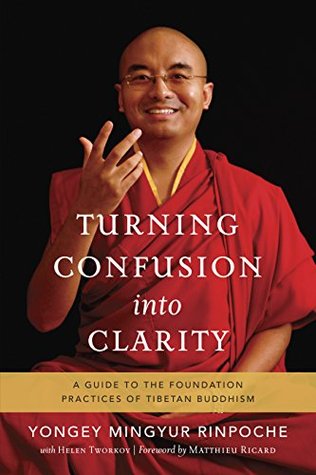
More on this book

Kindle Notes & Highlights

Started reading
September 6, 2025

We wish to let go of the experience of dissatisfaction, and one good place to begin is renouncing the habit of blaming external circumstances for our feelings of anxiety, anguish, and dissatisfaction.
“Phenomena cannot bind you to samsara. Only your own grasping can bind you to samsara. The point is to let go of grasping.”
“We already have everything we need for our journey.”
Dukkha describes a mind that is never completely at ease, that always wants things to be different than they are, a mind endlessly spinning.
The consistent theme of dukkha is wanting things to be different from the way they are.
We enter the second part of ngondro by taking refuge in the Buddha, the supreme guide; the Dharma, the Buddhist teachings; and the Noble Sangha, the community of enlightened beings.
The two critical ingredients for meditation are intention and recognition.
However, the meditation process itself connects us not only with the presence of awareness, but with the very nature of awareness.
Once we recognize this pure awareness, the entire path of awakening—including all the ngondro practices—helps nurture and stabilize this recognition, and integrates it with every aspect of our life.
“We are always responding to the projections, but we do not know how to work the projector,” said Saljay Rinpoche. “The projector is the monkey-mind, the boss. It will not help to hate the monkey. That just traps the mind in negativity and gives the monkey more power. Trying to lock the monkey away will not work because it will always figure out how to escape. But do not become a slave to the monkey-mind. The trick is to give the monkey-mind a job. Monkey-mind loves jobs, loves to work, and loves to keep busy. You make the monkey-mind your employee, and you become the boss.”
Sit in a relaxed posture with your back straight. Your eyes can be open or closed. Take a minute or two to rest in open awareness. Perhaps bring to mind that feeling of sinking into a chair to rest after strenuous exertion: aaahhh. Now breathe normally through your mouth, nose, or both. Bring your awareness to your breath as it flows in and out. At the end of the out-breath, rest your awareness in the gap that comes naturally before the next inhalation. If your mind wanders, simply bring it back to the breath. Continue this for five to ten minutes. Conclude the exercise
...more
when you work with the breath, try to make the shift from focusing on the breath to being aware of the breath. Whatever object you choose for “shamata with an object,” you try to make the shift from the object of support to awareness itself. Once you can steady the mind on the nature of awareness, you might drop the object altogether. This becomes shamata without object, which is the same as open awareness.
If we bring conscious awareness to the forefront of mental activity, the monkey-mind automatically loses its power.
the difference between treating my thoughts as friends and treating them as enemies defined the difference between happiness and suffering.
Identifying with our natural awareness, and not the thoughts, dissolves their destructive power.
When we stay aware of our thoughts, we do not follow the story line, and we do not get pushed around by the monkey-boss, but instead we simply remain nonreactively watchful of the thoughts passing through the mind.
the effect of this meditation over time is that even when your thoughts remain, they do not carry you away.
