
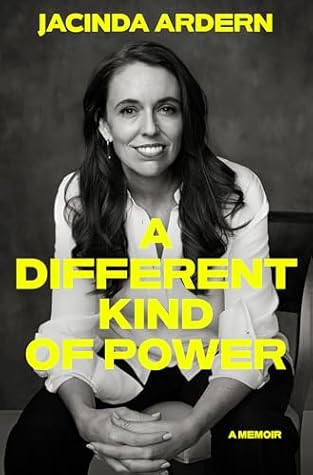
More on this book
Community


Kindle Notes & Highlights


My whole short life I had grappled with the idea that I was never quite good enough. That at any moment I would be caught short, and that meant no matter what I was doing, I had no business doing it. That’s why I believed mine was a personality better suited to work behind the scenes. I was the worker who quietly and steadily got things done. I wasn’t tough enough to become an actual politician. My elbows weren’t sharp enough; my skin was too thin. I was idealistic and sensitive.
Policing in New Zealand is also different from that in many countries. For one, officers don’t routinely carry guns. And while they have the power to make arrests, they use a U.K. principle known as policing by consent. The idea that police are essentially citizens in uniforms, and their authority stems from the approval and cooperation of the community.
“Jacinda,” he said. “My words will always be the greatest tool I have.”
The world is so big and life could be fragile, I understood. But not so big that one person can’t do something to change it.
Here in New Zealand, debates were raging over something called the Mother of All Budgets, which cut welfare payments. Also, for the first time, people were being charged for hospital stays and the cost of going to university was increasing. Students began protesting on university campuses. I saw passionate young people link arms, sometimes holding their ground even as police officers in helmets came crashing through.
This history was dark, painful, and unresolved. It was also connected to stories that were in the news today. In other words, history wasn’t consigned to the past or some chapter that had been closed; history was playing out now, all around us.
Reporters shoved microphones under people’s faces in the street and asked if they thought settlements were a good idea. Often you’d hear comments like Isn’t that all in the past? or We just need to move on. There was a strange nervousness in these answers, as if addressing a wrong somehow made everyone complicit. Or perhaps less patriotic toward their home. But learning New Zealand’s history didn’t change how I felt about my home country. In fact, it was in Mr. Fountain’s class, lesson by lesson, that I realized loving where you are from meant seeing all the wrongs that needed to be fixed and
...more
That the difference between what we are and what we could be is the greatest waste.
Many things that had once seemed black and white were blending into gray. People were complicated. Lives were complicated.
An election wasn’t just something that was battled out on a television screen. It wasn’t just about phone calls or pages of an Excel spreadsheet. It was about real things that happened to real people.
“Well, I don’t understand why no one is asking…why.” This was the same question I’d been asking since I was a child, and that I would continue to ask for the rest of my life. What makes someone commit a crime, or an act of violence—even violence on a massive scale? If we know why, after all, maybe we can do something. And I really wanted to believe we could do something.
For a moment, I stood there, taking it all in. All of us looked like adults, dressed in our formal clothing, taking ourselves very seriously. But you could just as easily put us into a schoolyard and assume we were arguing over a game of handball. One of the MPs looked particularly gleeful. She was an incredibly smart woman—self-assured and well respected by all sides. She wore tailored suits and sounded as if she were private school educated. But here she was, hair bobbing back and forth with a flushed face, pointing her finger in my direction as if we were nothing more than a couple of kids
...more
“Promise me you won’t try to toughen up, Jacinda. You feel things because you have empathy, and because you care. The moment you change that is the moment you’ll stop being good at your job.”
There was always some tiny thing you could do for people, and the tiny things added up to a feeling of usefulness. And more often than not, that was enough to carry you forward, to keep you going, even on the hardest days.
“I want this government to feel different,” I said. “I want people to feel that it’s open, that it’s listening, and that it’s going to bring kindness back.”
Some people thought kindness was sentimental, soft. A bit naive, even. I knew this. But I also knew they were wrong. Kindness has a power and strength that almost nothing else on this planet has. I’d seen kindness do extraordinary things: I’d seen it give people hope; I’d seen it change minds and transform lives. I wasn’t afraid to say it aloud, and as soon as I did, I was sure: kindness. This would be my guiding principle no matter what lay ahead.
The difference between what we are and what we could be is the greatest waste. I still thought about this debate topic from my high school years often. What if the difference, that loss of human potential, stemmed not just from big, memorable life events and traumas but also from an endless number of compounding small ones? What if tiny moments of dehumanization accumulate over time, ultimately becoming much more than the sum of their parts? And if so, what if we could do something about that?
Sure, women can do it all; they are mothers, workers, caregivers, change makers, advocates, counselors, cheerleaders, often doing these things with little support. But that doesn’t mean they should. Women shouldn’t have to choose—the way our mothers so often did—between being good at their profession and being a good mother, or daughter. There should be support networks, a village, whatever you call it, that can help them be all of those things without completely losing themselves in the process.
After the questions ended, and the students performed again, the girl made her way to the front of the room. Now that she was standing, I could clearly see her wide eyes, her blond hair hung down her back. She was quite possibly among the youngest in the room, and yet she had the courage and the wisdom to know that age and power don’t determine who needs comfort, and who can be a comforter. Maybe that’s why she approached me, and without saying a word, she hugged me.
But it also tells me something else: That every crisis asks clearly and unequivocally for action to be taken. And it will keep asking. Until there is change.
As I saw it, children are inherently curious and accepting. So what would our world look like if, as adults, we met people with the inclusivity we’re born with, rather than the exclusion we are taught?
By mid-2019, we were finally in the position to construct a budget we wanted, one that moved beyond GDP as the sole measure of our well-being and indicator for where investment should be directed. Under Grant’s leadership, we produced something called the Wellbeing Budget. It wasn’t just a title. Initiatives that contributed the most to our national well-being were prioritized with funding. Among other things, this meant we made a four-year, $1.9 billion investment in mental health initiatives.
While the occupation was about vaccines and mandates, for some it was about more than that. It was about trust…or more accurately mistrust. What manifested itself at the occupation was also bigger than New Zealand. It was a challenge the world over—people now couldn’t even agree on what was fact and what was fiction. People in the same neighborhoods or communities were living in different realities and that made solving our problems even harder. As I looked out over the lawn of Parliament, I felt sure that, globally, we would only solve this problem together.
So when someone approaches me to tell me that they thought all our choices were wrong, maybe expressing themselves less politely than that, perhaps even with fists raised and their face twisted with fury, or in an expletive-filled rant: That’s when I remember that all those hard, imperfect decisions saved twenty thousand lives. And that the person in front of me might just be one of them.
Indigenous Māori had generously shared language, cultural practices, and values that made New Zealand unique, from pōwhiri, the act of welcoming newcomers, to manaakitanga—showing kindness, generosity, and care for others. This was a grace that in my mind could only be fully appreciated if we all understood the often-brutal history that preceded it. In other words, if we could help build people’s understanding of our own country, perhaps we could repair our cracks along the way.
It was never lost on me that there I was, a politician, standing in front of students and asking them to describe one, only to have them describe traits that I thought belonged to someone else. But that was my point. I was trying to explore our underlying assumptions. To show that sometimes we think that jobs or roles require you to have certain traits or ways of being, and maybe that was something we should challenge.
If you have impostor syndrome, or question yourself, channel that. It will help you. You will read more, seek out advice, and humble yourself to situations that require humility to be conquered. If you’re anxious, and overthink everything, if you can imagine the worst-case scenario always, channel that too. It will mean you are ready when the most challenging days arrive. And if you are thin-skinned and sensitive, if criticism cuts you in two, that is not weakness; it’s empathy. In fact, all of the traits that you believe are your flaws will come to be your strengths. The things you thought
...more
