
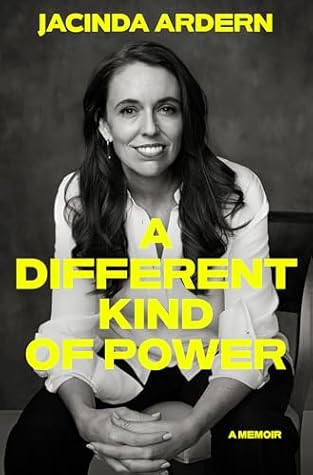
More on this book
Community


Kindle Notes & Highlights


My whole short life I had grappled with the idea that I was never quite good enough. That at any moment I would be caught short, and that meant no matter what I was doing, I had no business doing it.
The world is so big and life could be fragile, I understood. But not so big that one person can’t do something to change it.
In my short lifetime, I’d been able to see not just one woman reach the highest office in the nation, but two. Because of them, it never occurred to me that my gender would stop me from being involved in politics. Or that it wasn’t possible to be a woman and to lead.
The Māori concept of kaitiakitanga, the idea that we are all guardians of the land, the sea, and the sky, felt very real to me.
Here in New Zealand, climate change threatened our coastlines, our low-lying areas, and our Pacific neighbors.
I worried that this photo could become a banner for “women doing it all” or some kind of proof point that women should never complain about how much they have on their plate, because, look, here’s a woman running a country and being a mother. Sure, women can do it all; they are mothers, workers, caregivers, change makers, advocates, counselors, cheerleaders, often doing these things with little support. But that doesn’t mean they should.
Women shouldn’t have to choose—the way our mothers so often did—between being good at their profession and being a good mother, or daughter. There should be support networks, a village, whatever you call it, that can help them be all of those things without completely losing themselves in the process.
Leadership is a test for which you can only partially prepare.
If you have impostor syndrome, or question yourself, channel that. It will help you. You will read more, seek out advice, and humble yourself to situations that require humility to be conquered. If you’re anxious, and overthink everything, if you can imagine the worst-case scenario always, channel that too. It will mean you are ready when the most challenging days arrive. And if you are thin-skinned and sensitive, if criticism cuts you in two, that is not weakness; it’s empathy. In fact, all of the traits that you believe are your flaws will come to be your strengths. The things you
thought would cripple you will in fact make you stronger, make you better. They will give you a different kind of power, and make you a leader that this world, with all its turmoil, might just need.
That is what I would tell her. And I suppose in sharing my story, that’s...
This highlight has been truncated due to consecutive passage length restrictions.
I think you’d asked me what I wanted to be remembered by, and I’m pretty sure I said I wanted to be remembered for kindness.
I had not been everyone’s first image of a leader, including my own. I was a very ordinary person who found themselves in a set of extraordinary circumstances. But I had been a leader. And I had done it on my own terms.
Yes, I realized. I was happy. Happiness is a lot of things. And I had found plenty of it in this unexpected job I’d had. But the happiness I felt now came from knowing simply that I had done my best. Whatever the challenge, whatever came at me, I had done my best. And that was enough.
Why should my daughter, or anyone, feel hopeful in a world where there is climate change denial? Where there is so much hate, vilification, and extremism in the virtual world in which we now spend so much of our lives? And when the politicians we elect to solve these problems increasingly propagate them? Or the solutions that are put in place are simply rolled back in new electoral cycles? Could I, after all that I had seen, give one solid reason why we shouldn’t all just give up?
But there’s an inverse feature to seeing the world at its most brutal, because those are also the moments that show people at their most humane. Those are the moments when I saw that it was possible for people to galvanize behind their collective humanity. Sometimes, those moments are small. Other times, they create a ripple that sweeps across a country.
“You’re right, Neve. We should never give up.”
