
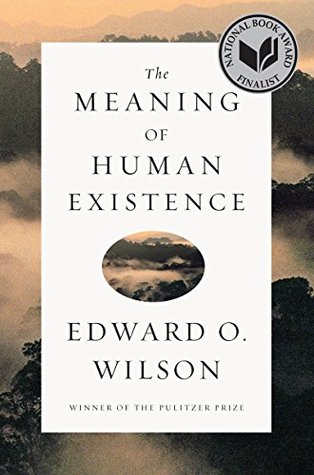
More on this book
Community


Kindle Notes & Highlights


A spider spinning its web intends, whether conscious of the outcome or not, to catch a fly. That is the meaning of the web. The human brain evolved under the same regimen as the spider’s web.
We are about to abandon natural selection, the process that created us, in order to direct our own evolution by volitional selection—the process of redesigning our biology and human nature as we wish them to be.
Humanity, I argue, arose entirely on its own through an accumulated series of events during evolution. We are not predestined to reach any goal, nor are we answerable to any power but our own. Only wisdom based on self-understanding, not piety, will save us. There will be no redemption or second chance vouchsafed to us from above. We have only this one planet to inhabit and this one meaning to unfold.
A majority of people prefer to interpret history as the unfolding of a supernatural design, to whose author we owe obeisance.
The time has come to consider what science might give to the humanities and the humanities to science in a common search for a more solidly grounded answer than before to the great riddle of our existence.
Eusociality stands out as an oddity in a couple of ways. One is its extreme rarity. Out of hundreds of thousands of evolving lines of animals on the land during the past four hundred million years, the condition, so far as we can determine, has arisen only nineteen times, scattered across insects, marine crustaceans, and subterranean rodents. The number is twenty, if we include human beings.
In all of the eusocial species analyzed to date, the final step before eusociality is the construction of a protected nest, from which foraging trips are launched and within which the young are raised to maturity.
The social intelligence of the campsite-anchored prehumans evolved as a kind of nonstop game of chess.
The expansion of the human brain was one of the most rapid episodes of complex tissue evolution in the history of life.
But we are still part of Earth’s fauna and flora, bound to it by emotion, physiology, and, not least, deep history. It is folly to think of this planet as a way station to a better world.
Human existence may be simpler than we thought. There is no predestination, no unfathomed mystery of life. Demons and gods do not vie for our allegiance. Instead, we are self-made, independent, alone, and fragile, a biological species adapted to live in a biological world. What counts for long-term survival is intelligent self-understanding, based upon a greater independence of thought than that tolerated today even in our most advanced democratic societies.
Biologists have identified at the time of this writing twenty evolutionary lines in the modern-world fauna that attained advanced social life based on some degree of altruistic division of labor. Most arose in the insects. Several were independent origins in marine shrimp, and three appeared among the mammals—that is, in two African mole rats, and us.
Within groups selfish individuals beat altruistic individuals, but groups of altruists beat groups of selfish individuals. Or, risking oversimplification, individual selection promoted sin, while group selection promoted virtue.
So it came to pass that humans are forever conflicted by their prehistory of multilevel selection. They are suspended in unstable and constantly changing positions between the two extreme forces that created us.
The conflict might be the only way in the entire Universe that human-level intelligence and social organization can evolve. We will find a way eventually to live with our inborn turmoil, and perhaps find pleasure in viewing it as the primary source of our creativity.
The most successful scientist thinks like a poet—wide-ranging, sometimes fantastical—and works like a bookkeeper.
Wildly searching, sometimes shocking in effect, the creative arts and much of the humanities scholarship analyzing them are nonetheless in an important sense just the same old story, with the same themes, the same archetypes, the same emotions. We readers don’t care. We’re addicted to anthropocentricity, bound to a bottomless fascination with ourselves and others of our kind. Even the best-educated live on an ad libitum diet of novels, movies, concerts, sports events, and gossip all designed to stir one or more of the relatively small range of emotions that diagnose Homo sapiens. Our stories
...more
We are devoted to stories because that is how the mind works—a never-ending wandering through past scenarios and through alternative scenarios of the future.
The discoveries affirm that Earth is not the center of the Universe—we’ve known that since Copernicus and Galileo—but just how far from the center has been hard to imagine. The tiny blue speck we call home is proportionately no more than that, a mote of stardust near the edge of our galaxy among a hundred billion or more galaxies in the universe. It occupies just one position in a continuum of planets, moons, and other planetlike heavenly bodies that we have just begun to understand. It would be becoming of us to speak modestly of our status in the cosmos.
So, what has this explosive growth of scientific knowledge to do with the humanities? Everything. Science and technology reveal with increasing precision the place of humanity, here on Earth and beyond in the cosmos as
Cultural evolution is different because it is entirely a product of the human brain, an organ that evolved during prehuman and Paleolithic times through a very special form of natural selection called gene-culture coevolution (where genetic evolution and cultural evolution each affect the trajectory of the other).
For the next few decades, most major technological advances are likely to occur in what is often denoted BNR: biotechnology, nanotechnology, and robotics. In pure science the secular grails now sought along the broad frontier include the deduction of how life originated on Earth, along with the creation of artificial organisms, gene substitution and surgically precise modification of the genome, discovery of the physical nature of consciousness, and, not least, the construction of robots that can think faster and work more efficiently than humans in most blue-collar and white-collar labor. At
...more
The creation of groups from personal and intimate mutual knowledge was the unique achievement of humanity.
The origin of the human condition is best explained by the natural selection for social interaction—the inherited propensities to communicate, recognize, evaluate, bond, cooperate, compete, and from all these the deep warm pleasure of belonging to your own special group.
Social intelligence enhanced by group selection made Homo sapiens the first fully dominant species in Earth’s history.
The audiovisual signals of the living world excite our emotions and throughout history have often inspired great creative works, the best of music, dance, literature, and the visual arts. They are nevertheless of themselves all paltry compared to what goes on around us in the world of pheromones and allomones. To illustrate this humbling principle of biology, imagine that you had the power to see these chemicals as vividly as the rest of life all around you that smells them. You are thrust instantly into a world far more dense, complex, and fast-moving than the one you left behind or even
...more
This highlight has been truncated due to consecutive passage length restrictions.
We cannot talk in the language of pheromones, but it will be well to learn more about how other organisms do it, in order better to save them and with them the majority part of the environment on which we depend.
The fortunate few species able to evolve superorganismic colonies have as a whole also been enormously successful. The twenty thousand or so known species of social insects (ants, termites, social bees, and wasps combined) make up only 2 percent of the approximately one million known species of insects, but three-fourths of the insect biomass.
To find even the simplest form of extraterrestrial life would be a quantal leap in human history. In self-image, it would confirm humanity’s place in the Universe as both infinitely humble in structure and infinitely majestic in achievement.
First, if the microbial E.T.s have a code different from that on Earth, their molecular biology would be different to a comparable degree. And if such proves to be the case, an entirely new biology might be instantly created.
If, on the other hand, the code of extraterrestrials is basically the same as that of native Earth organisms, it could suggest (but not prove, not yet) that life everywhere can only originate with one code, the same as in Earth’s biological genesis.
A large number of living bacteria occur in the middle and upper atmosphere, at altitudes of six to ten kilometers.
But it is an entirely different matter to picture the origin of extraterrestrial intelligence at the human grade or higher. This most complex level of evolution has occurred on Earth only once, and then only after more than six hundred million years of evolution within a vast diversity of animal life.
The final evolutionary steps prior to the human-level singularity, that is, altruistic division of labor at a protected nest site, has occurred on only twenty known occasions in the history of life. Three of the lines that reached this final preliminary level are mammals, namely two species of African mole rats and Homo sapiens—the latter a strange offshoot of African apes. Fourteen of the twenty high achievers in social organization are insects. Three are coral-dwelling marine shrimp. None of the nonhuman animals has a large enough body, and hence potential brain size, needed to evolve high
...more
Since the first lobe-finned fishes invaded the land on Earth about four hundred million years ago, all of their descendants, from frogs and salamanders to birds and mammals, have possessed four limbs.
It is hard to imagine any civilization built with beaks, talons, and scrapers.
After we have made all of the cultural knowledge available with only a few keystrokes, and after we have built robots that can outthink and outperform us, both of which initiatives are already well under way, what will be left to humanity? There is only one answer: we will choose to retain the uniquely messy, self-contradictory, internally conflicted, endlessly creative human mind that exists today.
There live among us today space enthusiasts who believe humanity can emigrate to another planet after using up this one. They should heed what I believe is a universal principle, for us and for all E.T.s: there exists only one habitable planet, and hence only one chance at immortality for the species.
The agents of destruction are summarized by the acronym HIPPO, with the relative importance of the agents declining left to right, in this acronym, in most parts of the world:
The Census of Marine Life and Encyclopedia of Life programs have made available on the internet most of what we know of Earth’s species.
The great religions are also, and tragically, sources of ceaseless and unnecessary suffering. They are impediments to the grasp of reality needed to solve most social problems in the real world. Their exquisitely human flaw is tribalism. The instinctual force of tribalism in the genesis of religiosity is far stronger than the yearning for spirituality.
It is tribalism, not the moral tenets and humanitarian thought of pure religion, that makes good people do bad things.
Acceptance of a particular creation story, and of accounts of miracles vouchsafed by it, is called the faith of the believer. Faith is biologically understandable as a Darwinian device for survival and increased reproduction. It is forged by the success of the tribe, the tribe is united by it when competing with other tribes, and it can be a key to success within the tribe for those members most effective in manipulating the faith to gain internal support.
Throughout evolutionary time this bargain for the human soul was the only bond with the strength to hold the tribe together in both peace and war. It invested its members with a proud identity, legitimized rules of conduct, and explained the mysterious cycle of life and death.
A great many educated citizens have realized that their own faiths are indeed false, or at least questionable in details. But they understand the rule attributed to the Roman stoic philosopher Seneca the Younger that religion is regarded by the common people as true, by the wise as false, and by rulers as useful.
The distinguished physiologist Anton (Ajax) J. Carlson, when asked what he thought of the 1950 ex cathedra (that is, infallible) pronouncement by Pius XII that the Virgin Mary ascended bodily into heaven, is reported to have responded that he couldn’t be sure because he wasn’t there, but of one thing he was certain, that she passed out at thirty thousand feet.
Another way of expressing the history of religion is that faith has hijacked religious spirituality. The prophets and leaders of organized religions, consciously or not, have put spirituality in the service of groups defined by their creation myths.
The Founding Fathers of the United States understood the risk of tribal religious conflict very well. George Washington observed, “Of all the animosities which have existed among mankind those which are caused by difference of sentiments in religion appear to be the most inveterate and distressing and ought most to be deprecated.” James Madison agreed, noting the “torrents of blood” that result from religious competition. John Adams insisted that “the government of the United States is not in any sense founded on the Christian religion.”
The Absolute Paradox tears at all in every religion who seek an honest resolution of body and soul. It is the inability to conceive of an all-knowing divinity who created a hundred billion galaxies, yet whose humanlike emotions include feelings of pleasure, love, generosity, vindictiveness, and a consistent and puzzling lack of concern for the horrific things Earth-dwellers endure under the deity’s rule.
There is no solution because there is nothing to solve. The problem is not in the nature or even in the existence of God. It is in the biological origins of human existence and in the nature of the human mind, and what made us the evolutionary pinnacle of the biosphere. The best way to live in this real world is to free ourselves of demons and tribal gods.
