
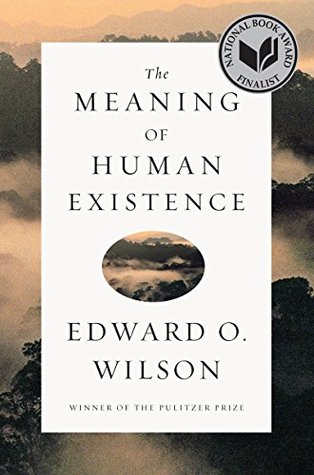
More on this book
Community


Kindle Notes & Highlights


effect.
The unfolding of history is obedient only to the general laws of the Universe. Each event is random yet alters the probability of later events. During organic evolution, for example, the origin of one adaptation by natural selection makes the origin of certain other adaptations more likely. This concept of meaning, insofar as it illuminates humanity and the rest of life, is the worldview of science.
The human brain evolved under the same regimen as the spider’s web. Every decision made by a human being has meaning in the first, intentional sense. But the capacity to decide, and how and why the capacity came into being, and the consequences that followed, are the broader, science-based meaning of human existence.
consequences is the capacity to imagine possible futures, and to plan and choose among them. How wisely we use this uniquely human ability depends on the accuracy of our self-understanding. The question of greatest relevant interest is how and why we are the way we are and, from that, the meaning of our many competing visions of the future.
environmental forces, most of which are beyond human control or even understanding. The genes and their prescribed traits can be what we choose. So—how about longer lives, enlarged memory, better vision, less aggressive behavior, superior athletic ability, pleasing body odor? The shopping list is endless.
four hundred million years, the condition, so far as we can determine, has arisen only nineteen times, scattered across insects, marine crustaceans, and subterranean rodents. The number is twenty, if we include human beings. This is likely to be an underestimate, perhaps a gross one, due to sampling error. Nevertheless, we can be certain that the number of originations of eusociality was relatively very small.
Once attained, advanced social behavior at the eusocial grade found a major ecological success. Of the nineteen known independent lines among animals, just two within the insects—ants and termites—globally dominate invertebrates on the land. Although they are represented by fewer than twenty thousand of the million known living insect species, ants and termites compose more than half of the world’s insect body weight. The history of eusociality raises a question:
In Africa roughly two million years ago, one species of the primarily vegetarian australopithecines evidently began to shift its diet to include a much higher reliance on meat. For a group to harvest such a high-energy, widely dispersed source of food, it did not pay to roam about as a loosely organized pack of adults and young in the manner of present-day chimpanzees and bonobos. It was more efficient to occupy a campsite (thus, the nest) and send out hunters who could bring home meat, both killed or scavenged, to share with others.
The social intelligence of the campsite-anchored prehumans evolved as a kind of nonstop game of chess. Today, at the terminus of this evolutionary process, our immense memory banks are smoothly activated to join past, present, and future. They allow us to evaluate the prospects and consequences of alliances, bonding, sexual contact, rivalries, domination, deception, loyalty, and betrayal. We instinctively delight in the telling of countless stories about others, cast as players upon our own inner stage. The best of it is expressed in the creative arts, political theory, and other higher-level
...more
primitive Homo habilis (or a species closely related to it) two million years ago. Prior to the habilines the prehumans had been animals.
humanlike bodies, but their cranial capacity remained chimpanzee-sized, at or below 600 cubic centimeters (cc). Starting with the habiline period the capacity grew precipitously, to 680cc in Homo habilis, 900cc in Homo erectus, and about 1,400cc in Homo sapiens. The expansion of the human brain was one of the most rapid episodes of complex
The combined effect on the survival and reproduction of the individual is called inclusive fitness, and the explanation of evolution by it is called the theory of inclusive fitness.
the grand master is multilevel selection. This formulation recognizes two levels at which natural selection operates: individual selection based on competition and cooperation among members of the same group, and group selection, which arises from competition and cooperation between groups. Group selection can occur through violent conflict or by competition between groups in the finding and harvesting of new resources. Multilevel selection is gaining in favor among evolutionary biologists because of recent mathematical proofs that kin selection can operate only under special conditions that
...more
However gently expressed and generous in the tone of our discourse, we tend to think of our own group as superior, and we define our personal identities as members within them. The existence of competition, including military conflict, has been a hallmark of societies as far back in prehistory as archaeological evidence can be brought to bear.
Human existence may be simpler than we thought. There is no predestination, no unfathomed mystery of life. Demons and gods do not vie for our allegiance. Instead, we are self-made, independent, alone, and fragile, a biological species adapted to live in a biological world. What counts for long-term survival is intelligent self-understanding, based upon a greater independence of thought than that tolerated today even in our most advanced democratic societies. 3 Evolution and Our Inner Conflict
is necessary to accept that we do have instincts, and it will be wise to take into account our very distant ancestors—as far back and in as fine a detail as possible.
Within biology itself, the key to the mystery is the force that lifted prehuman social behavior to the human level. The leading candidate is multilevel selection, by which hereditary social behavior improves the competitive ability not just of individuals within groups but among groups as a whole.
Research psychologists have found that all normal humans are geniuses at reading the intentions of others, whereby they evaluate, proselytize, bond, cooperate, gossip, and
second diagnostic hereditary trait of human behavior is the overpowering instinctual urge to belong to groups in the first place, shared with most kinds of social animals. To be kept forcibly in solitude is to be kept in pain, and put on the road to madness.
All things being equal (fortunately things are seldom equal, not exactly), people prefer to be with others who look like them, speak the same dialect, and hold the same beliefs. An amplification of this evidently inborn predisposition leads with frightening ease to racism and religious bigotry.
human condition is so distinctive and came so late in the history of life on Earth as to suggest the hand of a divine creator. Yet, as I’ve stressed, in a critical sense the human achievement was not unique at all. Biologists have identified at the time of this writing twenty evolutionary lines in the modern-world fauna that attained advanced social life based on some degree of altruistic division of labor.
By no later than half a million years ago, however, groups of the ancestral species Homo erectus were maintaining campsites with controlled fire—the equivalent of nests—from which they foraged and returned with food, including a substantial portion of meat. Their brain size had increased to mid-sized, between that of chimpanzees and modern Homo sapiens. The trend appears to have begun one million to two million years previously, when the earlier prehuman ancestor Homo habilis turned increasingly to meat in its diet. With groups crowded together at a single site, and an advantage added by
...more
It is the concept that science and the humanities share the same foundation, in particular that the laws of physical cause and effect can somehow ultimately account for both. You will likely recognize this proposition. Western culture has already traveled this way. It was called the Enlightenment.
The great branches of learning, Enlightenment scholars believed, can be unified by a continuous network of cause and effect. Then, when built from reality and reason alone, cleansed of superstition, all of knowledge might come together to form what in 1620 Francis Bacon, greatest of the Enlightenment’s forerunners, termed “the empire of man.”
The Enlightenment quest was driven by the belief that entirely on their own, human beings can know all that needs to be known, and in knowing understand, and in understanding gain the power to choose more wisely than ever before.
the early 1800s, however, the dream faltered and Bacon’s empire retreated. There were two reasons. First, although scientists were generating discoveries at an exponential pace, they were nowhere close to meeting the expectations of the more optimistic Enlightenment thinkers. Second, this shortfall allowed the founders of the Romantic tradition of literature, including some of the greatest poets of all time...
This highlight has been truncated due to consecutive passage length restrictions.
For the next two centuries and to the present day, science and the humanities went their own ways. Physicists of course no less continue to enjoy playing in string quartets, and novelists write books that marvel at the wonders uncovered by science. But the two cultures—as they came to be called by the middle of the twentieth century—were considered by most to be separated by a permanent chasm built into the mind, perhaps intrinsic
the nature of existence itself.
for students of science and the humanities alike.
the dominant criterion in the selection of new faculty was preeminence or the promise of preeminence in a specialty.
the pivotal question asked was, “Is the candidate the best in the world in his research specialty?”
On teaching, it was almost always an easygoing, “Is the candidate adequate?”
overall was that the assembly of a sufficient number of such world-class specialists would somehow coalesce into an intellectual superorganism attracti...
This highlight has been truncated due to consecutive passage length restrictions.
The most successful scientist thinks like a poet—wide-ranging, sometimes fantastical—and works like a bookkeeper.
It is the latter role that the world sees. When writing a report for a technical journal or speaking at a conference of fellow specialists, the scientist avoids metaphor. He is careful never to be accused of rhetoric or poetry. A very few loaded words may be used, if kept to the introductory paragraphs and the discussion following the presentation of data, and if added to clarify the meaning of a technical concept, but they are never used for the primary purpose of stirring emotion.
The language of the author must at all times be restrained and obedient to logic ba...
This highlight has been truncated due to consecutive passage length restrictions.
The exact opposite is the case in poetry and the other creative arts. There ...
This highlight has been truncated due to consecutive passage length restrictions.
His work is judged by the power and beauty of its metaphors. He obeys a dictum ascribed to Picasso: art is the lie that shows us the truth.
We are an insatiably curious species—provided the subjects are our personal selves and people we know or would like to know. The behavior goes far back beyond our species in the evolution of the primate family tree. It has been observed, for example, that when caged monkeys are allowed to look outside at a variety of other objects, their first choice for attention is other monkeys.
arose dramatically in concert with the evolution of the cerebral cortex during the origin of Homo sapiens from the African australopith prehumans. Gossip, celebrity worship, biographies, novels, war stories, and sports are the stuff of modern culture because a state of intense, even obsessive concentration on others has always enhanced survival of individuals and groups. We are devoted to stories because that is how the mind works—a never-ending wandering through past scenarios and through alternative scenarios of the future.
There is a parallel to gods and their human puppets in people watching kittens at play. The animals use three basic maneuvers suited to their future role as predators: to stalk and leap on a trailing string is practice for catching mice; to leap up to the string above and seize it with paws clapped together is for birds; and to scoop at a string near the feet is for fish or small prey at their feet.
You have of course heard of these qualities. But science has additional properties that distinguish it from the humanities. Of these the most important is the concept of the continuum. The idea of variation of entity and process occurring continuously in one, two, or more dimensions is so routine in most of physics and chemistry as to require no explicit mention. Continua include such familiar gradients as temperature, velocity, mass, wave length, particle spin, pH, and carbon-based molecular analogs. They become less obvious in molecular biology, where only a few basic variations in structure
...more
The tiny blue speck we call home is proportionately no more than that, a mote of stardust near the edge of our galaxy among a hundred billion or more galaxies in the universe.
Let me offer a metaphor: Earth relates to the Universe as the second segment of the left antenna of an aphid sitting on a flower petal in a garden in Teaneck, New Jersey, for a few hours this afternoon.
At the time of this writing (in 2013) there are 273,000 known species of plants in the living flora of Earth, a number expected to rise to 300,000 as more expeditions take to the field.
The number of all known species of organisms on Earth, plants, animals, fungi, and microbes, is about 2 million. The actual number, combining known and unknown, is estimated to be at least three times that number, or more.
accelerate even faster with exploration of the largely unknown microbial world, now that the technology needed for the study of extremely small organisms has become routine. There will come to light strange new bacteria, archaeans, viruses, and picozoans that still swarm unseen everywhere on the surface of the planet.
Of all the continua mapped by science, the most relevant to the humanities are the senses, which are extremely limited in our species. Vision is based in Homo sapiens on an almost infinitesimal sliver of energy, four hundred to seven hundred nanometers in the electromagnetic spectrum. The rest of the spectrum, saturating the Universe, ranges from gamma rays trillions of times shorter than the human visual segment to radio waves trillions of times longer. Animals live within their own slivers of continua. Below four hundred nanometers, for example, butterflies find pollen and nectar in flowers
...more
Healthy people believe intuitively that they can hear almost every sound. However, our species is programmed to detect only twenty to twenty thousand hertz (cycles of air compression per second). Above that range, flying bats broadcast ultrasonic pulses into the night air and listen for the echoes to dodge obstacles and snatch moths and other insects on the wing. Below the human range, elephants rumble complex messages in exchanges back and forth with other members of their herd. We walk through nature like a deaf person on the streets of New York, sensing only a few vibrations, able to
...more
smell of all the organisms on Earth, so weak that we have only a tiny voc...
This highlight has been truncated due to consecutive passage length restrictions.
