
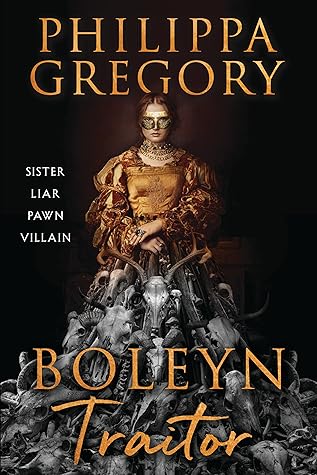
More on this book


Kindle Notes & Highlights


Now, I am a Boleyn myself, married to George for almost half my life, rising with him to the title of Lady Rochford, nearly thirty years old.
I was born Jane Parker, won the name Boleyn through marriage,
‘“The Most Happy”,’ George confirms. We never allow anyone to forget Anne’s motto.
Does a husband, married for love, have to be seduced and won over and over again?
The king tells us in every joust he wins and every masque where he plays the hero. He must be courted and fall in love daily. He never tires of the game of courtly love. Every day he has to fall in love again. Every day: fresh and new and passionate.
‘She admits to him that she made a mistake; she missed a course or two, and she hoped . . . We never say “miscarry”. Nor “dead-birth”. We never say “dead”.’
What matters is what our king thinks. What matters is that our king never hears the word “miscarry” again. Never hears anyone say his baby was “dead-born”. He heard it enough times from the first wife. He’s never to hear it from Anne.’
The quickest way to spread a story in this court is to swear secrecy.
A good courtier needs a patron, and a man of power needs information. We are paired, like a falcon and the falconer. I hunt for him; he protects me.
By law, I can’t refuse him, and he cannot desire a woman who does not refuse him.’ ‘He loves the chase . . .’
There is no subtle work of politics and persuasion at Henry’s court; it has become nothing more than pleasing a difficult man in a court of weakened men.
as one power rises, another falls, and as soon as a power falls, it will try to rise again. Nothing ever changes: there is rise and fall, flood tide and ebb, but it is the same river.
I have to teach the little girl I once was, that to be used is not the same as to be loved. When I know that, when it is clear to me, like a theorem becomes clear on the page, I think I have completed my education in heartbreak.
Machiavelli says that all kings have to become tyrants or be overthrown. This is the rise of the Tudors to tyranny; this is the rise of Anne to tyranny. Make sure you rise with them.’
‘No courtier can have beautiful hair at the court of a balding king.’
‘The queen is mistress of her rooms; her ladies are a reflection of her,’ I say. ‘Her rooms are rightly the heart of the court. A king should be royally served.’
And he gives a great bellow of laughter, throws open his arms, and wraps me in a hug like a bear, like a baited bear in a pit will crush a silly little bitch in his great arms.
‘It’s almost impossible for a man to imagine his death, except as a tragedy for others,’ my father thinks aloud. ‘How can a mind imagine its own absence? It’s a paradox.
How true it is, as Machiavelli would say: a friend is more dangerous than an enemy!’
My father is right to warn Lady Mary: Let not the foot of pride come against me.
Once, the king agreed with us, but His Majesty’s grasp of theology is rarely as strong as his whims.
‘But serving a man of power is to feed a furnace. The more that he has, the more he wants.’
‘Wealth I can easily get,’ says the destroyer of the Church. ‘It is power that is harder. The greatest want for a rich man is power over others.’
Once again, I put a queen to bed and wait at her side as the great double doors are thrown open and her husband the king and his drunken friends enter. Once again, Henry passes me in the royal bedchamber, his gaze on the bed. This time, he doesn’t smile at me, nor at anyone. He limps towards the bed like an unwilling old man on his way to an arduous chore.
‘She has a pretty face,’ I say simply. ‘But it’s not a false face. And he’s seen nothing but false faces and painted smiles for all his life. D’you think he wants an honest woman now? Does any man want an honest woman as his wife? Don’t you all prefer liars?’
The king has betrayed his own secrets. He has chosen to tell his friends that he is impotent with her – the most extraordinary self-shaming. No man at this court of boisterous cavaliers and seducers would ever admit to such a weakness. But the king has done so. He is so desperate to tell the world that he doesn’t like her, that he is ready to call himself unmanned, to say himself what it is illegal for us to say: that he is impotent.
He dares me to say that the king’s grossness, his drunkenness, and his superstitious fear of sin stands between him and normal, healthy lust. I don’t even think of love. He has no ability to love. I think he lost it when he exiled Katherine of Aragon, the love of his life.
‘People believe anything if it is said often enough, loudly enough. You of all people know that, who lost your family to noise.’
‘I always prefer to leave people without a choice,’ he says. ‘It makes deciding so much quicker.’
‘And if this is all done as Thomas Cromwell planned, does it earn him a pardon?’ ‘Why should you care?’ my uncle demands. ‘Unless you share his faith, his treasonous faith? Unless you have worked with him as his spy and his crony in treasonous plots? Unless you’re a traitor like him? Are you a traitor? Another Boleyn traitor?’
If we do not play our parts in this masque which is called Surrender, there can be no doubt that we will be dance in another called: Witch-hunt.
She laughs in genuine amusement. ‘It would be funny, after his hunger for a son, if his kingdom was ruled by a woman! It would be so funny if the woman was a Boleyn.’
He has sired a dozen ghosts. But it is against the law to even think this.
The king kills those closest to him, because he cannot bear to need them. He cannot bear that they are wiser or better or even more beautiful than him. He loves them at first, calling them to his side to make himself shine, and then he cannot tolerate that they eclipse him. That, he cannot bear.
Power has always been in the hands of the king, and those of us who thought we were steering him or controlling him are victims in waiting.
This is the tug of a single thread that unravels the whole picture of a tapestry.
‘You’re going to the Tower. This is an arrest. I am arresting you for treason. Another Boleyn traitor.’
We should have said ‘no’ to the deaths that followed. All that is needed to defeat a tyrant is the courage to say ‘no’.
All of us have to decide what offence against our institutions, against our traditions, against our liberties, or against the liberties and lives of others, is our sticking point: the point where we say ‘no’.
We must not be like Jane Boleyn, recognising the dangers too late to say ‘no’, or we will be silenced like her, and the tyrant will write our history, too.
