
More on this book
Community


Kindle Notes & Highlights

Read between
December 7 - December 9, 2025

One of the hallmarks of Western liberalism is an assumption, in hindsight, of virtuous resistance as the only polite expectation of people on the receiving end of colonialism. While the terrible thing is happening—while the land is still being stolen and the natives still being killed—any form of opposition is terroristic and must be crushed for the sake of civilization. But decades, centuries later, when enough of the land has been stolen and enough of the natives killed, it is safe enough to venerate resistance in hindsight. I tell stories for a living, and there’s a thick thread of
...more
It’s come to shape the way I think about every country, every community: Whose nonexistence is necessary to the self-conception of this place, and how uncontrollable is the rage whenever that nonexistence is violated?
The starting point of history can always be shifted, such that one side is always instigating, the other always justified in response.
Once far enough removed, everyone will be properly aghast that any of this was allowed to happen. But for now, it’s just so much safer to look away, to keep one’s head down, periodically checking on the balance of polite society to see if it is not too troublesome yet to state what to the conscience was never unclear.
This is an account of a fracture, a breaking away from the notion that the polite, Western liberal ever stood for anything at all.
In the Middle East I’d seen North Americans and Europeans arrive and immediately cocoon themselves into gated compounds and gated friendships.
(It would come as a genuine surprise to me, years later, when I came to the West and found that this precise thing was a routine accusation lobbed at people from my part of the world. We simply did not do enough to learn the language, the culture. We stubbornly refused to assimilate.)
It is a reminder that, in times like these, one remarkable difference between the modern Western conservative and their liberal counterpart is that the former will gleefully sign their name on the side of the bomb while the latter will just sheepishly initial it.
Fight it, then. Propose something to meet the nature of the moment. It can’t be the case both that the Supreme Court is an unaccountable neoconservative body intent on rendering the whole country unrecognizable and that there’s simply no way to do anything significant about it. It can’t be that climate change is the single most important issue facing the world, with our entire species at risk, and drilling licenses need to continue. It can’t be that innocent Palestinians have faced unbearable suffering and we care very deeply about their plight, and absolutely nothing will stop the arming of
...more
The moral component of history, the most necessary component, is simply a single question, asked over and over again: When it mattered, who sided with justice and who sided with power? What makes moments such as this one so dangerous, so clarifying, is that one way or another everyone is forced to answer.
No one, during those years, was ever tortured, only subjected to enhanced interrogation. When a soldier pulling at a joystick thousands of miles away mistook a wedding party for a terror cell and sent a missile-wielding drone to incinerate the lot, nobody was killed; there was only some collateral damage (a term first coined to describe the killing in Vietnam). No prisoners, who require a prison sentence, only detainees, who can be held forever without charge. And when those detainees, after years of confinement to cells not much bigger than broom closets, went on hunger strikes, they were
...more
To preserve the values of the civilized world, it is necessary to set fire to a library. To blow up a mosque. To incinerate olive trees. To dress up in the lingerie of women who fled and then take pictures. To level universities. To loot jewelry, art, banks, food. To arrest children for picking vegetables. To shoot children for throwing stones. To parade the captured in their underwear. To break a man’s teeth and shove a toilet brush in his mouth. To let combat dogs loose on a man with Down syndrome and then leave him to die. Otherwise, the uncivilized world might win.
He is forced in that moment to confront the reality that so much of the American self-image demands a narrative in which his country plays the role of the rebel, the resistance, when at the same time every shred of contemporary evidence around him leads to the conclusion that, by scope and scale and purpose of violence, this country is clearly the empire.
It is not without reason that the most powerful nations on earth won’t intervene to stop a genocide but will happily bomb one of the poorest countries on the planet to keep a shipping lane open.
On a British television network, a newscaster describes the scene at an Israeli checkpoint: “Accidentally, a stray bullet found its way into the van ahead, and that killed a three- or four-year-old young lady.” It was tragic, he says.
It’s all fiction, I understand—the novel, the speech within it, maybe the other speech too. But so long as there exists a Western self-conception that demands the appearance of purity at all times, it should be known that what shocks the most isn’t the cruelty or indifference. Many people’s governments are cruel, many people’s governments are indifferent. It’s this relentless parachuting of virtue. It’s these speeches and statements of eloquently stated concern for human rights and freedom and the demand that those who abuse human rights or withhold freedom be held to account. And it’s the way
...more
It is a source of great confusion first, then growing rage, among establishment Democrats that there might exist a sizable group of people in this country who quite simply cannot condone a real, ongoing genocide, no matter how much worse an alternative ruling party may be or do. This stance boggles a particular kind of liberal mind because such a conception of political affairs, applied with any regularity, forces the establishment to stand for something. It suddenly becomes insufficient to say: Elect us or else they will abolish abortion rights; elect us or they will put more migrants in
...more
It is an admirable thing, in a politics possessed of a moral floor, to believe one can change the system from the inside, that with enough respectful prodding the establishment can be made to bend, like that famous arc, toward justice. But when, after decades of such thinking, decades of respectful prodding, the condition one arrives at is reticent acceptance of genocide, is it not at least worth considering that you are not changing the system nearly as much as the system is changing you?
It’s difficult to live in this country in this moment and not come to the conclusion that the principal concern of the modern American liberal is, at all times, not what one does or believes or supports or opposes, but what one is seen to be. From this outcome, everything is reverse-engineered. Being seen as someone who believes in justice—not the messy, fraught work of achieving it—is the starting point of any conversation on justice. Saying the right slogans supersedes whatever it is those slogans are supposed to oblige. It makes sense—when there are no real personal stakes, when the
...more
A growing number of people ask a different question; the world asks a different question. The world, full of people who factor not one iota in the calculus of those morning meetings, looks upon this and asks, simply: Beyond self-interest, what do you believe in? And every morning the answer, dressed up in anesthetic euphemism and dependent on our collective capacity for resignation to the lesser of two evils, is: Nothing.
On January 26, 2024, the International Court of Justice rules that Israel must stand trial for genocide. Not long after, the United States, Canada, the United Kingdom, and six other nations decide to cut off all funding to the United Nations Relief and Works Agency, one of the few organizations providing any aid to Palestinians. The decision is supposedly based on allegations that about a dozen of the UNRWA’s 30,000 or so workers were involved in the October 7 Hamas attacks. The allegation is enough. Hundreds of millions of dollars are withheld. More people will starve to death because of this
...more
And the obvious centrist refrain—But do you want the deranged right wing to win?—should, after even a moment of self-reflection, yield to a far more important question: How empty does your message have to be for a deranged right wing to even have a chance of winning? Of all the epitaphs that may one day be written on the gravestone of Western liberalism, the most damning is this: Faced off against a nihilistic, endlessly cruel manifestation of conservatism, and somehow managed to make it close.
I went to see Bill Clinton give a speech once, in Toronto, years after his presidency ended.
As a lot of former presidents like to do, he eventually meandered onto the topic people in this part of the world like to call the Middle East peace process. Its failure, he argued in passing, wasn’t a failure of Israeli compromise or intent, but rather one of Palestinian imagination. What this particular bromide is intended to mean, when Western officials trot it out time and time again, is that one party in these proceedings got a little too big for its britches, and if these perpetually angry people only understood the generosity with which they were being treated, they would not be in this
...more
On Sunday, February 25, 2024, a man named Aaron Bushnell walked up to the gates of the Israeli embassy in Washington, D.C., and set himself on fire. His last words were, “Free Palestine.” In the moments before his death, Bushnell spoke more lucidly and with greater moral clarity than almost any Western politician. It is no small thing, to downplay the work of a man like that, a man whose passing leaves a gaping maw of grief not simply by virtue of his act but by the irrefutable fact that the world, in the span of that act, loses a rare voice unwavering in its orientation to justice. And yet
...more
In mid-February 2024, the United States once again vetoes a resolution calling for a ceasefire in Gaza. Most everyone sees it coming, and for all the rhetorical backlash afterward, nobody seriously believes the administration endorsing this genocide is going to suddenly participate in even a ventriloquism of concern. The image that once again graces most articles about the veto is of the U.S. ambassador to the United Nations, Linda Thomas-Greenfield, raising her hand. This is not the first time she has done this, sinking a ceasefire resolution on the grounds that it might jeopardize U.S.
...more
For months I’ve watched presidents and prime ministers balk at calling for a ceasefire that most of their electorate supports, for fear that trying to end a genocide might in some way prove politically disadvantageous.
When the Israeli military opens fire on starving civilians clambering for flour, The Guardian describes the killings as “food aid–related deaths.” One struggles to imagine how food aid could do such a thing. “As with many events in the war between Israel and Hamas,” The Economist reports, “the facts are destined to remain fiercely contested.” It is destiny for facts to be fiercely contested.
Once, in Portland, I was invited to an awards ceremony honoring local businesses. One company received an award for—I forget now: trailblazing? synergy? something, on account of completing a particularly difficult job in Israel. The company was a labor middleman, it specialized in getting other corporations the workers they needed, and in this case, at the last minute, the owners of a manufacturing plant decided that no Palestinians would be allowed to work there. So the labor supplier scrambled, but managed to source the workers from somewhere in Eastern Europe. For this, they were being
...more
In the final moments of Aaron Bushnell’s life, officers rush to the site of his burning. One asks for a fire extinguisher, another points his gun at the flames.
It is a disorienting thing, to keep a ledger of atrocity, to write the ugliness of each day as it happens. The months smother the months, soon the years will smother the years. Killings that might have once made front-page news slowly submit to the law of diminishing returns—what is left to say but more dead, more dead?
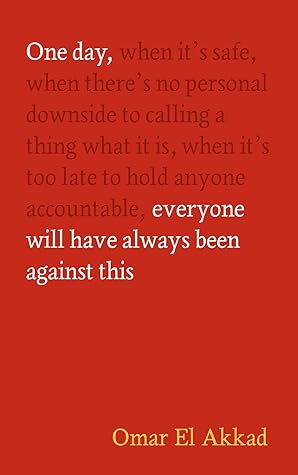
One day this will end. In liberation, in peace, or in eradication at a scale so overwhelming it resets history. It’ll end when sanctions pile up high enough, or the political cost of occupation and apartheid proves debilitating. When finally there is no other means of preserving self-interest but to act, the powerful will act. The same people who did the killing and financed the killing and justified the killing and turned away from the killing will congratulate themselves on doing the right thing. It is very important to do the right thing, eventually.
One day there will be no more looking away. Looking away from climate disaster, from the last rabid takings of extractive capitalism, from the killing of the newly stateless. One day it will become impossible to accept the assurances of the same moderates who say with great conviction: Yes the air has turned sour and yes the storms have grown beyond categorization and yes the fires and the floods have made of life a wild careen from one disaster to the next and yes millions die from the heat alone and entire species are swept into extinction daily and the colonized are driven from their land
...more
And yet, against all this, one day things will change. Alongside the ledger of atrocity, I keep another. The Palestinian doctor who would not abandon his patients, even as the bombs closed in. The Icelandic writer who raised money to get the displaced out of Gaza. The American doctors and nurses who risked their lives to go treat the wounded in the middle of a killing field. The puppet-maker who, injured and driven from his home, kept making dolls to entertain the children. The congresswoman who stood her ground in the face of censure, of constant vitriol, of her own colleagues’ indifference.
...more
