
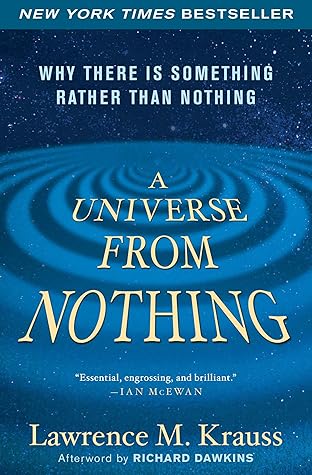
More on this book
Community


Kindle Notes & Highlights


I don’t make any claims to answer any questions that science cannot answer, and I have tried very carefully within the text to define what I mean by “nothing” and “something.” If those definitions differ from those you would like to adopt, so be it. Write your own book. But don’t discount the remarkable human adventure that is modern science because it doesn’t console you.
After all, what is the difference between arguing in favor of an eternally existing creator versus an eternally existing universe without one?
After all, what is the difference between arguing in favor of an eternally existing creator versus an eternally existing universe without one?
While consistency is not proof, of course, there is an increasing view among cosmologists that, once again, if it walks like a duck and looks like a duck and quacks like a duck, it is probably a duck.
Quantum fluctuations, which otherwise would have been completely invisible, get frozen by inflation and emerge afterward as density fluctuations that produce everything we can see! If we are all stardust, as I have written, it is also true, if inflation happened, that we all, literally, emerged from quantum nothingness.
Recall that the domination of the expansion of our universe by the energy of seemingly empty space was inferred from the fact that this expansion is speeding up. And, just as with inflation, as described in the last chapter, our observable universe is at the threshold of expanding faster than the speed of light. And with time, because of the accelerated expansion, things will only get worse. This means that, the longer we wait, the less we will be able to see. Galaxies that we can now see will one day in the future be receding away from us at faster-than-light speed, which means that they will
...more
Only in the first seconds of a hot Big Bang, with an initial abundance of protons and neutrons that would result in something very close to the observed density of matter in visible galaxies today, and a density of radiation that would leave a remnant that would correspond precisely to the observed intensity of the cosmic microwave background radiation today, would nuclear reactions occur that could produce precisely the abundance of light elements, hydrogen and deuterium, helium and lithium, that we infer to have comprised the basic building blocks of the stars that now fill the night sky. As
...more
We are hardwired to think that everything that happens to us is significant and meaningful. We have a dream that a friend is going to break her arm, and the next day we find out that she sprained her ankle. Wow! Cosmic! Clairvoyant? The physicist Richard Feynman used to like to go up to people and say: “You won’t believe what happened to me today! You just won’t believe it!” And when they would inquire what happened, he would say, “Absolutely nothing!” By this he was suggesting that when something like the dream I described above happens, people ascribe significance to it. But they forget the
...more
At the same time, in science we have to be particularly cautious about “why” questions. When we ask, “Why?” we usually mean “How?” If we can answer the latter, that generally suffices for our purposes. For example, we might ask: “Why is the Earth 93 million miles from the Sun?” but what we really probably mean is, “How is the Earth 93 million miles from the Sun?” That is, we are interested in what physical processes led to the Earth ending up in its present position. “Why” implicitly suggests purpose, and when we try to understand the solar system in scientific terms, we do not generally
...more
But plausibility itself, in my view, is a tremendous step forward as we continue to marshal the courage to live meaningful lives in a universe that likely came into existence, and may fade out of existence, without purpose, and certainly without us at its center.
Alternatively, we could even imagine an antimatter universe in which all of the particles that make up the stars and galaxies were replaced with their antiparticles. Such a universe would appear to be almost identical to the one we live in. Observers in such a universe (themselves made of antimatter) would no doubt call what we call antimatter as matter. The name is arbitrary. However, if our universe began sensibly, with equal amounts of matter and antimatter, and stayed that way, we wouldn’t be around to ask “Why?” or “How?” This is because all particles of matter would have annihilated with
...more
If one argues, as many deeply religious individuals do, that without God there can be no ultimate right and wrong—namely that God determines for us what is right and wrong—one can then ask the questions: What if God decreed that rape and murder were morally acceptable? Would that make them so? While some might answer yes, I think most believers would say no, God would not make such a decree. But why not? Presumably because God would have some reason for not making such a decree. Again, presumably this is because reason suggests that rape and murder are not morally acceptable. But if God would
...more
In fact, there may be no fundamental theory at all. Although I became a physicist because I hoped that there was such a theory, and because I hoped that I might one day help contribute to discovering it, this hope may be misplaced, as I have already lamented. I take solace in the statement by Richard Feynman, which I summarized briefly before, but want to present in its entirety here: People say to me, “Are you looking for the ultimate laws of physics?” No, I’m not. I’m just looking to find out more about the world, and if it turns out there is a simple ultimate law that explains everything,
...more
Without science, everything is a miracle. With science, there remains the possibility that nothing is.
