
More on this book

Kindle Notes & Highlights

Read between
August 10 - August 14, 2025

Our phones have turned us into human transceivers, nodes on a communication network of unprecedented scope and speed. Whatever else we may be doing, we are always receiving and emitting signals, many of which we’re conscious of (words, images, sounds) and others of which we’re not (data on our location, behavior, mood).
communication technologies are much more than tools that people use to throw their voices and ideas across distances. Every new medium creates a new environment. As we adapt to the environment, it shapes our perceptions and thoughts, our relationships with others, even our sense of self.
By means of its media a society promotes values and sets norms, allocates praise and censure, promulgates models of conduct and character, motivates and coordinates action, and establishes hierarchies and other structures of power and status.
Every communication medium is political, a conduit of power as much as thought.
One of the curiosities of the early twenty-first century is the way so much power over social relations came into the hands of young men with more interest in numbers than in people.
To control a nation’s soundtrack was to be always inside its citizens’ heads.
By imposing what Mark Zuckerberg disdainfully calls friction on the processes of information production, distribution, and retrieval, the specialization of media networks and devices also imposed order on the welter of information that was suddenly pouring into people’s homes. The specialized technology served as a means to sort and segregate information and regulate the pace and timing of its delivery.
Like the legal and regulatory system that surrounded it, the analog media system was imperfect, but its very messiness helped maintain communication’s human scale. Its physicality and fragmentation prevented the speed and volume of electronic networks from overwhelming people’s sense-making capacities.
Content has collapsed, as our adoption of the drab, generic term content to refer to all forms of expression testifies. Everything now has to fit the internet’s conventions and protocols, with their stress on immediacy, novelty, multiplicity, interconnectedness, and above all efficiency. The brakes that were imposed, by necessity more than design, on electronic communication during the last century are gone. With digitization, communication has lost its human scale.
The feed removed human deliberation and judgment from the process. It replaced personal agency with machine agency.
Social media renders category errors obsolete because it renders categories obsolete. All information belongs to a single category—it’s all “content”—and it pours through a single channel with a single objective: maximizing “engagement.” News, entertainment, conversation, and all other forms of human expression would from now on be in direct competition, angling for both the consumer’s fleeting attention and the algorithm’s blessing.
The power of the feed algorithm doesn’t lie in the meaning of the messages it delivers—the algorithm knows nothing of meaning—but rather in its ability to match messages to individuals’ emotional triggers. It automates the striking of responsive chords.
We may have stopped talking about the role of the public interest in governing decisions about what’s published and broadcast, but the public interest is still being taken into account. It’s just not happening out in the open, through established political and judicial procedures and institutions. The public interest is being interpreted in secret, by large corporations that see the public not as a polity but as a customer base. We’ve outsourced the stewardship of speech to Big Tech.
As media systems advanced from the electric to the electronic to the digital, the spirit of the Industrial Revolution, with its stress on measurement and productivity, expanded from factories and offices into the intellectual and political realms of conversation, discourse, and debate.
What fills online feeds, research shows, is content that stirs strong emotions and provokes symptoms of “physiological arousal”—a quickened heart rate, tensed muscles, dilated pupils.34 The nervous system is put on alert, primed to respond to incoming stimuli. We feel compelled to scroll more, see more, share more. We’re drawn deeper into the feed. Whether we realize it or not, social media churns out information that’s been highly processed to stimulate not just engagement but dependency.
Social media is not successful because it goes against our instincts and desires. It’s successful because it gives us what we want. As a machine for harvesting attention, its productivity is unmatched. As a machine for bending the will, it is a triumph of efficiency. In engineering what we pay attention to, it also engineers much else about us—how we talk, how we see other people, how we experience the world.
Beyond its social role, letter writing was for many persons an act of self-expression and, more deeply still, self-reflection and self-definition. Sitting down and composing a letter provided women and men with a rare opportunity to contemplate their daily lives and, through the careful arrangement of words and sentences, shape their experiences and emotions into a coherent and meaningful narrative.
The death was foretold by the German social critic Theodor Adorno. In his 1951 book, Minima Moralia, he wrote of his sense that the industrial “spirit of practicality” was expanding from the realm of business into that of everyday social relations. An efficiency-minded approach to communication was beginning to warp the way people spoke to each other: If time is money, it seems moral to save time, above all one’s own, and such parsimony is excused by consideration for others. One is straightforward. Every sheath interposed between men in their transactions is felt as a disturbance to the
...more
The fact that many American public schools had abandoned the teaching of phonics years earlier—replacing it with the “balanced literacy” approach favored by progressive educators16—may have made the creation of the new language easier. Because reading instruction had come to place more stress on recognizing words visually than sounding them out phonetically, teens and preteens likely had a diminished auditory sense of written language and a propensity to interpret written characters as visual symbols. They had been trained to read more by eye than by ear—a hindrance to book reading but a boon
...more
The development of textspeak, like the earlier development of email style, was prompted less by space constraints than by time constraints. As the earliest IMers had realized, keeping up with the torrents of conversation pouring through computer screens demanded quick reflexes, nonstop skimming, and constant shifts of focus. Every second spent on one message left one less second for all the rest. Speed in reading and terseness in writing were essential to staying afloat on the information flood, which in turn was essential to maintaining a robust social life.
Worst of all, writing an email required, if only for a moment, a retreat from the social whirl into the quiet of one’s own thoughts. It was anxiety producing.
captions. Instagram captions are different from TikTok comments. TikTok comments are different from WhatsApp messages. But they all share the fundamental characteristics of textspeak. They are all variations on a theme, and the theme is streamlined, easy-to-skim communication. As McWhorter noted, when people talk casually they prune their vocabulary to a small set of common words, use sentence fragments instead of sentences, and keep their syntax simple. As much is said through gestures and expressions as through words. That allows the conversation to move at a fast clip while remaining
...more
To be adept at social media, to successfully navigate the informational whitewater, is to rely on automatic thinking—on snap judgments and hot takes. The deliberativeness of System 2 thinking is ill suited to interpreting and reacting to a continuous stream of messages in real time. To put it another way, reasoned analysis requires the friction of hard mental work. And friction, as Zuckerberg and the other designers of social media platforms make clear, is the enemy of the efficient operation of digital communication networks. Quick, intuitive thinking is the lubricant that keeps the machine
...more
lose, the essence of our soul. Very few of us, no matter how hard we peer inside ourselves, ever come across a kernel of selfhood. The fear is the opposite: that we will be reduced to a kernel.
When we feel impinged upon by large numbers of other people and overwhelmed by a profusion of sensory stimuli, we experience a kind of social claustrophobia, with symptoms of stress, depression, withdrawal, and, at worst, aggression.
The environment in which we live—the “real environment”—is “altogether too big, too complex, and too fleeting for direct acquaintance,” Lippmann argued. “To act in that environment, we have to reconstruct it on a simpler model.” Drawing on whatever information is available to us and filtering it through our own desires and biases, each of us creates a mental “pseudo-environment”—a simplified and necessarily fictionalized picture of reality—and then we fit our thoughts and actions to the mirage’s contours. Depending on the individual and his or her education and personality, the
...more
This highlight has been truncated due to consecutive passage length restrictions.
Far from promoting pluralism, the democratization of media has paradoxically created an information environment conducive to authoritarian movements and cults of personality.
The more we rely on computers to mediate what we say and see and think about, the more we have to adapt our thought, speech, and behavior to their characteristics and requirements. “Repeated exposure to computing alters human sense-making,” explains communication scholar Brian Ott.
The internet is not broken. It’s operating as it was designed to operate.
If there was anything fortunate about Covid’s arrival, it was the timing. The disease appeared after social media had already trained us in the art of social distancing.
the self cannot exist except in a social context. Without the presence of others, we have no cause to picture ourselves as distinct beings—or
It is in and through the body that the individual self and the social self emerge and meld.
the transmission of messages can be metamorphic, altering physical and mental states at a deep level. Through its emphasis on repetition and imitation, social media does more than influence people’s opinions. It shapes and sometimes shakes the very foundations of their being.
intelligent text-generation systems like OpenAI’s ChatGPT, Google’s Gemini, and Microsoft’s Copilot is as clairvoyants. They are mediums that bring the words of the past into the present in a new arrangement.
Behind today’s dystopian AI dreams lurk character traits all too common to the tech elite: grandiosity, hubris, and self-aggrandizement. The visions are yet another expression of Silicon Valley’s god complex: we may have failed in our attempt to use computers to establish a new Eden on Earth, but at least we still have the power to lay everything to waste.
If you’re good with words, people will understand you. They’ll understand you even if you don’t know what you’re talking about.
in drawing on its corpus of past human speech to fashion something new, the chatbot is channeling the pain of others who have suffered unbearable losses. Spirits are talking.
As truth decays, so too will trust. That would have profound political implications. A world of doubt and uncertainty is good for autocrats and bad for democracy, Chesney and Citron argue. “Authoritarian regimes and leaders with authoritarian tendencies benefit when objective truths lose their power.”
History and psychology both suggest that, in politics as in art, generative AI will succeed in fulfilling the highest aspiration of its creators: to make the virtual feel more authentic than the real.
“When man is overwhelmed by information,” Marshall McLuhan saw, “he resorts to myth. Myth is inclusive, time-saving, and fast.”35 A myth provides a readymade context for quickly interpreting new information as it flows chaotically around us.
When all the evidence presented to our senses seems unreal, strangeness itself becomes a criterion of truth. A paranoid logic takes hold. The more uncanny the story, the more appealing and convincing it can seem—as long as it fits your worldview.
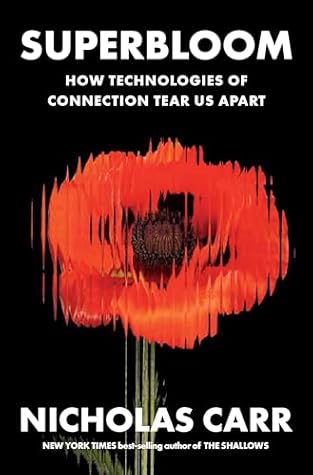
Now that the smartphone has become an extension of the human nervous system, an apparatus of consciousness, we’re inclined to see the things of the world—a field of poppies, for instance—not in their own right, as natural or man-made objects with an existence separate from our own, but as potential content that we might use to project something about ourselves to an audience. The work of self-expression takes everything as its raw material.
the screen provides, particularly for the sensitive young, a shield against the risks of embarrassment and misinterpretation inherent in in-person socializing.
We’re always on the hunt for fresh inputs to feed into our nervous system. The material world, with its spatiotemporal boundaries and its many frictions, tames the seeking impulse. Once we grow accustomed to a particular place, to a set of physical surroundings and a group of people, the novelty wears off. Environmental stimulation subsides, the mind calms, and our thoughts come under our control. We gain focus. We begin to explore narrowly rather than widely, deeply rather than superficially. Our seeking instinct tells us that the familiar is without interest, but once the instinct is
...more
A life spent only in seeking is an empty life. What we see today as the real world’s shortcomings—its withholding of easy and immediate amusements, its stretches of solitude and boredom, its frictions and inefficiencies—are the very things that open the world’s possibilities to us. They push us to seek out and master difficult, complicated, and ultimately more satisfying ways to spend our time.
Perception begins in presence. Intuition precedes cognition.
Maybe salvation, if that’s not too strong a word, lies in personal, willful acts of excommunication—the taking up of positions, first as individuals and then, perhaps, together, not outside of society but at society’s margin, not beyond the reach of the informational flow but beyond the reach of its liquefying force.
